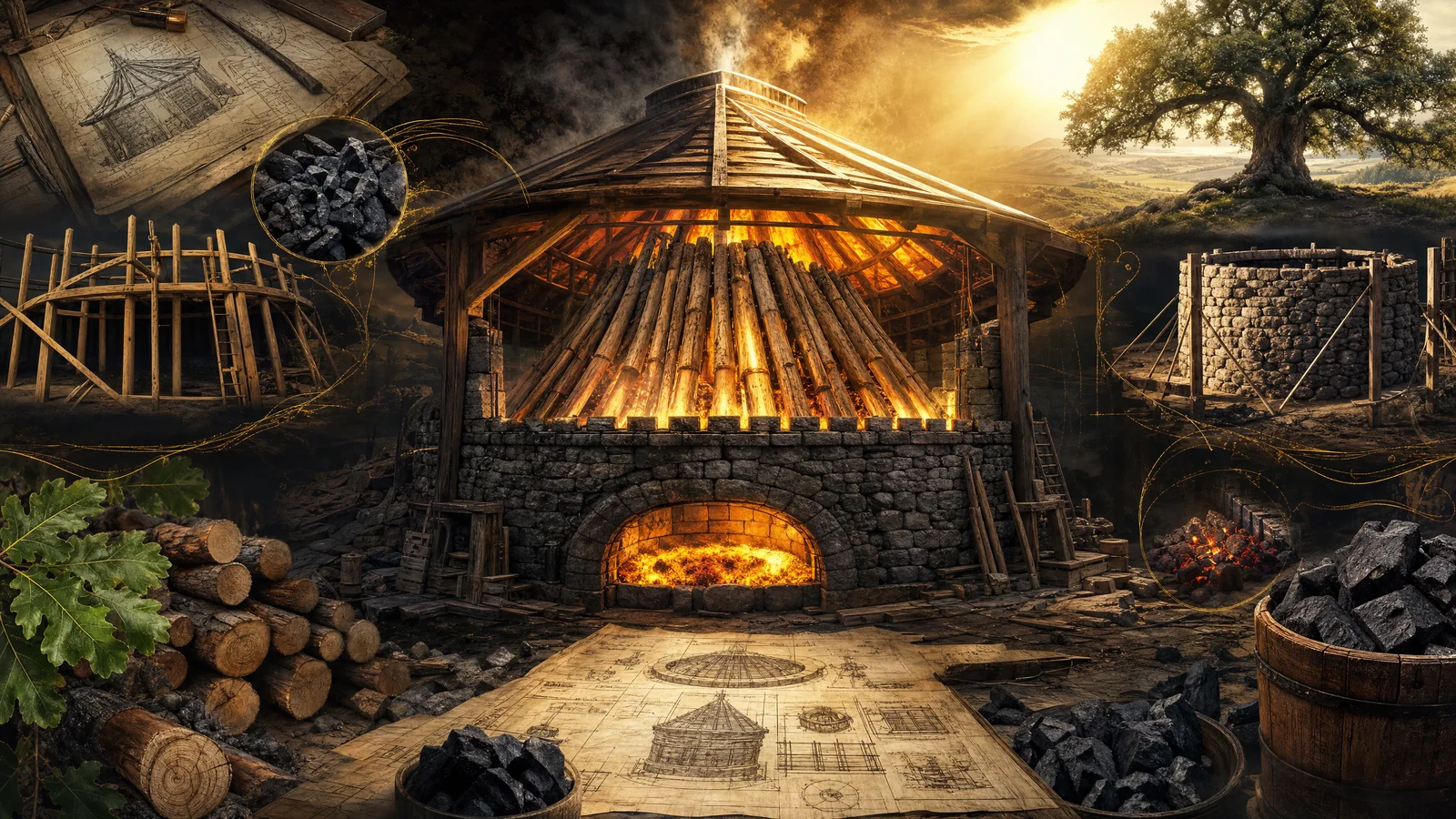
Complete Charcoal Kiln Construction: From Wood to Carbon
Charcoal is essential for metalworking, water filtration, medicine, and fuel. This campaign covers kiln types, wood selection, burning process, and charcoal applications.
Chapter 1: Charcoal Production Methods
Method
Yield
Quality
Scale
Difficulty
Time
Pit method
15-25%
Good
Small-medium
Low
24-48 hours
Mound (meiler) method
20-30%
Very good
Medium-large
Moderate
2-7 days
Drum/barrel retort
25-35%
Very good
Small
Low-moderate
4-8 hours
Brick kiln
25-35%
Excellent
Medium-large
Moderate-high
24-72 hours
Metal retort kiln
30-40%
Excellent
Medium
Moderate
6-12 hours
TLUD (top-lit updraft)
20-30%
Good
Very small
Very low
1-3 hours
Chapter 2: Pit Method
Pit charcoal production: 1) Dig pit 3-4 feet deep, 4-6 feet diameter. 2) Cut wood into uniform lengths (arm-length pieces, 2-4 inch diameter). 3) Stack wood tightly in pit (vertical or horizontal). 4) Fill gaps with smaller pieces (maximize wood density). 5) Light fire on top of wood pile. 6) Let burn until top layer is well-ignited (30-60 minutes). 7) Cover with green branches and leaves (creates barrier). 8) Cover with earth (6-8 inches thick, seal completely). 9) Poke small vent holes around base (allows limited air). 10) Smoke should be thin and blue-white (thick white = too much air). 11) Monitor for 24-48 hours (seal any cracks that appear). 12) When smoke stops or turns very thin blue, charcoal is done. 13) Seal all vents completely. 14) Let cool for 24-48 hours (opening too soon = fire, not charcoal). 15) Dig out charcoal carefully (some pieces may still be hot).
Chapter 3: Mound Method (Traditional)
Step
Action
Duration
Key Point
1
Build chimney (central stake or pipe)
30 min
Provides draft for ignition
2
Stack wood around chimney in dome shape
2-4 hours
Uniform pieces, tight stacking
3
Cover with straw/leaves
30 min
Barrier between wood and earth
4
Cover with earth (6-8 inches)
1-2 hours
Seal completely
5
Light through chimney
15 min
Drop burning material down chimney
6
Monitor and manage vents
2-7 days
Control air flow
7
Seal when done
15 min
Close all openings
8
Cool
24-48 hours
Do not open early
9
Break open and sort
1-2 hours
Separate charcoal from brands
Chapter 4: Wood Selection
Wood
Charcoal Quality
Burn Temperature
Density
Best For
Oak
Excellent
Very high
Dense, long-burning
Blacksmithing, smelting
Hickory
Excellent
Very high
Very dense
Metalworking
Maple
Very good
High
Dense
General purpose
Beech
Very good
High
Dense
General purpose
Birch
Good
Moderate-high
Medium
Quick-burning applications
Pine
Fair
Moderate
Light, fast-burning
Fire starting, not metalwork
Willow
Good (specific use)
Low-moderate
Light
Drawing charcoal, filtration
Bamboo
Good
Moderate
Medium
Activated charcoal
Chapter 5: Charcoal Applications
Application
Charcoal Type
How Used
Why Charcoal
Blacksmithing
Dense hardwood (oak)
Fuel in forge
Burns hotter than wood, less smoke
Smelting
Dense hardwood
Fuel in furnace
Reaches metal-melting temperatures
Water filtration
Any (crushed)
Filter medium
Adsorbs contaminants
Activated charcoal (medicine)
Hardwood or coconut shell
Ingested for poisoning
Adsorbs toxins in stomach
Soil amendment (biochar)
Any
Mixed into soil
Improves water/nutrient retention
Drawing/writing
Willow
Stick form
Marks on paper/surfaces
Gunpowder component
Willow preferred
Ground to powder
Carbon source in black powder
Odor absorption
Any
Placed in containers
Adsorbs odor molecules
Tooth cleaning
Hardwood (ground)
Brushed on teeth
Mild abrasive, whitening
Property
Wood
Charcoal
Comparison
Burn temperature
600-1,000°F
1,500-2,700°F
Charcoal burns much hotter
Smoke
Heavy
Very light
Charcoal is nearly smokeless
Weight (per BTU)
Heavy
Light
Charcoal is lighter per unit of energy
Storage
Rots if wet
Stable indefinitely if dry
Charcoal stores forever
Ignition
Easy
Moderate (needs kindling)
Wood lights easier
Reference Card
Charcoal burns twice as hot as wood (charcoal reaches temperatures that wood cannot; this is why metalworking requires charcoal, not wood). 2. Seal the kiln completely (any air leak turns charcoal back into ash; the entire process depends on limiting oxygen). 3. Dense hardwood makes the best charcoal (oak and hickory charcoal burns longest and hottest; softwood charcoal burns fast and cool). 4. Blue smoke means it is working (thin blue-white smoke indicates proper carbonization; thick white smoke means too much air is entering). 5. Patience prevents ash (opening the kiln too early introduces oxygen that burns your charcoal to ash; cool for at least 24 hours). 6. Uniform pieces burn evenly (cut wood to consistent size so all pieces carbonize at the same rate; mixed sizes produce mixed results). 7. Charcoal stores forever (properly made charcoal kept dry will last indefinitely; it is the ultimate long-term fuel storage). 8. Every homestead needs a charcoal supply (blacksmithing, water filtration, medicine, soil improvement, and cooking all require charcoal; produce it regularly).