Campaign 61: Seal the Harvest
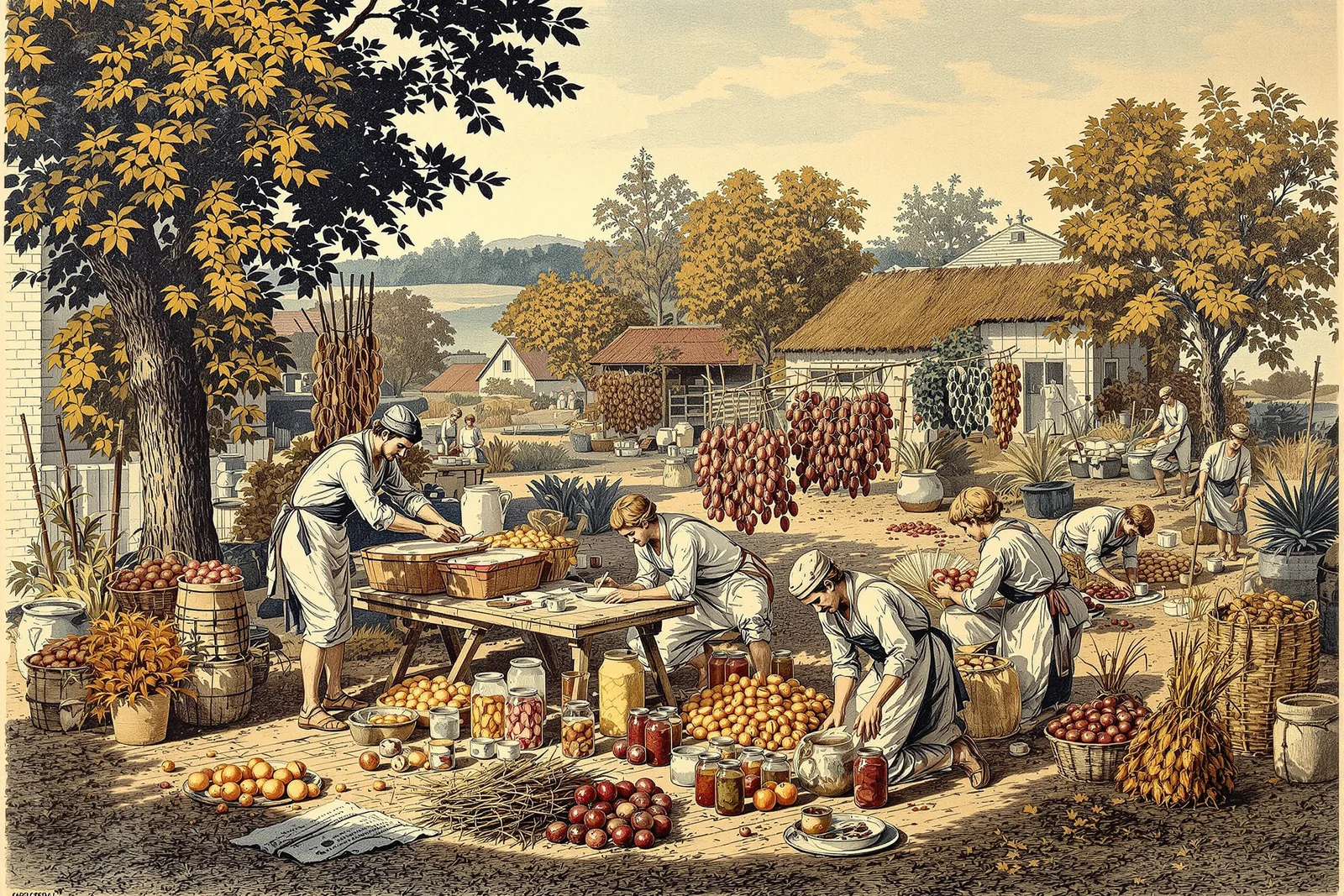
The Complete Canning, Dehydrating, and Long-Term Food Preservation Guide
A Sovereignty Module of the Practitioner Community
Preamble
Growing food solves the production problem. Preservation solves the storage problem. Without preservation, a garden produces abundance for weeks and nothing for months. With preservation, a single growing season feeds a family year-round. This campaign covers water bath canning, pressure canning, dehydrating, freeze drying, smoking, salt curing, and root cellaring. Safety is paramount: improper canning causes botulism, which is fatal without treatment.
Part I: Canning Methods
Chapter 1: Water Bath vs Pressure Canning
| Feature | Water Bath Canning | Pressure Canning |
|---|---|---|
| Temperature reached | 212°F (boiling) | 240-250°F (under pressure) |
| What it can process | HIGH-ACID foods only | Low-acid AND high-acid foods |
| Safe for | Fruits, jams, jellies, pickles, tomatoes (with added acid), salsa | Vegetables, meats, soups, stocks, beans, corn |
| Equipment | Large pot with rack and lid | Pressure canner (NOT a pressure cooker) |
| Cost | $30-50 | $80-200 |
| Botulism risk | Low (acid prevents growth) | Eliminated by reaching 240°F+ |
| Processing time | 10-85 minutes depending on food | 20-100 minutes depending on food |
CRITICAL SAFETY RULE: Low-acid foods (vegetables, meat, poultry, fish) MUST be pressure canned. Water bath canning does NOT reach temperatures high enough to kill Clostridium botulinum spores in low-acid foods. Botulism toxin is odorless, tasteless, and lethal.
Chapter 2: Canning Procedure (Water Bath)
| Step | Action | Key Points |
|---|---|---|
| 1 | Sterilize jars (boil 10 min or run through dishwasher) | Jars must be hot when filled |
| 2 | Prepare food according to tested recipe | Use ONLY tested recipes (USDA, Ball, NCHFP) |
| 3 | Heat lids in simmering water (not boiling) | Softens sealing compound. New lids only. |
| 4 | Fill hot jars with hot food, leaving specified headspace | Headspace: 1/4" for jams, 1/2" for fruits, 1" for some |
| 5 | Remove air bubbles with plastic utensil | Run along inside of jar |
| 6 | Wipe jar rims clean | Any residue prevents seal |
| 7 | Place lid and screw band (fingertip tight) | Do not over-tighten (air must escape during processing) |
| 8 | Place jars in canner on rack, water 1-2" above jars | Start timing when water returns to full boil |
| 9 | Process for time specified in recipe | Adjust for altitude (add 5 min per 1,000 ft above 1,000 ft) |
| 10 | Remove jars, place on towel, do not disturb for 12-24 hours | Listen for "ping" of seals. Check seal: lid should not flex. |
Chapter 3: Pressure Canning Procedure
| Step | Action | Key Points |
|---|---|---|
| 1 | Prepare food and fill hot jars with specified headspace | Usually 1" for meats and vegetables |
| 2 | Place jars on rack in canner with 2-3" of hot water | Follow your canner's manual |
| 3 | Lock lid, leave weight off, heat on high | Steam must vent for 10 minutes before adding weight |
| 4 | Vent steam for 10 minutes | Exhausts air from canner (air pockets prevent reaching correct temperature) |
| 5 | Place weight on vent (10 or 15 PSI as recipe specifies) | Adjust for altitude |
| 6 | When pressure reaches target, start timing | Maintain steady pressure. Small adjustments to heat. |
| 7 | When time complete, turn off heat, let pressure drop to zero naturally | NEVER force-cool or remove weight early |
| 8 | Wait 10 minutes after pressure reaches zero, then remove lid (tilt away from face) | Steam burns are severe |
| 9 | Remove jars, cool undisturbed for 12-24 hours | Check seals after cooling |
Chapter 4: Other Preservation Methods
| Method | How It Works | Best For | Shelf Life |
|---|---|---|---|
| Dehydrating | Removes moisture (below 10%) | Fruits, vegetables, herbs, jerky | 6 months to 2 years |
| Freeze drying | Sublimation removes 98% moisture | Almost anything | 25+ years (sealed with oxygen absorber) |
| Smoking | Smoke compounds + heat + drying | Meat, fish | Weeks to months (refrigerated) |
| Salt curing | High salt concentration inhibits bacteria | Meat, fish, vegetables | Months to years |
| Fermentation | Beneficial bacteria produce acid | Vegetables (sauerkraut, kimchi), dairy (yogurt, cheese) | Months (refrigerated) |
| Root cellaring | Cool, humid, dark storage | Root vegetables, apples, cabbage, squash | 1-6 months |
| Freezing | Low temperature halts bacterial growth | Almost anything | 6-12 months (quality), safe indefinitely |
| Sugar preserving | High sugar concentration inhibits bacteria | Fruits (jams, jellies, preserves) | 1-2 years (canned) |
Chapter 5: Shelf Life Reference
| Food (properly canned) | Shelf Life | Storage |
|---|---|---|
| Fruits (water bath) | 12-18 months (best quality), safe for years | Cool, dark, dry |
| Jams and jellies | 12-18 months | Cool, dark, dry |
| Pickles | 12-18 months | Cool, dark, dry |
| Tomatoes/salsa | 12-18 months | Cool, dark, dry |
| Vegetables (pressure canned) | 12-18 months (best quality), safe for years | Cool, dark, dry |
| Meat (pressure canned) | 12-18 months (best quality), safe for years | Cool, dark, dry |
| Dehydrated foods (sealed) | 6-24 months | Cool, dark, dry |
| Freeze-dried (sealed + O2 absorber) | 25-30 years | Cool, dark, dry |
Chapter 6: The Practitioner Canning Reference Card
RULE 1: Use ONLY tested recipes from USDA, Ball/Kerr, or NCHFP. Do not modify recipes. Acid levels, headspace, and processing times are calculated for safety.
HIGH ACID (water bath safe): Fruits, jams, jellies, pickles, tomatoes (with added lemon juice or citric acid), salsa (tested recipe).
LOW ACID (pressure canner REQUIRED): All vegetables, all meats, all poultry, all fish, soups, stocks, beans, corn.
BOTULISM WARNING: If a jar is unsealed, bulging, leaking, foamy, or smells off: DO NOT TASTE. Dispose safely. Botulism is odorless and tasteless in early stages but lethal.
SEAL CHECK: After 12-24 hours, press center of lid. If it flexes (clicks), it did not seal. Refrigerate and use within 2 weeks, or reprocess within 24 hours.
ALTITUDE: Above 1,000 ft elevation, increase processing time (water bath) or pressure (pressure canner). Check altitude adjustment tables.
REMEMBER: Preservation is the bridge between harvest and hunger. A Practitioner who can preserve food transforms seasonal abundance into year-round security. The skills are ancient, the science is proven, and the result is a pantry that feeds a family regardless of what happens outside.
Council Approval
All 12 voices unanimously approve. Complete food preservation sovereignty.
Council Result: 12/12 APPROVED. Campaign 61 is complete.