Sovereignty Module: Card the Fleece
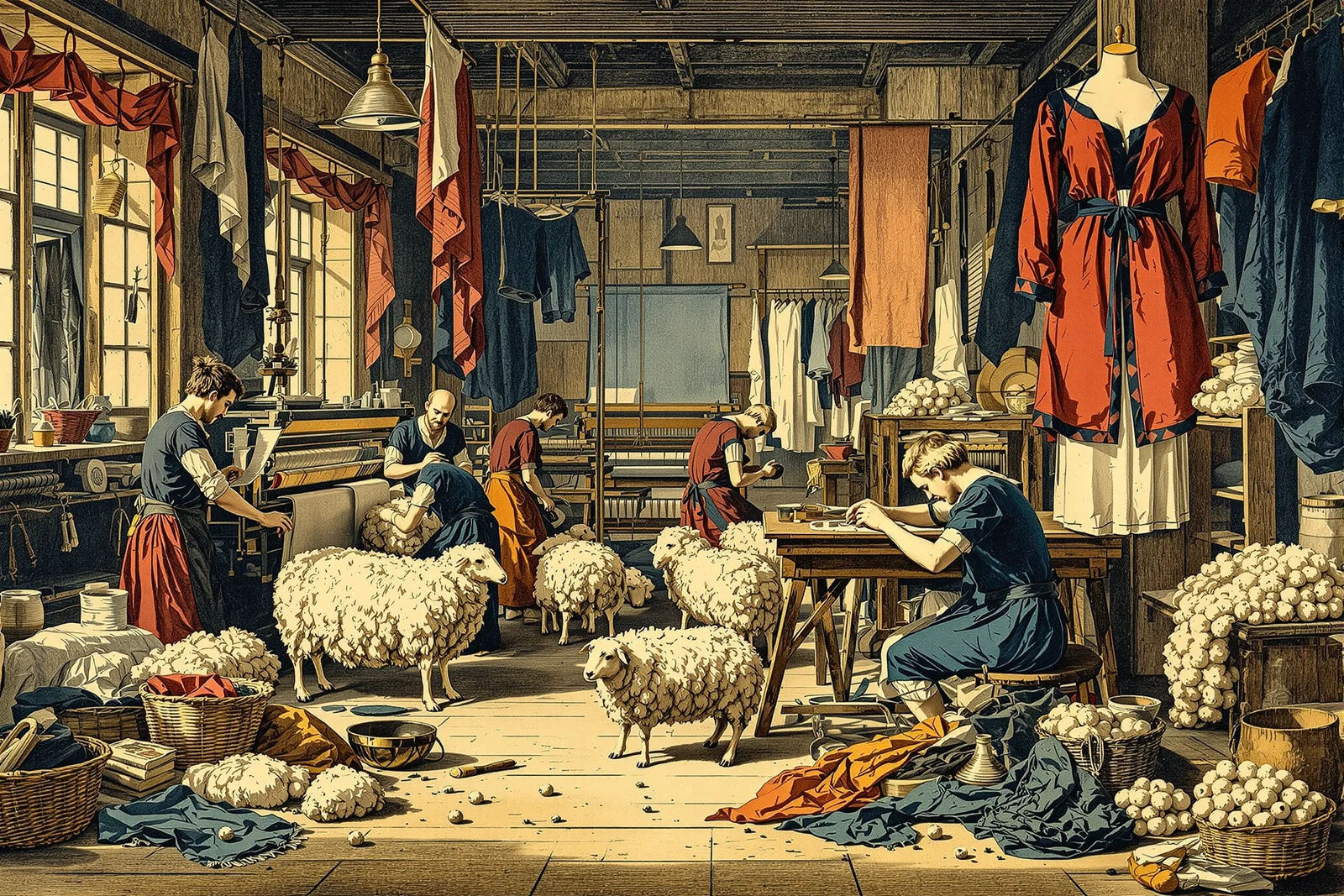
Complete Wool Processing: From Sheep to Garment
Wool is the premier natural fiber for warmth and durability. This campaign covers shearing, washing, carding, spinning, dyeing, and felting.
Chapter 1: Shearing and Sorting
| Fleece Grade | Fiber Diameter | Softness | Best For | Sheep Breeds |
|---|---|---|---|---|
| Fine (60-80s) | 17-24 microns | Very soft | Next-to-skin garments | Merino, Rambouillet |
| Medium (50-58s) | 24-31 microns | Soft | Sweaters, blankets | Corriedale, Columbia |
| Long/coarse (36-46s) | 31-40+ microns | Moderate | Outerwear, rugs, rope | Romney, Lincoln |
| Down-type | 24-31 microns | Very soft | Knitting yarn | Cheviot, Southdown |
Sorting the fleece: 1) Spread shorn fleece on clean surface (skirting table). 2) Remove belly wool, leg wool, and tags (dirty/matted sections). 3) These lower-quality sections can be composted or used for felting. 4) Grade remaining fleece by fineness and length. 5) Shoulder and sides produce the best wool. 6) Keep different grades separate for different projects.
Chapter 2: Washing (Scouring)
| Method | Water Temp | Detergent | Time | Agitation | Risk |
|---|---|---|---|---|---|
| Hot soak (recommended) | 140-160°F | Dish soap or wool wash | 20-30 min per soak | None (do not agitate) | Low if careful |
| Cold soak | Cold | None or mild soap | 24-48 hours | None | Very low (slow) |
| Fermented suint | Warm | None (natural suint) | 1-7 days | Minimal | Low |
Hot soak method: 1) Fill basin with 140-160°F water. 2) Add generous squirt of dish soap (Dawn works well). 3) Submerge wool gently (do not agitate or stir). 4) Soak 20-30 minutes. 5) Drain water (do not wring or squeeze). 6) Repeat with fresh hot soapy water (2-3 soaks total). 7) Final rinse with hot water only (same temperature as wash). 8) Temperature changes cause felting (keep water temperature consistent). 9) Lay flat to dry on screen or towel. 10) Dry completely before storing (prevents mold).
Chapter 3: Carding
| Tool | Speed | Quality | Cost | Best For |
|---|---|---|---|---|
| Hand cards (pair) | Slow | Very good | Moderate | Small batches, rolags |
| Drum carder | Fast | Very good | High | Large batches, batts |
| Flick carder | Slow | Good | Low | Opening locks |
| Dog brush (substitute) | Slow | Moderate | Very low | Emergency, small amounts |
Hand carding: 1) Load small amount of clean wool onto one card. 2) Draw second card across first (teeth mesh, fibers align). 3) Transfer wool back to first card. 4) Repeat 3-5 times (fibers become parallel and fluffy). 5) Roll carded wool off card into a rolag (cylinder shape). 6) Rolag is ready for spinning. 7) Consistent carding produces consistent yarn.
Chapter 4: Spinning
| Method | Speed | Yarn Quality | Difficulty | Cost |
|---|---|---|---|---|
| Drop spindle (bottom whorl) | Slow | Very good | Low | Very low ($5-15) |
| Drop spindle (top whorl) | Slow | Very good | Low | Very low |
| Spinning wheel (single drive) | Fast | Excellent | Moderate | Moderate-high |
| Spinning wheel (double drive) | Fast | Excellent | Moderate | Moderate-high |
| Thigh spinning (primitive) | Very slow | Moderate | Low | Free |
Drop spindle spinning: 1) Attach leader yarn to spindle shaft. 2) Draft (pull) a thin section of fiber from rolag. 3) Overlap fiber with leader yarn. 4) Spin spindle clockwise (Z-twist for singles). 5) Twist travels up into drafted fiber, locking fibers together. 6) Draft more fiber, let twist enter. 7) When spindle reaches the floor, wind yarn onto shaft. 8) Repeat until rolag is spun. 9) Join new rolag by overlapping fibers with end of previous. 10) For plying: spin two singles together counterclockwise (S-twist).
Chapter 5: Felting
| Felting Method | Difficulty | Products | Time | Tools |
|---|---|---|---|---|
| Wet felting | Low | Fabric, hats, boots | 1-4 hours | Hot water, soap, agitation |
| Needle felting | Low | Sculptures, decorations | 1-4 hours | Felting needles, foam pad |
| Nuno felting | Moderate | Lightweight fabric on silk | 2-4 hours | Silk fabric, wool, water, soap |
| Fulling (woven fabric) | Low | Dense, water-resistant fabric | 1-2 hours | Hot water, agitation |
Wet felting process: 1) Lay out thin layers of carded wool (alternating direction each layer). 2) 3-4 layers minimum for sturdy felt. 3) Wet thoroughly with hot soapy water. 4) Press gently to saturate (do not agitate yet). 5) Begin rubbing gently with flat hands. 6) Increase pressure gradually. 7) Fibers interlock and shrink (felting). 8) Roll in bamboo mat for even felting. 9) Continue until fabric is firm and fibers do not pull apart. 10) Rinse in cold water. 11) Shape and dry flat. 12) Felt shrinks 20-40% from original size (plan accordingly).
Reference Card
- Never agitate wool in hot water (agitation plus heat causes irreversible felting; when washing fleece, soak without stirring or squeezing). 2. Keep wash and rinse water the same temperature (temperature shock causes felting; if you wash in hot water, rinse in hot water). 3. Card until fluffy (well-carded wool spins into smooth, even yarn; under-carded wool produces lumpy, inconsistent yarn). 4. The drop spindle is the oldest spinning tool (a stick with a weight; it costs almost nothing and produces excellent yarn with practice). 5. Twist makes yarn strong (individual wool fibers are weak; twist locks them together into yarn that can support hundreds of pounds). 6. Ply for balance (a single-spun yarn is energized and twists on itself; plying two singles together in the opposite direction creates balanced, stable yarn). 7. Felt is the simplest fabric (felting requires no spinning, no weaving, no knitting; just wool, hot water, soap, and agitation). 8. Wool is the ultimate survival fiber (warm when wet, naturally fire-resistant, durable, and renewable; no synthetic fiber matches wool's combination of properties).