Sovereignty Module: Hollow the Hull
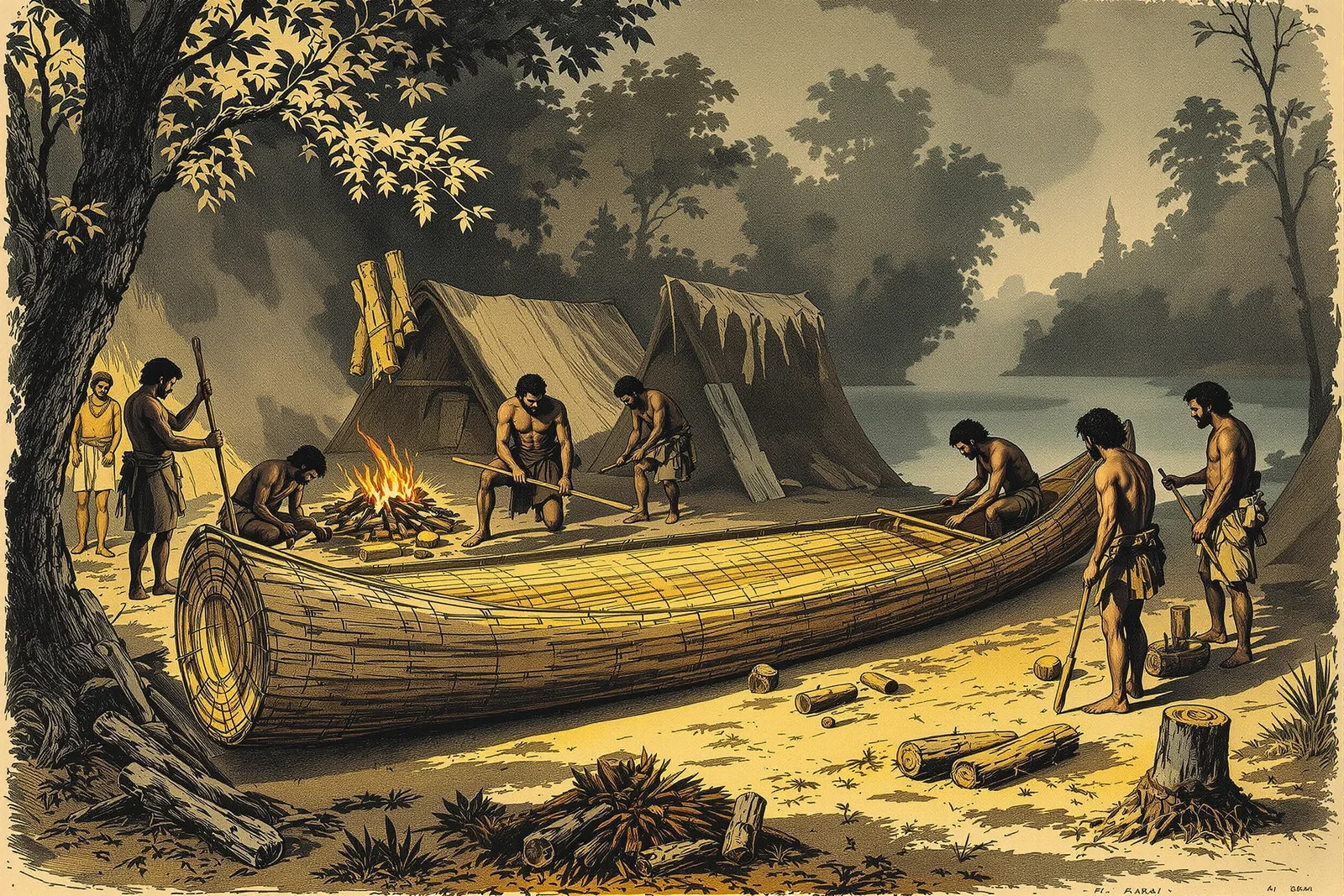
Complete Dugout Canoe Construction: From Log to Watercraft
The dugout canoe is the oldest form of watercraft. This campaign covers tree selection, felling, hollowing techniques, shaping, finishing, and paddling.
Chapter 1: Tree Selection
| Tree Species | Workability | Rot Resistance | Weight (dry) | Availability | Rating |
|---|---|---|---|---|---|
| Tulip poplar | Excellent (soft, straight) | Moderate | Light | Eastern N. America | Best for beginners |
| Western red cedar | Excellent (soft, splits clean) | Excellent | Very light | Pacific NW | Traditional, excellent |
| Cottonwood | Good (soft) | Low | Light | Widespread | Easy to work, short-lived |
| White pine | Good (soft) | Moderate | Light | Northern regions | Good, resinous |
| Cypress | Moderate (medium hard) | Excellent | Medium | Southeast | Very durable |
| Douglas fir | Moderate | Good | Medium | Pacific NW | Strong, moderate difficulty |
| Oak | Difficult (hard) | Good | Heavy | Widespread | Very durable but heavy |
Selection criteria: 1) Straight trunk (no major curves or twists). 2) Minimum diameter: 24 inches for a one-person canoe. 3) 30-36 inches for a two-person canoe. 4) Length: 10-16 feet for a practical canoe. 5) No major rot or hollow sections. 6) Minimal branching in the trunk section. 7) Fell the tree and let it season for 2-4 weeks (reduces weight, easier to work).
Chapter 2: Hollowing Methods
| Method | Speed | Control | Tools Needed | Difficulty |
|---|---|---|---|---|
| Fire and scrape | Slow | Moderate | Fire, adze, scraper | Low (primitive) |
| Adze only | Moderate | Very good | Adze, mallet | Moderate |
| Chainsaw rough + adze finish | Fast | Good | Chainsaw, adze | Moderate |
| Chisel and mallet | Slow | Excellent | Chisel set, mallet | Moderate |
Fire and scrape method: 1) Position log with flat side up (split log) or mark top center. 2) Build small, controlled fire on top surface. 3) Use wet clay to protect areas you do not want to burn. 4) Let fire char wood to 1-2 inch depth. 5) Scrape out charred wood with adze or shell scraper. 6) Repeat: burn, scrape, burn, scrape. 7) Work from center outward. 8) Leave walls 1.5-2 inches thick (thinner at gunwales). 9) Leave bottom 2-3 inches thick (structural strength). 10) Check thickness frequently (drill test holes from outside if needed). 11) Process takes days to weeks depending on size.
Chapter 3: Shaping the Hull
| Hull Feature | Purpose | Specification | Method |
|---|---|---|---|
| Bow (front) | Cut water, reduce drag | Tapered, slightly upswept | Adze, axe |
| Stern (rear) | Stability, tracking | Tapered, flat or slight upturn | Adze, axe |
| Keel line | Tracking (straight travel) | Slight V or flat bottom | Adze, plane |
| Gunwales | Structural rigidity | Thickened upper edge | Leave extra wood |
| Thwarts (cross-braces) | Prevent spreading | Wooden bars across interior | Fitted, pegged |
| Seats | Paddler position | Carved or added boards | Fitted |
Spreading with hot water: 1) After hollowing, canoe can be widened by spreading. 2) Fill interior with water. 3) Heat water with hot rocks (drop fire-heated rocks into water). 4) Hot water softens wood fibers. 5) Gradually insert wider and wider thwarts (spreader sticks). 6) Wood bends outward as it softens. 7) Let cool and dry in spread position. 8) Wood retains new shape when dry. 9) This technique can add 4-8 inches of beam width.
Chapter 4: Finishing
| Finish | Purpose | Method | Durability |
|---|---|---|---|
| Fire hardening | Harden surface | Pass flame over exterior | Good |
| Oil (linseed, tung) | Water resistance | Multiple coats, sand between | Good |
| Pine tar/pitch | Waterproofing | Heat and apply to seams/cracks | Very good |
| Paint | UV protection, appearance | Multiple coats | Good |
| Wax | Water beading | Rub on, buff | Moderate |
Sealing cracks: 1) Small cracks are normal in dugout canoes. 2) Fill with mixture of pine pitch and charcoal powder. 3) Heat pitch until liquid. 4) Mix in fine charcoal (thickens pitch). 5) Press into cracks while hot. 6) Smooth with heated tool. 7) For larger cracks: insert thin wood shim, seal with pitch. 8) Check and re-seal annually.
Chapter 5: Paddling and Safety
| Canoe Size | Capacity | Stability | Speed | Best For |
|---|---|---|---|---|
| 10 feet, narrow | 1 person + gear | Moderate | Good | Solo travel |
| 12 feet, medium | 1-2 persons | Good | Good | General purpose |
| 14-16 feet, wide | 2-3 persons + gear | Very good | Moderate | Expedition, cargo |
| 20+ feet | 4+ persons + cargo | Excellent | Moderate | Trade, war (historical) |
Reference Card
- Tulip poplar is the beginner's best wood (soft, straight-grained, and light; tulip poplar carves easily and makes a serviceable canoe). 2. Fire does most of the work (the burn-and-scrape method requires no metal tools; fire chars the wood and you simply scrape away the char). 3. Leave the walls thick enough (1.5-2 inches for sides, 2-3 inches for bottom; too thin and the canoe cracks or collapses). 4. Thwarts prevent collapse (cross-braces keep the sides from spreading or collapsing; install thwarts as soon as hollowing is complete). 5. Hot water spreads the hull (heating water inside the canoe with hot rocks softens the wood; gradually insert wider spreaders to increase beam width). 6. Seal every crack with pitch (pine pitch mixed with charcoal fills cracks and prevents leaks; check and re-seal every season). 7. A dugout canoe lasts decades (properly maintained, a dugout canoe made from rot-resistant wood can last 20-50 years). 8. Always carry a bailer (dugout canoes sit low in the water and take on spray; a simple scoop or bucket keeps you afloat).