Sovereignty Module: Age the Curd
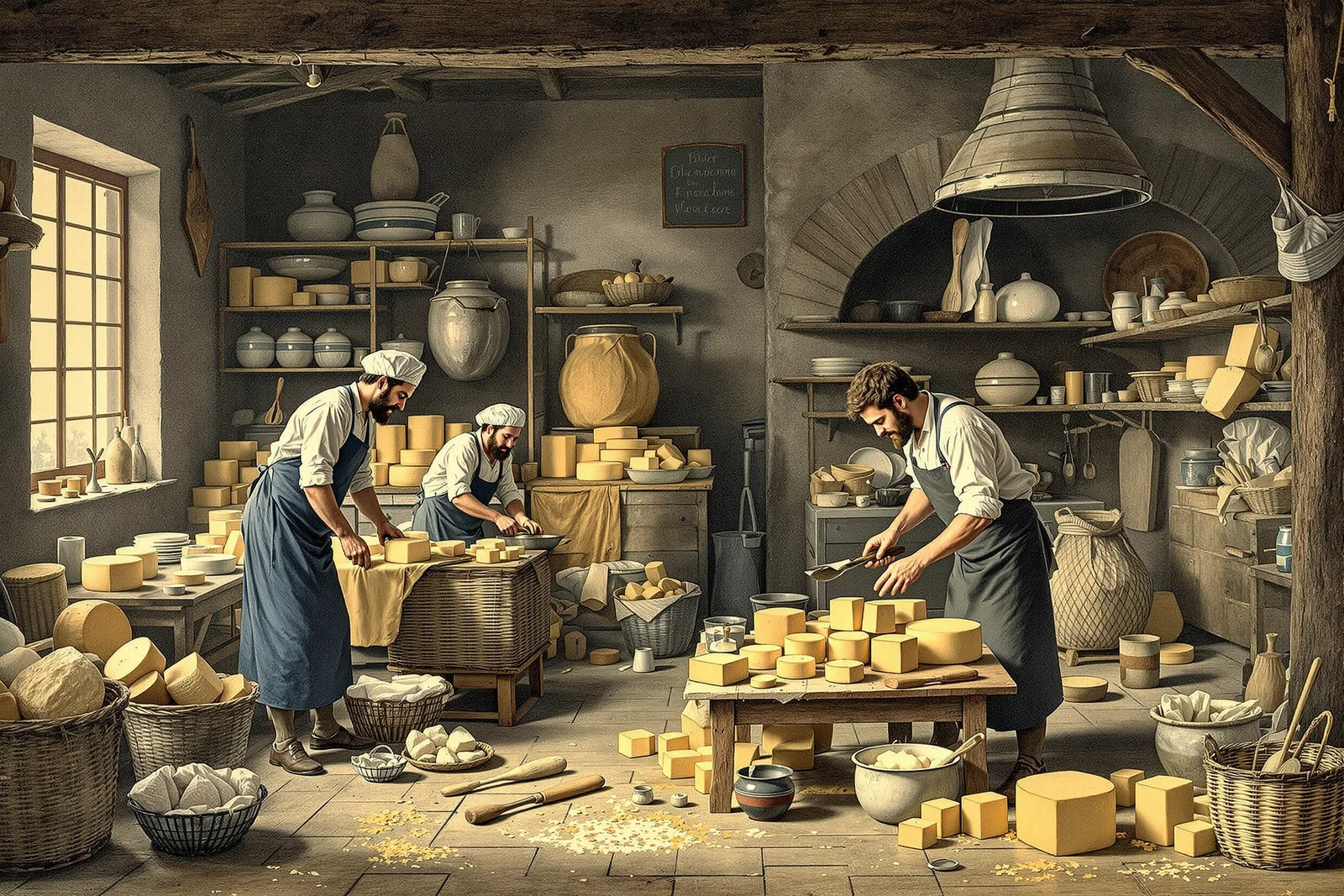
Age the Curd
Complete Cheese Making, Dairy Processing, and Preservation Guide
Complete Cheese Making, Dairy Processing, and Preservation Guide
Cheese transforms perishable milk into food that lasts months to years. Every pastoral culture developed cheese making independently. This campaign covers every cheese type from simple fresh cheeses to aged hard varieties.
Chapter 1: Cheese Types and Aging
| Type | Example | Aging Time | Difficulty | Yield (per gallon milk) | Shelf Life |
|---|---|---|---|---|---|
| Fresh (unaged) | Ricotta, paneer, queso fresco | None (same day) | Very low | 1-2 lbs | 1-2 weeks (refrigerated) |
| Soft-ripened | Brie, camembert | 2-6 weeks | Moderate-high | 1-1.5 lbs | 2-4 weeks |
| Semi-hard | Cheddar, gouda, colby | 2-12 months | Moderate | 1-1.5 lbs | 6-12 months |
| Hard | Parmesan, romano, gruyère | 6-36 months | High | 0.8-1.2 lbs | 1-5 years |
| Blue | Roquefort, stilton | 2-6 months | High | 1-1.5 lbs | 3-6 months |
| Washed-rind | Limburger, époisses | 1-3 months | Moderate-high | 1-1.5 lbs | 2-4 weeks |
| Stretched-curd | Mozzarella, provolone | Hours to months | Moderate | 1-1.5 lbs | 1 week to months |
Chapter 2: Basic Cheese Making Process
| Step | Action | Temperature | Time | Details |
|---|---|---|---|---|
| 1 | Heat milk to target temperature | 86-102F (varies by type) | 15-30 minutes | Pasteurized or raw (raw = more complex flavor) |
| 2 | Add culture (mesophilic or thermophilic bacteria) | At target temp | Ripen 30-60 minutes | Acidifies milk, develops flavor |
| 3 | Add rennet (coagulant) | At target temp | Set 30-60 minutes | Forms solid curd from liquid milk |
| 4 | Cut curd (knife or wire, into cubes) | Same | 5-15 minutes | Smaller cuts = harder cheese (more whey expelled) |
| 5 | Cook/stir curds (raise temperature slowly) | 100-130F (varies) | 30-60 minutes | Higher temp = firmer, drier cheese |
| 6 | Drain whey (separate liquid from curds) | - | 15-30 minutes | Save whey for ricotta, animal feed, or bread |
| 7 | Salt curds (mix salt throughout) | - | 5-10 minutes | 1-2% of curd weight. Flavor + preservation |
| 8 | Press into mold (apply weight) | Room temp | 2-24 hours | More pressure = denser, harder cheese |
| 9 | Air dry (form rind) | 50-60F, 80% humidity | 1-5 days | Surface dries, rind begins forming |
| 10 | Age in cave/cellar (controlled environment) | 50-58F, 80-85% humidity | Weeks to years | Flip regularly, monitor for unwanted mold |
Chapter 3: Rennet Sources
| Source | Type | Strength | Availability | Notes |
|---|---|---|---|---|
| Calf stomach (traditional) | Animal rennet | Very strong | Slaughter a calf/kid | Stomach lining dried and soaked in salt water |
| Thistle (Cynara cardunculus) | Vegetable rennet | Moderate | Wild/garden | Dried flower stamens soaked in water |
| Fig sap (Ficus carica) | Vegetable rennet | Moderate | Fig trees | Fresh sap from leaves or green figs |
| Nettle (Urtica dioica) | Vegetable rennet | Weak | Wild (common) | Juice from crushed leaves |
| Vinegar/lemon juice | Acid coagulation | N/A (different process) | Everywhere | Makes fresh cheese only (paneer, ricotta) |
Traditional rennet: Wash stomach of young calf/kid/lamb. Salt heavily and dry. To use: soak small piece in warm salt water for 12-24 hours. Strain. Add liquid to milk. One stomach makes enough rennet for hundreds of gallons.
Chapter 4: Simple Fresh Cheese (No Rennet Needed)
| Recipe | Milk | Acid | Heat | Result |
|---|---|---|---|---|
| Paneer | 1 gallon whole milk | 1/4 cup lemon juice or vinegar | Heat to 190F, add acid, curds form | Press 1-2 hours. Firm fresh cheese. |
| Ricotta | Whey (leftover from other cheese) + 1 cup milk | 1/4 cup vinegar | Heat to 200F, add acid | Drain in cloth. Soft, sweet cheese. |
| Queso fresco | 1 gallon whole milk | 1/4 cup vinegar | Heat to 180F, add acid | Light press 1 hour. Crumbly fresh cheese. |
| Labneh (yogurt cheese) | 1 quart thick yogurt | None (already acidified) | None | Strain in cloth 12-24 hours. Cream cheese texture. |
| Farmer's cheese | 1 gallon whole milk | 1/2 cup buttermilk + 2 tbsp vinegar | Heat to 180F | Drain and press lightly. Mild, versatile. |
Chapter 5: Aging Environment (Cheese Cave)
| Parameter | Ideal Range | Too Low | Too High |
|---|---|---|---|
| Temperature | 50-58F (10-14C) | Aging too slow, mold issues | Aging too fast, spoilage |
| Humidity | 80-85% | Rind cracks, cheese dries out | Excessive mold, sliminess |
| Air circulation | Gentle, consistent | Mold concentrates | Dries cheese unevenly |
| Light | Dark (no direct light) | N/A | UV damages fats, off-flavors |
Natural caves: perfect cheese aging environment (stable temp and humidity year-round). Alternatives: root cellar, basement, modified refrigerator (add water pan for humidity), buried container.
Chapter 6: Troubleshooting
| Problem | Cause | Prevention | Fix |
|---|---|---|---|
| Curd won't set | Weak/old rennet, milk too cold, UHT milk | Fresh rennet, correct temp, use pasteurized (not UHT) | Add more rennet, wait longer |
| Bitter flavor | Too much rennet, contamination | Use correct amount, sanitize | Age longer (bitterness fades) |
| Excessive mold (unwanted) | Too humid, contamination | Control humidity, sanitize cave | Wipe with vinegar-soaked cloth |
| Cracks in rind | Too dry, temperature fluctuation | Maintain 80-85% humidity | Seal cracks with butter or wax |
| Bloating (gas holes) | Unwanted bacteria (coliform) | Better sanitation, proper acidification | Cannot fix (prevent next time) |
| Dry/crumbly texture | Over-acidified, too much salt, over-pressed | Control acid development, measure salt | Cannot fix (adjust next batch) |
Reference Card
- Simplest cheese: heat milk to 190F + add vinegar = curds in 5 minutes. Press = paneer. No rennet needed.
- Rennet from calf stomach: salt, dry, soak piece in warm salt water. One stomach = hundreds of batches.
- Vegetable rennet: thistle flowers or fig sap. Soak dried thistle stamens in warm water.
- Aging environment: 50-58F, 80-85% humidity, dark, gentle airflow. Root cellar or cave ideal.
- Cut size determines hardness: small curds (1/4 inch) = hard cheese. Large curds (1 inch) = soft cheese.
- Salt at 1-2% of curd weight: too little = spoilage, too much = dry and bitter.
- Hard cheese (parmesan-style) lasts 1-5 years without refrigeration: ultimate food preservation.
- Save whey: make ricotta (reheat + acid), feed to pigs, use in bread baking, or drink (nutritious).
TransmissionCOMPLETE — unaltered & unabridged
Words1,157 — every one of them
SHA-256 of source text182a5f8fb7cbef62e791b9e084994d83ccd1448898ec3f0ef9a1451ed80974ea
Canonical textdownload campaign-cheese-making.md — byte-identical to what this page renders