Sovereignty Module: Mark the Hours
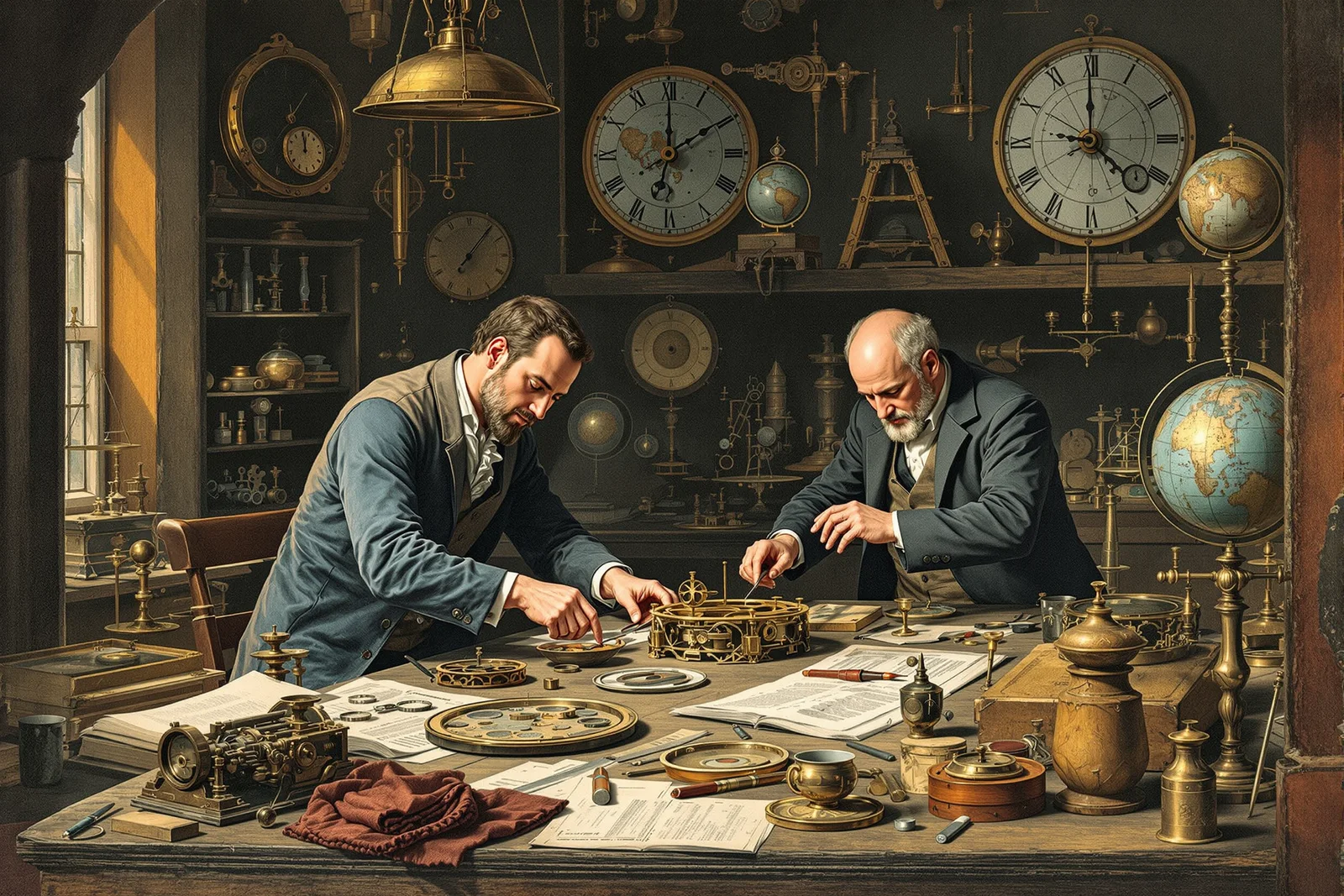
Complete Clockwork, Timekeeping, and Precision Mechanisms Guide
The Philosophy of Time
Time is the framework upon which all coordination depends. Without shared timekeeping, agriculture loses its seasons, navigation loses its longitude, medicine loses its dosing schedules, and community loses its ability to synchronize. From sundials to mechanical clocks, timekeeping technology represents humanity's mastery over the invisible dimension. This campaign covers every method of measuring time, from celestial observation to spring-driven mechanisms.
Chapter 1: Celestial Timekeeping
Solar Time (the sun as clock):
| Method | Accuracy | Complexity | Requirements |
|---|---|---|---|
| Shadow stick (gnomon) | ±15 minutes | Minimal | Straight stick, flat ground |
| Sundial (horizontal) | ±5 minutes | Low | Angled gnomon, marked plate |
| Sundial (equatorial) | ±2 minutes | Moderate | Gnomon aligned to polar axis |
| Noon mark | Exact noon daily | Minimal | North-south line, any vertical object |
| Analemma correction | ±30 seconds | High | Equation of time table applied to sundial |
Building a Horizontal Sundial:
- Determine your latitude (from star observation or maps)
- Cut a triangular gnomon: the angle between the base and the hypotenuse equals your latitude
- Mount gnomon on a flat plate with the hypotenuse edge pointing true north (toward Polaris)
- Mark hour lines on the plate using the formula: tan(hour angle) = sin(latitude) × tan(15° × hours from noon)
- The shadow of the gnomon's upper edge indicates solar time
Equation of Time:
The sun does not move at a perfectly uniform rate across the sky. Solar time varies from clock time by up to ±16 minutes depending on the date. This correction (the Equation of Time) must be applied to sundial readings for accurate clock time.
| Month | Correction (approximate) |
|---|---|
| January | Sun is 10 minutes slow |
| February | Sun is 14 minutes slow |
| March | Sun is 12 minutes slow → 0 |
| April | Sun is 0 → 2 minutes fast |
| May | Sun is 3 minutes fast |
| June | Sun is 2 minutes fast → 0 |
| July | Sun is 4 minutes slow |
| August | Sun is 5 minutes slow → 0 |
| September | Sun is 0 → 5 minutes fast |
| October | Sun is 10 minutes fast |
| November | Sun is 16 minutes fast → 0 |
| December | Sun is 0 → 10 minutes slow |
Chapter 2: Water and Sand Clocks
Water Clock (Clepsydra):
| Type | Accuracy | Duration | Principle |
|---|---|---|---|
| Outflow (draining) | ±5 minutes/hour | Variable | Water drains from vessel; level indicates time |
| Inflow (filling) | ±2 minutes/hour | Variable | Constant-rate drip fills graduated vessel |
| Feedback-regulated | ±1 minute/hour | Continuous | Float valve maintains constant head pressure |
Building a Regulated Water Clock:
- Upper reservoir: large container with overflow (maintains constant water level = constant pressure)
- Orifice: small, precise hole at bottom of reservoir (controls flow rate)
- Collection vessel: graduated cylinder that fills at constant rate
- Float indicator: float in collection vessel connected to pointer on a scale
- Calibration: mark the scale at known time intervals (using sundial at noon)
Hourglass (Sand Clock):
| Specification | Requirement |
|---|---|
| Sand | Fine, uniform, dry, non-clumping (sifted through fine mesh) |
| Glass | Two bulbs connected by narrow neck |
| Neck diameter | Controls duration (smaller = longer time) |
| Calibration | Adjust sand quantity for desired duration |
| Common durations | 1 minute, 3 minutes, 15 minutes, 30 minutes, 1 hour |
Chapter 3: Mechanical Clocks — The Escapement
The Key Invention: The Escapement
The escapement is the mechanism that converts continuous energy (falling weight or unwinding spring) into measured, equal increments of time. It is the heart of every mechanical clock.
Escapement Types:
| Type | Era | Accuracy | Complexity |
|---|---|---|---|
| Verge and foliot | 1300s | ±15 minutes/day | Low (first mechanical escapement) |
| Anchor (recoil) | 1670s | ±1 minute/day | Moderate |
| Deadbeat (Graham) | 1720s | ±5 seconds/day | Moderate-high |
| Lever (for watches) | 1750s | ±30 seconds/day | High |
| Grasshopper | 1720s | ±2 seconds/day | High (nearly frictionless) |
How the Verge Escapement Works:
- A weight on a cord turns a drum (the power source)
- The drum drives a gear train that speeds up the rotation
- The final gear (escape wheel) has pointed teeth
- A vertical shaft (verge) has two paddles (pallets) that alternately catch and release the escape wheel teeth
- A horizontal bar (foliot) with adjustable weights sits on top of the verge
- The foliot swings back and forth, its inertia regulating the rate at which the escape wheel advances
- Each swing allows one tooth to pass = one "tick"
How the Pendulum Escapement Works:
- Same power source (weight + gear train)
- The escape wheel has specially shaped teeth
- An anchor-shaped piece (the anchor) straddles the escape wheel
- The anchor is connected to a pendulum
- As the pendulum swings, the anchor alternately catches and releases escape wheel teeth
- The pendulum's period is determined by its length: T = 2π√(L/g)
- A 1-meter pendulum swings with a period of almost exactly 2 seconds (1 second per half-swing)
Chapter 4: Building a Pendulum Clock
Components:
| Component | Function | Material |
|---|---|---|
| Weight (drive) | Provides energy | Lead, stone, or iron (5-15 lbs) |
| Cord/chain | Connects weight to drum | Strong cord, chain, or gut |
| Main drum | Converts falling weight to rotation | Wood or metal cylinder |
| Gear train (3-4 gears) | Steps up rotation speed | Brass, steel, or hardwood |
| Escape wheel | Final gear, interacts with escapement | Brass or steel (30 teeth typical) |
| Anchor/pallets | Catches and releases escape wheel | Steel (hardened) |
| Pendulum rod | Swings at constant rate | Steel, wood, or invar (low thermal expansion) |
| Pendulum bob | Provides mass for inertia | Lead or brass disk |
| Dial and hands | Displays time | Any material |
| Case | Protects mechanism, mounts pendulum | Wood |
Pendulum Length for Desired Period:
| Period (full swing) | Length | Beats per minute |
|---|---|---|
| 1 second | 24.8 cm (9.8 inches) | 60 |
| 1.5 seconds | 55.9 cm (22 inches) | 40 |
| 2 seconds | 99.4 cm (39.1 inches) | 30 |
| 3 seconds | 223.6 cm (88 inches) | 20 |
The "seconds pendulum" (1 second per half-swing, 2 seconds full period) is 99.4 cm long — this is the classic grandfather clock pendulum.
Gear Train Calculation:
If the escape wheel has 30 teeth and the pendulum beats once per second (releasing one tooth per beat), the escape wheel rotates once per 30 seconds (2 rpm). To drive a minute hand (1 revolution per hour), you need a 30:1 reduction from escape wheel to minute hand. To drive an hour hand (1 revolution per 12 hours), you need an additional 12:1 reduction.
Chapter 5: Spring-Driven Clocks and Watches
Mainspring:
A coiled strip of tempered steel that stores energy when wound. As it unwinds, it drives the gear train. Problem: a fully wound spring delivers more force than a nearly unwound spring, causing the clock to run fast when freshly wound and slow when nearly run down.
Solutions to Uneven Spring Force:
| Solution | Method | Effectiveness |
|---|---|---|
| Fusee | Cone-shaped pulley that compensates for spring force variation | Excellent (used in early watches) |
| Going barrel | Accept slight variation, regulate with escapement | Good (modern approach) |
| Constant-force escapement | Intermediate spring recharged each beat | Excellent (complex) |
Watch Escapement (Lever):
Miniaturized version of the anchor escapement using a balance wheel (oscillating wheel with hairspring) instead of a pendulum. The hairspring provides the restoring force that makes the balance wheel oscillate at a constant rate.
| Component | Function |
|---|---|
| Balance wheel | Oscillates back and forth (replaces pendulum) |
| Hairspring | Provides restoring force (replaces gravity for pendulum) |
| Lever (pallet fork) | Catches and releases escape wheel teeth |
| Escape wheel | Advances one tooth per oscillation |
Chapter 6: Clock Regulation and Maintenance
Adjusting Rate:
| Problem | Cause | Fix |
|---|---|---|
| Clock runs fast | Pendulum too short / balance spring too tight | Lengthen pendulum (lower bob) / loosen hairspring |
| Clock runs slow | Pendulum too long / balance spring too loose | Shorten pendulum (raise bob) / tighten hairspring |
| Erratic timekeeping | Worn pivots, dirty mechanism, temperature changes | Clean, oil, repair worn parts |
| Clock stops | Insufficient power, worn escapement, obstruction | Check weight/spring, inspect escapement, remove obstruction |
Lubrication:
| Location | Lubricant | Frequency |
|---|---|---|
| Pivot holes (all gears) | Clock oil (light mineral oil) | Every 3-5 years |
| Escapement pallets | Very thin oil or dry (depending on type) | Every 3-5 years |
| Mainspring (spring clocks) | Mainspring grease | When serviced |
| Pendulum suspension | None (must swing freely) | N/A |
Temperature Compensation:
Metal pendulum rods expand when warm (clock runs slow in summer) and contract when cold (clock runs fast in winter). Solutions:
- Wood rod (low thermal expansion)
- Invar rod (nickel-steel alloy, near-zero expansion)
- Gridiron pendulum (alternating brass and steel rods that compensate each other)
- Mercury pendulum (mercury in bob rises when warm, raising center of gravity, compensating for rod expansion)
Chapter 7: Time Distribution
Synchronizing Multiple Clocks:
| Method | Range | Accuracy |
|---|---|---|
| Master clock with slave dials | Building-wide | Exact (electrical connection) |
| Time ball (visual signal at noon) | Harbor/city | ±1 second (visual) |
| Telegraph time signal | Continental | ±0.1 second |
| Radio time signal | Global | ±0.01 second |
| Church bell (hours) | 1-3 miles | ±1 minute |
| Noon cannon/gun | City-wide | ±1 second (sound delay with distance) |
Establishing a Time Standard:
- Determine local noon precisely (when sun is at highest point / shadow is shortest)
- Set master clock to 12:00:00 at that moment
- Apply Equation of Time correction for the date
- Apply longitude correction if synchronizing with a standard time zone
- All other clocks in the community are set from the master clock
Chapter 8: Navigation and Longitude
The Longitude Problem:
Latitude is easily determined from star angles. Longitude requires knowing the exact time at a reference point (Greenwich) while observing local time. Each hour of difference = 15 degrees of longitude. Each minute of time error = ~1 nautical mile of position error at the equator.
Solution: The Marine Chronometer
A highly accurate portable clock that maintains Greenwich time at sea despite motion, temperature changes, and humidity. John Harrison's H4 (1761) achieved ±5 seconds over 81 days at sea — accurate enough for navigation within 1 nautical mile.
Key Features of a Marine Chronometer:
| Feature | Purpose |
|---|---|
| Detent escapement | Minimal friction, high accuracy |
| Bimetallic balance wheel | Temperature compensation |
| Fusee | Constant force from mainspring |
| Gimbal mount | Keeps level despite ship motion |
| 56-hour power reserve | Survives missed winding |
Chapter 9: Calendar Systems
Solar Year: 365.2422 days (time for Earth to orbit the sun)
Calendar Corrections:
| System | Rule | Error |
|---|---|---|
| Julian (45 BC) | Leap year every 4 years (365.25 average) | +1 day per 128 years |
| Gregorian (1582) | Leap year every 4, except centuries, except 400s | +1 day per 3,236 years |
| Observation-based | Add leap day when equinox drifts | Zero (self-correcting) |
Determining the Date Without a Calendar:
- Mark the winter solstice (shortest day / longest night) = approximately December 21
- Count days forward from solstice
- Verify with equinoxes (day = night, approximately March 20 and September 22)
- Verify with summer solstice (longest day, approximately June 21)
Chapter 10: Precision Mechanisms Beyond Clocks
Skills Transferable from Clockwork:
| Mechanism | Application Beyond Clocks |
|---|---|
| Gear trains | Mills, lathes, vehicles, any speed/torque conversion |
| Escapements | Governors, regulators, metering devices |
| Springs | Triggers, latches, return mechanisms, energy storage |
| Bearings/pivots | Any rotating machinery |
| Precision measurement | Scientific instruments, surveying, manufacturing |
| Cam mechanisms | Automata, textile machinery, engine valves |
| Ratchets | One-way mechanisms, winding, jacks |
Tools for Clockwork:
| Tool | Use |
|---|---|
| Files (needle, various cuts) | Shaping small metal parts |
| Gravers/burins | Cutting gear teeth, engraving |
| Lathe (watchmaker's) | Turning pivots, wheels, drums |
| Dividing plate | Spacing gear teeth evenly |
| Pivot polisher | Finishing bearing surfaces |
| Tweezers (fine) | Handling small parts |
| Loupe/magnifier | Seeing small work |
| Staking set | Setting pivots, pressing parts |
Reference Card
TIMEKEEPING ESSENTIALS:
- Pendulum period depends only on length: T = 2π√(L/g). A 1-meter pendulum = 2 seconds.
- The escapement is the heart of every mechanical clock (converts continuous force to measured ticks)
- Sundial time must be corrected by the Equation of Time (±16 minutes depending on date)
- Temperature changes affect pendulum length and clock rate (compensate with wood/invar/gridiron)
- 1 hour of time difference = 15 degrees of longitude (critical for navigation)
- Gear ratio determines hand speed: escape wheel RPM / gear ratio = hand RPM
- Lubricate pivot holes every 3-5 years with light clock oil
- The seconds pendulum (99.4 cm) is the standard for precision clocks
This campaign provides the complete knowledge to build timekeeping devices from sundials to precision mechanical clocks. A community with accurate timekeeping can coordinate activities, navigate precisely, schedule agriculture, and build the precision mechanical skills that underpin all advanced manufacturing. The clock is the first precision machine, and the skills to build one transfer to every other mechanism.