Sovereignty Module: Loop the Warmth
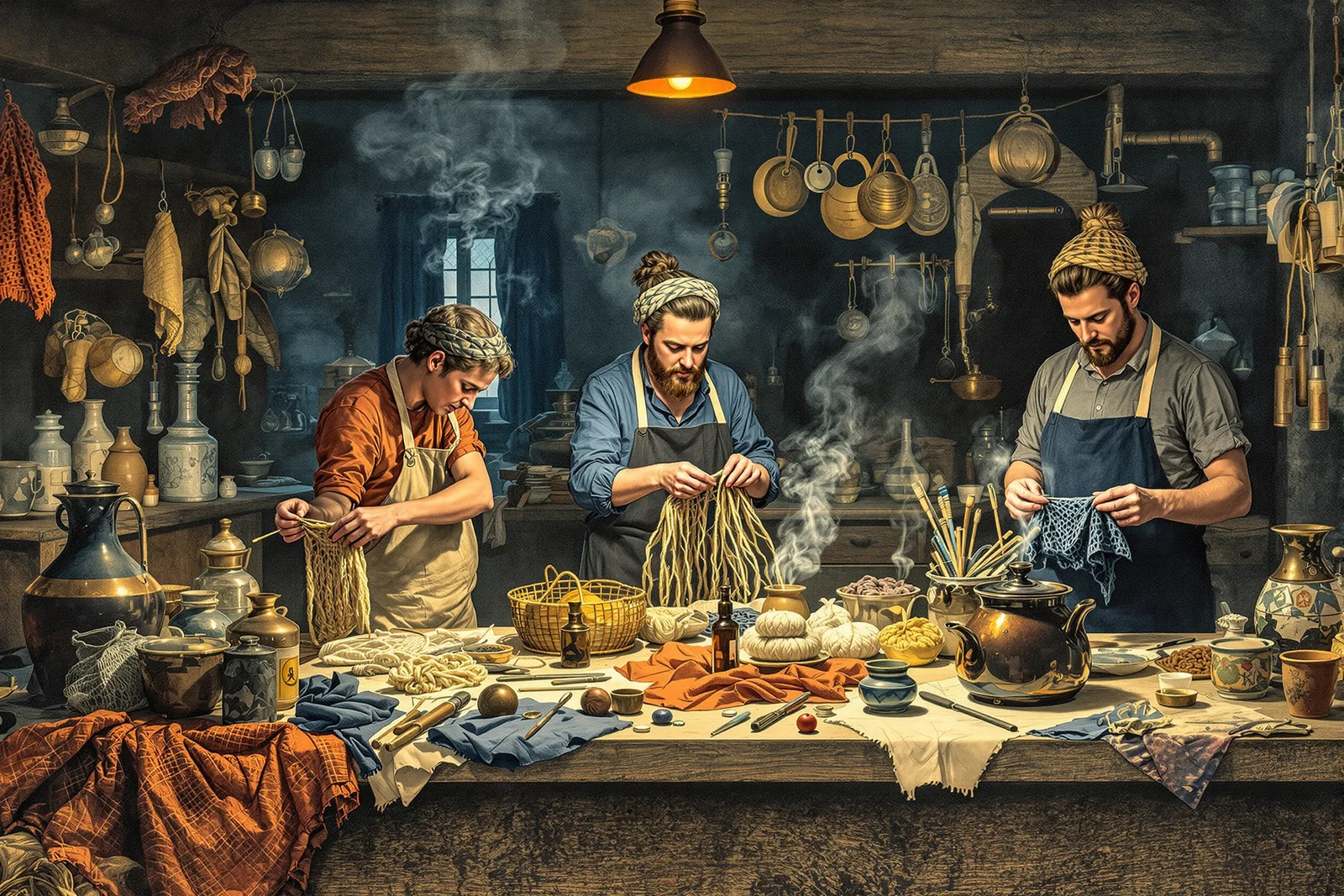
Loop the Warmth
Complete Knitting, Crochet, and Textile Repair Guide
Complete Knitting, Crochet, and Textile Repair Guide
Knitting transforms a single continuous thread into stretchy, insulating fabric without any loom. It produces socks, hats, gloves, sweaters, and blankets — the garments that prevent hypothermia. This campaign covers techniques from casting on to complex patterns.
Chapter 1: Knitting vs. Crochet vs. Weaving
| Attribute | Knitting | Crochet | Weaving |
|---|---|---|---|
| Tools | 2 needles (or circular) | 1 hook | Loom (frame) |
| Fabric type | Stretchy, thin, draping | Thicker, structured, less stretch | Stable, non-stretch |
| Speed | Moderate | Fast | Fast (once warped) |
| Yarn use | Less (thinner fabric) | More (thicker fabric) | Moderate |
| Portability | Excellent | Excellent | Poor (loom needed) |
| Best for | Socks, sweaters, fitted garments | Blankets, hats, amigurumi, lace | Cloth, blankets, rugs |
| Repair | Difficult (runs) | Easy (pull back to error) | Moderate |
| Learning curve | Moderate | Low | Moderate-high |
Chapter 2: Basic Knitting
| Technique | Method | Use |
|---|---|---|
| Cast on (long-tail) | Loop yarn around thumb and needle, pull through | Starting edge of work |
| Knit stitch | Insert needle front-to-back, wrap yarn, pull through, slip off | Basic stitch (creates garter or stockinette) |
| Purl stitch | Insert needle back-to-front, wrap yarn, pull through, slip off | Reverse of knit (creates texture patterns) |
| Bind off (cast off) | Knit 2, pass first over second, repeat | Finishing edge |
| Increase (M1) | Pick up bar between stitches, knit through back | Shaping wider |
| Decrease (K2tog) | Knit two stitches together as one | Shaping narrower |
| Stockinette | Knit one row, purl one row (flat). All knit (circular). | Smooth fabric (curls at edges) |
| Garter stitch | Knit every row (flat). Knit one round, purl one round (circular). | Flat, reversible, doesn't curl |
| Ribbing (K1P1 or K2P2) | Alternate knit and purl in same row | Stretchy edges (cuffs, hems, necklines) |
Chapter 3: Essential Garments
| Garment | Skill Level | Yarn Amount | Time (beginner) | Priority |
|---|---|---|---|---|
| Hat (beanie) | Beginner | 100-150 yards | 4-8 hours | High (heat loss from head) |
| Scarf | Beginner | 200-400 yards | 8-16 hours | Moderate |
| Mittens | Intermediate | 150-200 yards | 8-12 hours | High (frostbite prevention) |
| Socks | Intermediate-advanced | 300-400 yards | 15-25 hours | Critical (foot health) |
| Sweater | Advanced | 1000-2000 yards | 40-80 hours | High (core warmth) |
| Blanket | Beginner (large) | 2000-4000 yards | 60-100 hours | Moderate |
Chapter 4: Sock Construction (Top-Down)
| Step | Action | Details |
|---|---|---|
| 1 | Cast on (56-64 stitches for adult) on double-pointed needles or circular | Divide evenly across needles |
| 2 | Knit ribbing (K2P2) for 1-2 inches | Stretchy cuff, holds sock up |
| 3 | Knit leg (stockinette) to desired length | 6-8 inches for standard sock |
| 4 | Knit heel flap (half the stitches, back and forth) | 2-3 inches, creates reinforced heel |
| 5 | Turn heel (short rows: knit to center, decrease at edges) | Creates the cup shape |
| 6 | Pick up stitches along heel flap edges | Rejoins round knitting |
| 7 | Decrease gusset (every other round until back to original count) | Shapes foot |
| 8 | Knit foot to 2 inches before toe | Plain stockinette |
| 9 | Decrease toe (K2tog at 4 points every other round) | Shapes toe |
| 10 | Graft toe closed (Kitchener stitch) | Seamless, comfortable toe |
Chapter 5: Textile Repair
| Repair | Method | When to Use |
|---|---|---|
| Darning (woven patch) | Weave new threads over hole in grid pattern | Holes in woven fabric, socks |
| Swiss darning (duplicate stitch) | Knit-stitch-shaped embroidery over worn area | Thin spots in knitting (before hole forms) |
| Patching | Cut patch larger than hole, stitch around edges | Large holes, heavy fabrics |
| Invisible mending | Match thread, weave into existing fabric structure | Fine garments, small tears |
| Felted patch (wool) | Needle-felt wool roving over hole | Wool garments, quick repair |
| Seam repair | Re-stitch along original seam line | Split seams |
| Button replacement | Thread through holes, wrap shank, secure | Lost buttons |
| Elastic replacement | Open casing, thread new elastic, close | Stretched waistbands |
Chapter 6: Yarn from Raw Fiber
| Step | Action | Equipment |
|---|---|---|
| 1 | Shear/harvest fiber (sheep, goat, rabbit, plant) | Shears, scissors |
| 2 | Wash (scour) to remove oils/dirt | Hot water + soap (wool), retting (plant) |
| 3 | Card (align fibers in same direction) | Hand cards or drum carder |
| 4 | Draft (pull fibers into thin roving) | Hands |
| 5 | Spin (twist roving into yarn) | Drop spindle or spinning wheel |
| 6 | Ply (twist 2-3 singles together, opposite direction) | Spindle or wheel |
| 7 | Set twist (wash and hang to dry under tension) | Water, weight |
| 8 | Wind into ball or skein | Nostepinne or swift |
Drop spindle: simplest spinning tool. A weighted stick that hangs and spins. Draft fibers with one hand, spin spindle with other. Gravity provides tension. One person can spin enough yarn for a pair of socks in 8-12 hours.
Reference Card
- Knit stitch: insert front-to-back, wrap, pull through. Purl: back-to-front.
- Stockinette = knit one side, purl the other. Garter = knit both sides.
- Ribbing (K2P2) creates stretchy edges for cuffs and hems
- Socks are the highest-priority knitted garment (foot health = survival)
- Darn holes before they grow: Swiss darning reinforces thin spots
- Drop spindle: simplest way to make yarn from raw fiber (no equipment needed)
- Wool insulates even when wet (unlike cotton which loses all insulation)
- Always knit a gauge swatch: 4x4 inches to check stitches per inch before starting
TransmissionCOMPLETE — unaltered & unabridged
Words1,064 — every one of them
SHA-256 of source textfd4f871d42d8063299c59b31a6b825a59cb80c5f45d5ac3653ebc2a3c47f7141
Canonical textdownload campaign-knitting-v2.md — byte-identical to what this page renders