Sovereignty Module: Pour the Foundation
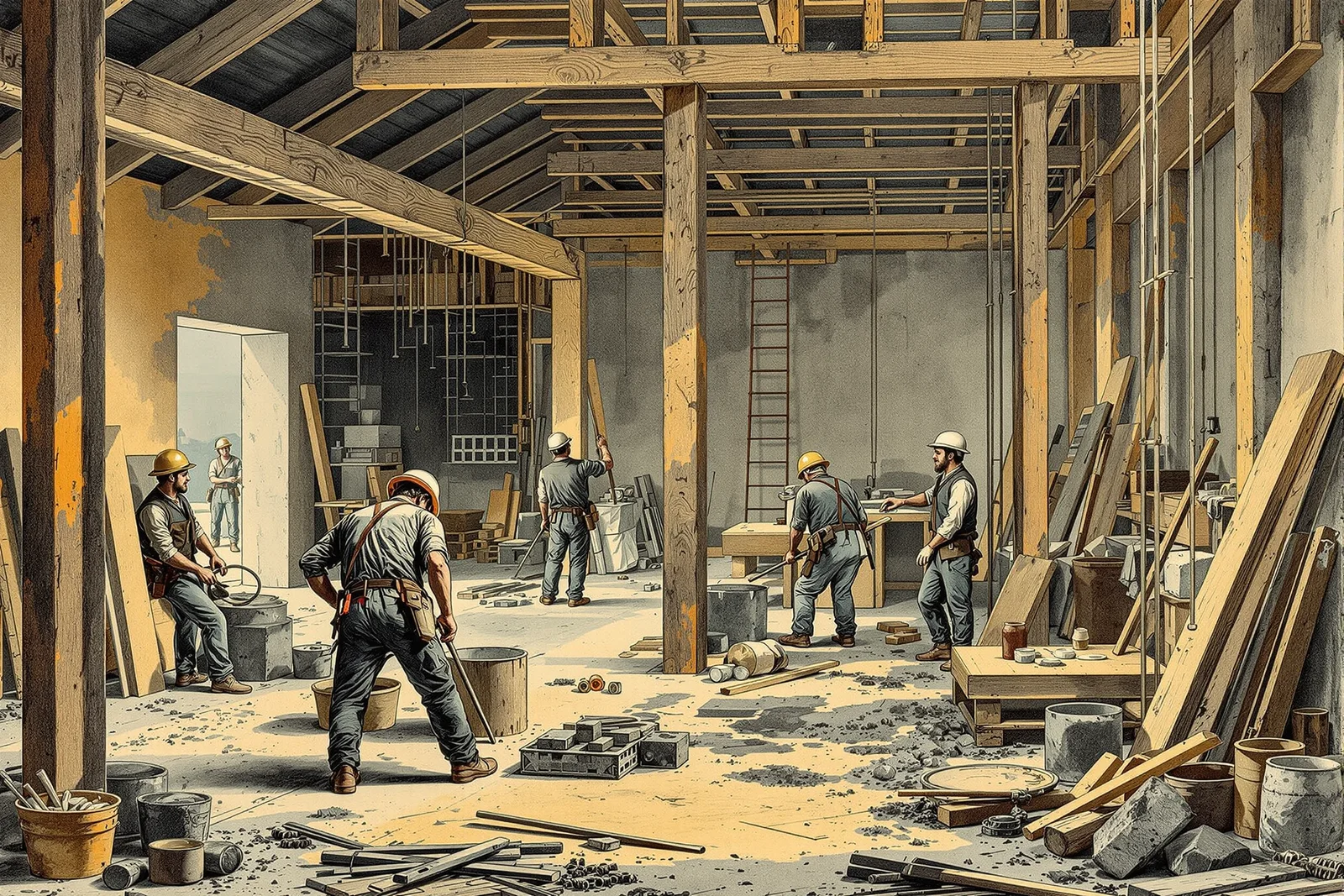
Complete Concrete, Cement, and Hydraulic Construction Guide
The Philosophy of Concrete
Concrete is liquid stone. It can be poured into any shape, sets hard as rock, resists fire and water, and lasts millennia (Roman concrete structures still stand after 2,000 years). It requires only limestone, clay, sand, gravel, and fuel. A community that can make concrete can build bridges, dams, foundations, water tanks, roads, and multi-story structures that will outlast generations. This campaign covers cement production, concrete mixing, reinforcement, and construction techniques.
Chapter 1: Cement Chemistry
What Cement Is:
Cement is powdered calcium silicate that reacts with water to form a hard, stone-like mass. It is the "glue" in concrete that binds sand and gravel together.
Portland Cement Production (simplified):
- Quarry limestone (calcium carbonate, CaCO3) and clay (aluminum silicates)
- Crush and mix in ratio: approximately 80% limestone, 20% clay
- Heat to 1,450C (2,640F) in a kiln until mixture fuses into clinite (calcium silicate nodules)
- Cool the clinker
- Grind clinker to fine powder (with 5% gypsum added to control setting time)
- Result: Portland cement
Alternative Cements (lower technology):
| Type | Ingredients | Kiln Temperature | Strength | Hydraulic? |
|---|---|---|---|---|
| Lime mortar | Limestone only | 900C | Low-moderate | No (air-setting only) |
| Hydraulic lime | Limestone with natural clay content (10-20%) | 900-1,000C | Moderate | Yes (sets underwater) |
| Pozzolanic cement | Lime + volcanic ash (or brick dust, fly ash) | 900C (for lime) | Good | Yes |
| Roman cement | Natural cement rock (argillaceous limestone) | 900-1,000C | Good | Yes |
| Portland cement | Limestone + clay (manufactured) | 1,450C | Excellent | Yes |
Pozzolanic Reaction (the Roman secret):
Lime (calcium hydroxide) + pozzolan (reactive silica) + water = calcium silicate hydrate (the same compound in Portland cement). Pozzolans include: volcanic ash, pumice, burnt clay/brick dust, rice husk ash, fly ash, and diatomaceous earth.
Roman concrete used lime + volcanic ash (pozzolana from Pozzuoli, Italy). It sets underwater and actually gets stronger over centuries as seawater promotes further crystal growth.
Chapter 2: Kiln Construction for Cement
Lime Kiln (for quicklite/hydraulic lime):
| Feature | Specification |
|---|---|
| Type | Vertical shaft kiln (most efficient for small scale) |
| Height | 10-20 feet |
| Diameter | 4-8 feet internal |
| Construction | Stone or firebrick, lined with refractory clay |
| Fuel | Wood, charcoal, coal (alternating layers with limestone) |
| Temperature | 900-1,000C |
| Capacity | 1-5 tons of limestone per burn |
| Burn time | 3-7 days continuous |
| Output | Approximately 56% of limestone weight becomes quicklime |
Rotary Kiln (for Portland cement, larger scale):
A long, slightly inclined rotating steel tube (50-200 feet long, 6-15 feet diameter) lined with refractory brick. Raw material enters the high end, fuel burns at the low end. Material tumbles slowly down the rotating tube, progressively heating until it reaches 1,450C at the hot end and fuses into clinker. Industrial scale but can be built from salvaged steel pipe.
Chapter 3: Concrete Mix Design
Basic Concrete Proportions (by volume):
| Component | Parts | Function |
|---|---|---|
| Cement | 1 | Binder (reacts with water) |
| Sand (fine aggregate) | 2 | Fills voids between gravel |
| Gravel (coarse aggregate) | 3 | Bulk, strength, reduces cement needed |
| Water | 0.5 (by weight of cement) | Activates cement reaction |
This 1:2:3 mix produces approximately 3,000-4,000 PSI compressive strength (suitable for most construction).
Mix Variations:
| Application | Cement:Sand:Gravel | Strength (PSI) | Use |
|---|---|---|---|
| Lean mix (mass concrete) | 1:3:6 | 1,500-2,000 | Foundations, fill, mass pours |
| Standard structural | 1:2:3 | 3,000-4,000 | Columns, beams, walls, floors |
| Rich mix (high strength) | 1:1.5:2.5 | 4,000-5,000 | Heavily loaded structures |
| Mortar (no gravel) | 1:3 (sand only) | 1,500-2,500 | Laying brick/stone, plastering |
| Screed (thin layer) | 1:3 (fine sand) | 2,000-3,000 | Floor finishing |
Water-Cement Ratio (critical for strength):
| W/C Ratio | Approximate Strength | Workability |
|---|---|---|
| 0.35 | 5,000+ PSI | Stiff (needs vibration) |
| 0.45 | 4,000 PSI | Moderate (good for most work) |
| 0.55 | 3,000 PSI | Fluid (easy to place) |
| 0.65 | 2,000 PSI | Very fluid (weak, porous) |
Rule: Less water = stronger concrete (but harder to work). Never add extra water for convenience.
Chapter 4: Reinforced Concrete
Why Reinforce?
Concrete is strong in compression (resisting squeezing) but weak in tension (resisting pulling/bending). Steel is strong in tension. Combining them creates a material strong in both: reinforced concrete.
Reinforcement Principles:
| Principle | Application |
|---|---|
| Place steel where tension occurs | Bottom of beams (bending pulls the bottom apart) |
| Minimum cover | 1.5-2 inches of concrete over all steel (protects from corrosion) |
| Overlap splices | Where bars meet, overlap 40-60 bar diameters |
| Hooks at ends | Bend bar ends into hooks for anchorage |
| Stirrups/ties | Vertical loops around main bars (prevents shear failure) |
Steel Sources (post-collapse):
| Source | Bar Size | Availability |
|---|---|---|
| Rebar (salvaged from demolished concrete) | #3 to #8 (3/8" to 1") | Abundant in ruins |
| Fence wire (multiple strands twisted) | Equivalent to #2-#3 | Very common |
| Car/truck leaf springs (straightened) | Equivalent to #4-#6 | Vehicles |
| Bed frames, angle iron | Various | Buildings |
| Cable (wire rope) | High tensile | Industrial sites |
Alternative Reinforcement (if no steel):
| Material | Tensile Strength | Durability in Concrete | Notes |
|---|---|---|---|
| Bamboo (treated) | Good | Moderate (must seal against moisture) | Coat with bitumen/tar before embedding |
| Fiber (sisal, hemp, coconut) | Moderate | Low-moderate | Mix short fibers into concrete (fiber-reinforced) |
| Glass fiber | Good | Good | If available |
| Wood (treated) | Moderate | Low (rots if moisture enters) | Last resort |
Chapter 5: Formwork (Molds for Concrete)
Formwork Materials:
| Material | Reuse | Surface Quality | Cost |
|---|---|---|---|
| Plywood | 5-20 uses | Smooth | Moderate |
| Sawn lumber | 3-10 uses | Board-marked | Low |
| Steel (fabricated) | 100+ uses | Very smooth | High (but reusable) |
| Earth (excavated shape) | 1 use | Rough | Minimal |
| Brick/block (permanent) | Permanent (stays in place) | N/A | Moderate |
Formwork Design Rules:
| Rule | Reason |
|---|---|
| Must withstand liquid concrete pressure (150 lbs/cubic foot × depth) | Concrete is heavy liquid until it sets |
| Must be braced against blowout | Lateral pressure increases with depth |
| Must be level and plumb | Crooked forms = crooked structure |
| Must be oiled or lined before pouring | Prevents concrete from bonding to form |
| Must remain in place until concrete reaches adequate strength | Too-early removal causes collapse |
Form Removal Timing:
| Element | Minimum Time Before Removal | Notes |
|---|---|---|
| Walls and columns (sides) | 24-48 hours | Concrete can support its own weight |
| Slab soffit (underside) | 7-14 days | Must reach 70%+ design strength |
| Beam soffit | 14-21 days | Critical: premature removal causes collapse |
| Props under slabs | 21-28 days | Full strength development |
Chapter 6: Placing and Curing Concrete
Placing Rules:
| Rule | Reason |
|---|---|
| Pour within 30-60 minutes of mixing | Concrete begins setting; late placement = weak joints |
| Drop height maximum 5 feet | Greater height causes segregation (gravel separates) |
| Place in layers (12-18 inches) | Allows proper compaction |
| Compact each layer (vibrate or rod) | Removes air voids that weaken concrete |
| Do not add water to stiffening concrete | Destroys strength (dilutes cement paste) |
Curing (critical for strength):
Concrete needs water to continue the chemical reaction (hydration) for at least 7 days. If it dries out too fast, the reaction stops and concrete is permanently weakened.
| Curing Method | Effectiveness | Effort |
|---|---|---|
| Ponding (flood surface with water) | Excellent | High (needs containment) |
| Wet burlap/cloth covering | Excellent | Moderate (re-wet daily) |
| Plastic sheet covering | Good | Low (traps moisture) |
| Spraying/sprinkling | Good | Moderate (periodic) |
| Curing compound (spray-on membrane) | Good | Low (if available) |
Strength Development:
| Age | Percentage of 28-Day Strength |
|---|---|
| 1 day | 15-20% |
| 3 days | 40-50% |
| 7 days | 65-75% |
| 14 days | 85-90% |
| 28 days | 100% (design strength) |
| 90 days | 110-120% |
| 1 year | 125-130% |
Concrete continues gaining strength for years (slowly after 28 days).
Chapter 7: Specific Applications
Water Tank (reinforced concrete):
| Specification | Value |
|---|---|
| Wall thickness | 6-8 inches (reinforced) |
| Floor thickness | 8-10 inches (reinforced) |
| Reinforcement | #4 bars at 8-12 inches spacing, both faces |
| Mix | Rich mix (1:1.5:2.5), low W/C ratio (0.45) |
| Waterproofing | Plaster interior with 1:2 cement:sand mortar |
| Capacity (10' × 10' × 6' deep) | Approximately 4,500 gallons |
Bridge (simple beam):
| Span | Beam Depth | Reinforcement | Notes |
|---|---|---|---|
| 10 feet | 12 inches | 3 × #5 bars bottom | Foot traffic only |
| 20 feet | 18 inches | 4 × #6 bars bottom | Light vehicle |
| 30 feet | 24 inches | 6 × #7 bars bottom + stirrups | Vehicle traffic |
| 40+ feet | Requires engineering | Multiple bars + prestressing | Professional design needed |
Road/Path (unreinforced):
| Feature | Specification |
|---|---|
| Subgrade | Compacted earth, level |
| Sub-base | 4-6 inches compacted gravel |
| Concrete thickness | 4 inches (foot traffic), 6 inches (vehicle) |
| Mix | Standard 1:2:3 |
| Joints | Cut or formed every 10-15 feet (prevents random cracking) |
| Width | 4 feet (path), 10-12 feet (single lane road) |
Chapter 8: Masonry with Concrete
Concrete Block Making:
| Specification | Value |
|---|---|
| Mix | 1:4:6 (cement:sand:fine gravel) — lean mix |
| Mold | Steel or wood, 8"×8"×16" (standard block) |
| Compaction | Vibrate or tamp firmly |
| Curing | Moist cure 7+ days before use |
| Strength | 1,000-2,000 PSI (adequate for walls) |
| Production rate | 50-200 blocks/day (manual) |
Block Wall Construction:
| Course | Mortar | Reinforcement | Notes |
|---|---|---|---|
| First course | Set in mortar on foundation | Vertical rebar from foundation into block cores | Level carefully |
| Subsequent courses | 3/8" mortar joints, staggered (running bond) | Continue vertical rebar; fill cores with grout every 4 feet | Check plumb each course |
| Bond beam | Every 4 feet height | Horizontal rebar in U-block or knocked-out block, filled with grout | Ties wall together horizontally |
| Top (ring beam) | Final course | Continuous horizontal rebar, fully grouted | Supports roof, ties walls |
Chapter 9: Special Concretes
| Type | Modification | Property | Use |
|---|---|---|---|
| Lightweight | Replace gravel with pumice, perlite, or foamed slag | Lower weight (90-110 lb/cf vs 150) | Upper floors, insulation |
| Heavyweight | Use iron ore, steel shot, or barite as aggregate | Higher density (200-300 lb/cf) | Radiation shielding |
| Fiber-reinforced | Add short fibers (steel, glass, polypropylene) to mix | Crack resistance, toughness | Slabs, thin sections |
| Waterproof | Reduce W/C ratio, add pozzolan, dense compaction | Low permeability | Water tanks, below-grade |
| Insulating | Aerated (add aluminum powder or foam) | Low thermal conductivity | Building insulation |
| Rapid-setting | Use high-early cement or add calcium chloride | Sets in hours instead of days | Emergency repairs, cold weather |
Chapter 10: Production Planning
Cement Production for a Community:
| Need | Cement Required (annual) | Notes |
|---|---|---|
| 1 house foundation | 2-3 tons | Footings + slab |
| 1 water tank (5,000 gal) | 3-4 tons | Walls + floor |
| 100 feet of road (single lane) | 5-8 tons | 6" thick × 10' wide |
| 500 concrete blocks | 1-2 tons | For walls |
| General maintenance/repair | 1-2 tons | Patching, mortar, misc |
| Community of 50 (annual) | 10-20 tons | Moderate construction pace |
Kiln Output:
A small vertical shaft kiln (6' diameter) burning for 5 days produces approximately 5-10 tons of quicklime (or hydraulic lime/cement depending on raw material). Four to six burns per year supplies a community's needs.
Raw Material Requirements (per ton of cement):
| Material | Amount | Source |
|---|---|---|
| Limestone | 1.5 tons | Quarry |
| Clay/shite | 0.4 tons | Clay pit |
| Fuel (coal equivalent) | 0.3-0.5 tons | Mine or charcoal (1-1.5 tons charcoal) |
| Gypsum | 50 lbs | Mine or salvage |
Reference Card
CONCRETE ESSENTIALS:
- Concrete = Cement + Sand + Gravel + Water (1:2:3 by volume, 0.45 W/C ratio)
- Less water = stronger concrete (never add water for convenience)
- Cure for minimum 7 days (keep wet) or concrete will be permanently weak
- Place reinforcing steel where tension occurs (bottom of beams, outside face of retaining walls)
- Minimum 1.5 inches of concrete cover over all steel (corrosion protection)
- Remove formwork only after concrete reaches adequate strength (walls: 2 days, beams: 14-21 days)
- Roman concrete (lime + volcanic ash/brick dust) sets underwater and lasts millennia
- Concrete reaches design strength at 28 days but continues strengthening for years
This campaign provides the complete knowledge to produce cement and construct with concrete. A community with concrete capability can build permanent infrastructure — bridges, dams, water systems, roads, and buildings — that will serve for centuries. Concrete is the material of civilization's bones.