Campaign 101: Build the Barrel
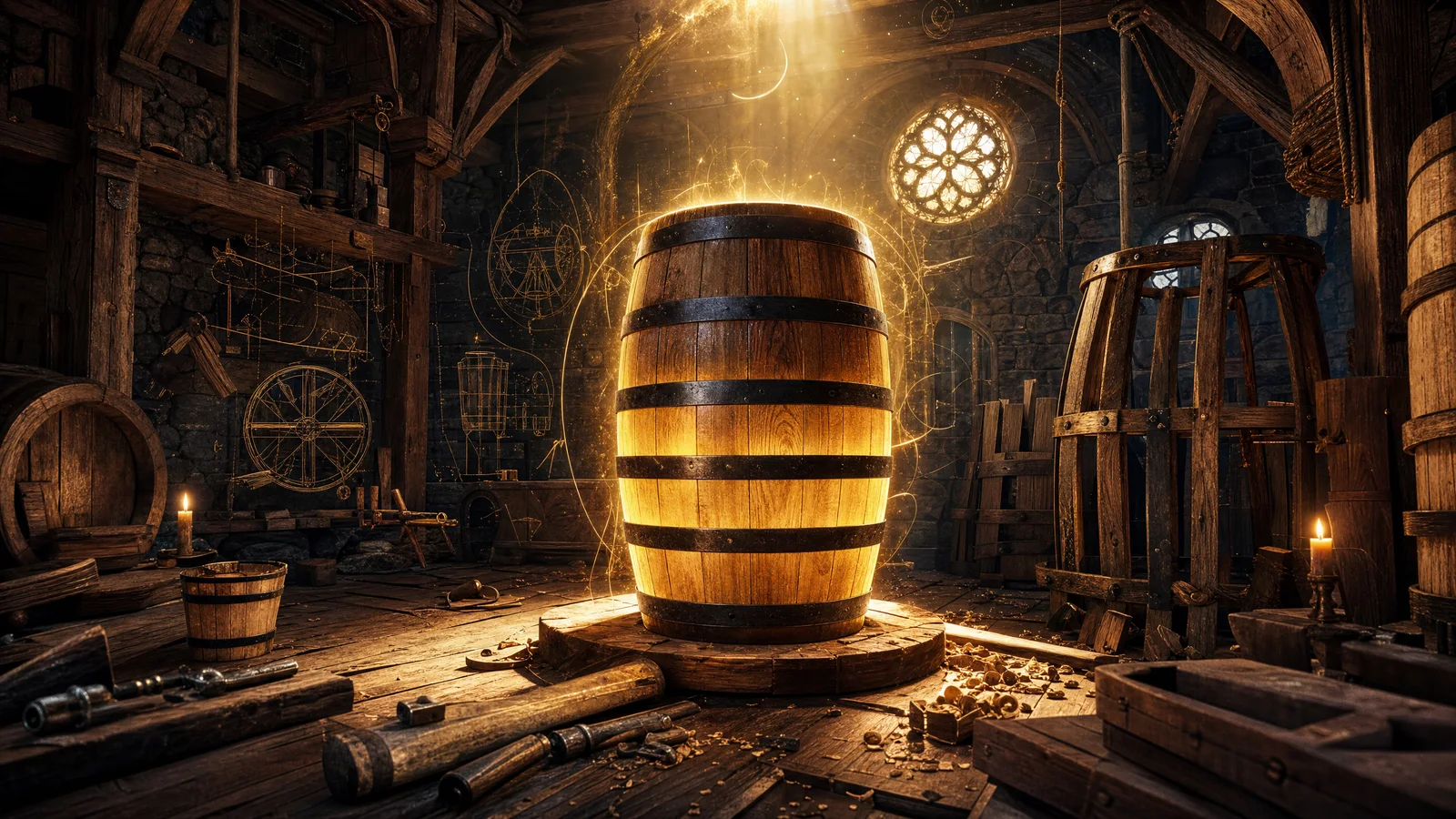
The Complete Coopering, Barrel Making, and Wooden Vessel Construction Guide
A Sovereignty Module of the Practitioner Community
Preamble
Before plastic, glass, and metal containers, barrels stored everything: water, wine, beer, vinegar, oil, flour, salt, gunpowder, and salted meat. A well-made barrel is watertight without glue or sealant — the wood swells when wet, sealing every joint. Coopering (barrel making) is one of the most skilled traditional trades. This campaign covers stave preparation, hoop fitting, assembly, and barrel types.
Part I: Barrel Fundamentals
Chapter 1: Barrel Types
| Type | Use | Watertight | Wood | Size Range |
|---|---|---|---|---|
| Tight (wet) barrel | Liquids: water, wine, beer, oil, vinegar | Yes | White oak (best), chestnut | 5-60 gallons |
| Slack (dry) barrel | Dry goods: flour, grain, salt, nails | No (close-fitting but not sealed) | Any hardwood | 10-55 gallons |
| Bucket/pail | Carrying water, milking | Yes | White oak, cedar | 2-5 gallons |
| Tub/vat | Washing, fermenting, soaking | Yes | White oak, cedar | 10-100+ gallons |
| Cask | Aging spirits, wine | Yes | White oak (charred interior for spirits) | 5-65 gallons |
Chapter 2: Stave Preparation
| Step | Action | Details |
|---|---|---|
| 1. Select wood | White oak for tight coopering (tyloses seal pores) | Quarter-sawn for strength and water resistance |
| 2. Rive (split) staves | Split log along grain with froe and mallet | Splitting follows grain = stronger than sawing |
| 3. Shape staves | Taper both ends (barrel shape) and bevel edges | Edges must angle inward so staves form a circle |
| 4. Joint edges | Plane edges to precise angle with jointer plane | Each stave edge must mate perfectly with neighbors |
| 5. Season | Air dry 1-3 years (tight coopering) | Kiln drying acceptable for slack coopering |
| 6. Hollow inside | Scoop slight concavity on inside face | Allows staves to bend into barrel curve |
Chapter 3: Assembly Process
| Step | Action | Key Detail |
|---|---|---|
| 1. Raise staves | Stand staves in raising hoop (temporary large hoop) | Arrange by width — alternate wide and narrow |
| 2. Drive truss hoops | Hammer temporary hoops down to pull staves together | Work from top down, gradually tightening |
| 3. Fire and bend | Heat open end over fire (or steam), drive hoops to close | Wood becomes pliable when heated. Work quickly. |
| 4. Plane ends | Level both ends of barrel with topping plane | Must be perfectly flat for heads (lids) |
| 5. Cut croze | Groove inside barrel near each end for head to sit in | Use croze tool (specialized groove-cutting plane) |
| 6. Fit heads | Assemble head from boards with dowels, cut to circle, bevel edge | Head fits into croze groove |
| 7. Insert heads | Remove one end hoop, spring head into croze, replace hoop | Head is held by groove and hoop pressure |
| 8. Fit permanent hoops | Replace temporary hoops with permanent iron or wood hoops | Drive tight. Hoops compress staves for watertight seal. |
| 9. Bung hole | Drill hole in belly stave for filling/emptying | Fit with tapered bung (plug) |
Chapter 4: The Practitioner Coopering Reference Card
WHITE OAK FOR LIQUID: White oak has tyloses (cellular plugs) that make it naturally watertight. Red oak, maple, and other woods leak. For liquid storage, white oak is the only choice.
SPLIT, DON'T SAW: Riving (splitting) staves along the grain produces stronger, more water-resistant staves than sawing. The grain runs unbroken from end to end.
HOOPS CREATE THE SEAL: A barrel has no glue, no caulk, no sealant. The hoops compress the staves together. When the barrel is filled with liquid, the wood swells and the seal becomes absolute.
CHARRING FOR SPIRITS: Charring the inside of an oak barrel creates a carbon filter layer and caramelizes wood sugars. This is what gives whiskey, bourbon, and brandy their color and flavor.
REMEMBER: A barrel is a precision instrument made from split wood and iron hoops. It stores liquid indefinitely, can be rolled for transport, stacks efficiently, and lasts 50-100 years. A Practitioner who can cooper a barrel has permanent, portable, watertight storage for any liquid or dry good.
Council Approval
All 12 voices unanimously approve. Complete wooden vessel sovereignty.
Council Result: 12/12 APPROVED. Campaign 101 is complete.