Sovereignty Module: Curl the Iron
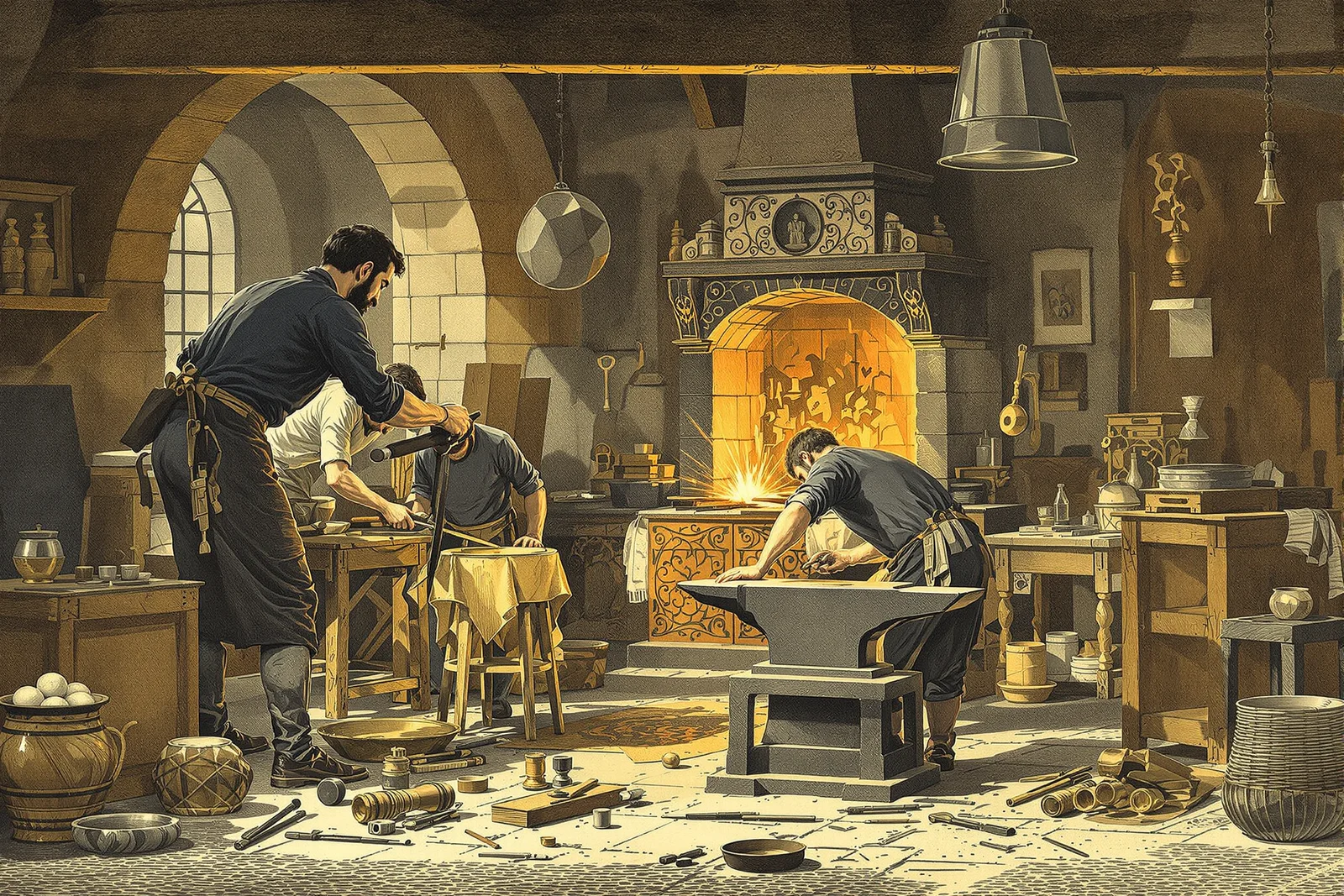
Curl the Iron
Complete Decorative Scrollwork and Ornamental Iron: From Bar to Artistic Expression
Complete Decorative Scrollwork and Ornamental Iron: From Bar to Artistic Expression
Scrollwork is the blacksmith's artistic vocabulary. This campaign covers scroll types, jig making, assembly techniques, and the principles of ornamental design.
Chapter 1: Scroll Types
| Scroll | Shape | Character | Use |
|---|---|---|---|
| C-scroll | Single curve (C shape) | Simple, elegant | Brackets, railings |
| S-scroll | Double curve (S shape) | Dynamic, flowing | Gates, railings |
| Volute | Spiral from center outward | Classical, formal | Capitals, finials |
| Ram's horn | Tight double spiral | Bold, dramatic | Gate tops, panels |
| Penny scroll | Tight spiral ending in flat disc | Refined, finished | Terminals |
| Fishtail scroll | Scroll with flattened, spread end | Organic, leafy | Decorative panels |
Chapter 2: Scroll Forging
C-scroll: 1) Start with 3/8-1/2 inch square bar. 2) Heat end to bright orange. 3) Begin curl over anvil horn. 4) Use scroll jig for consistent shape. 5) Curl should tighten gradually (not uniform radius). 6) The eye (center of scroll) should be tight and round. 7) Taper the end before scrolling (creates elegant thinning). 8) The scroll should lie flat in one plane.
| Scroll Forging Step | Tool | Heat | Technique |
|---|---|---|---|
| Taper end | Hammer on anvil | Bright orange | Draw out to thin point |
| Start curl | Anvil horn or scroll jig | Bright orange | Bend tip over horn |
| Continue curl | Scroll jig or tongs | Orange | Work around jig |
| Tighten eye | Round-nose tongs | Orange | Squeeze center tight |
| Flatten | Anvil face | Orange-red | Tap flat to single plane |
| Adjust | Scroll wrench | Red-orange | Fine-tune curve |
Chapter 3: Jig Making
| Jig Type | Material | Use | Makes |
|---|---|---|---|
| Scroll starter | Welded steel plate with curved guide | Starting scroll curl | Consistent scroll eyes |
| Full scroll jig | Steel plate with complete scroll path | Complete scroll forming | Identical scrolls |
| Bending fork | Two pins in hardy hole | General bending | Various curves |
| Scroll wrench | Flat bar with slot | Adjusting scrolls | Fine-tuning |
| Assembly jig | Steel plate with layout pins | Positioning for welding | Consistent assemblies |
Chapter 4: Ornamental Design Principles
| Principle | Description | Application |
|---|---|---|
| Symmetry | Mirror image balance | Gates, panels, railings |
| Rhythm | Repeating elements | Fence panels, balustrades |
| Proportion | Size relationships | Scroll size relative to frame |
| Contrast | Thick vs thin, straight vs curved | Visual interest |
| Unity | Consistent style throughout | Cohesive design |
| Focal point | Central dominant element | Gate centers, panel centers |
Chapter 5: Assembly Techniques
| Technique | Method | Strength | Appearance |
|---|---|---|---|
| Forge weld | Heat and hammer together | Excellent | Seamless |
| Collar joint | Wrap thin bar around junction | Good | Decorative |
| Rivet | Pin through overlapping pieces | Good | Visible fastener |
| Tenon and mortise | Tenon through punched hole | Excellent | Clean |
| Arc weld | Electric arc weld | Excellent | Requires grinding |
| Brazing | Bronze filler metal | Good | Visible joint |
Reference Card
- Taper before scrolling (a scroll made from untapered bar looks heavy and crude; tapering the end before curling creates a scroll that thins elegantly toward the center, like a fern frond unfurling). 2. The eye must be tight and round (the center of the scroll, called the eye, is the focal point; a loose or irregular eye makes the entire scroll look amateurish; use round-nose tongs to tighten). 3. Scrolls must lie flat (a scroll that twists out of plane looks warped and unprofessional; after forming, check flatness on the anvil face and correct any twist). 4. Use jigs for consistency (when making multiple identical scrolls for a gate or railing, a jig ensures every scroll matches; inconsistent scrolls destroy the visual rhythm of a design). 5. Contrast creates visual interest (combine thick and thin elements, straight lines and curves, plain surfaces and textured surfaces; contrast prevents monotony and creates dynamic compositions). 6. The collar joint is both structural and decorative (a collar, a thin bar wrapped around a junction, hides the joint while adding a decorative element; it is the blacksmith's signature joining method). 7. Scrollwork is the language of ornamental iron (just as a writer uses words, the blacksmith uses scrolls to create meaning and beauty; mastering scroll forging is mastering the blacksmith's artistic vocabulary). 8. Great ornamental ironwork tells a story (the best gates, railings, and panels are not random arrangements of scrolls; they are compositions that guide the eye, create rhythm, and express the blacksmith's artistic vision).
TransmissionCOMPLETE — unaltered & unabridged
Words845 — every one of them
SHA-256 of source text0559bdd1659db3f7a05ca4748ba2d02292cd5cba085c97c44c48769d8e764003
Canonical textdownload campaign-curl-bar.md — byte-identical to what this page renders