Sovereignty Module: Hold the Water
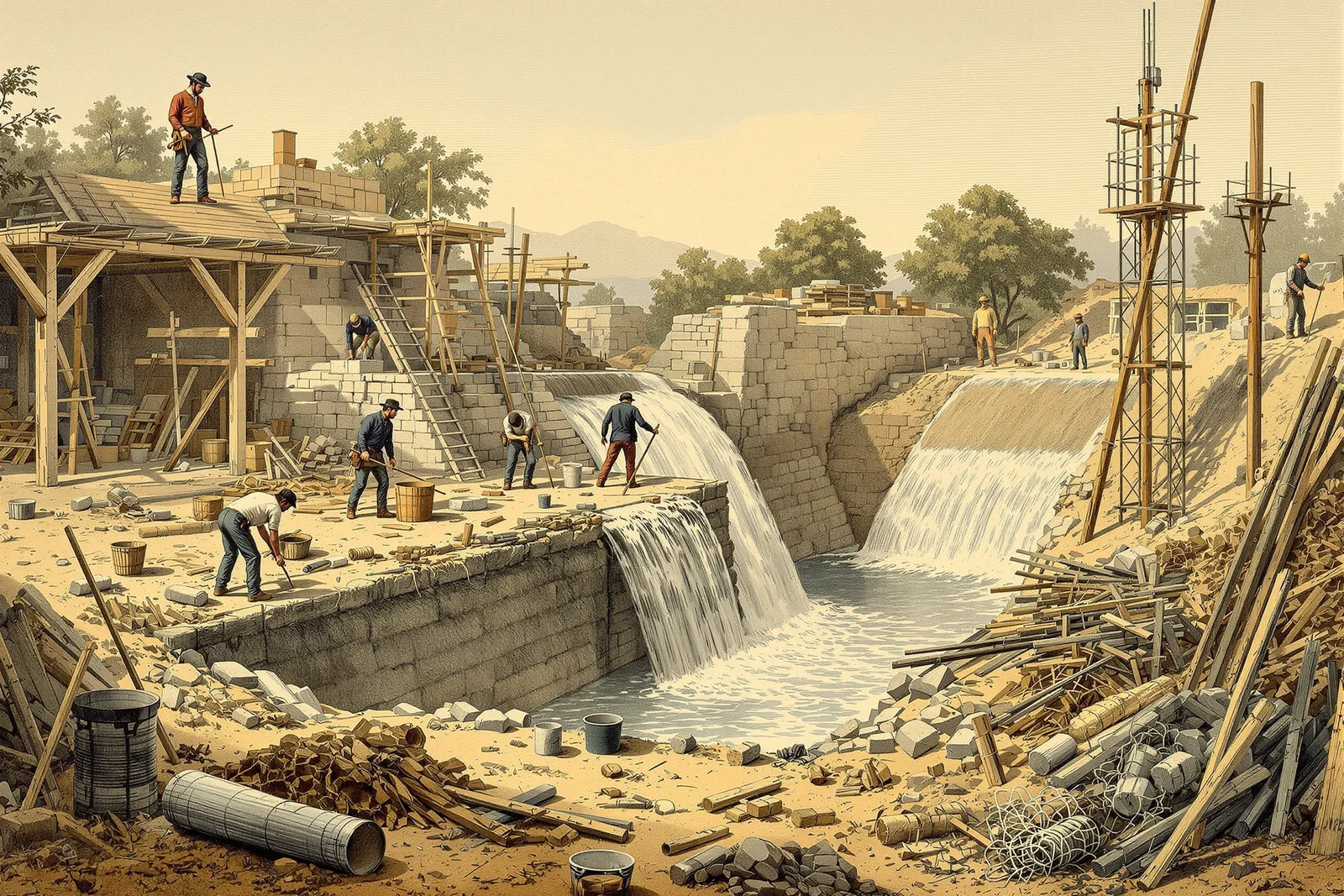
Hold the Water
Complete Earthen Dam, Pond Construction, and Water Impoundment Guide
Complete Earthen Dam, Pond Construction, and Water Impoundment Guide
Water storage transforms marginal land into productive farmland. This campaign covers site selection, dam design, construction, and management for irrigation, fish, and livestock.
Chapter 1: Pond Types and Applications
| Type | Size | Depth | Primary Use | Water Source | Construction |
|---|---|---|---|---|---|
| Farm pond (embankment) | 0.5-5 acres | 8-15 feet | Irrigation, livestock, fish | Runoff + springs | Earth dam across drainage |
| Dugout pond | 0.1-1 acre | 8-12 feet | Livestock, small irrigation | Groundwater + runoff | Excavated below grade |
| Spring-fed pond | 0.1-2 acres | 6-10 feet | Fish, irrigation | Spring flow | Dam or excavation at spring |
| Swale pond (keyline) | 0.01-0.5 acres | 3-6 feet | Infiltration, trees | Runoff | Contour swale with dam |
| Rice paddy | 0.1-2 acres | 4-8 inches | Rice growing | Irrigation/rain | Leveled, bermed fields |
Chapter 2: Site Selection
| Factor | Ideal | Acceptable | Avoid |
|---|---|---|---|
| Soil (dam material) | 20-30% clay content | 15-40% clay | Pure sand or gravel (won't hold water) |
| Drainage area | 4-10 acres per acre-foot of storage | 3-15 acres per acre-foot | Too small (won't fill) or too large (overwhelms spillway) |
| Slope | Gentle valley (narrow point for dam) | Moderate slopes | Steep terrain (unstable, expensive) |
| Foundation | Clay or tight soil to bedrock | Moderate permeability | Limestone, fractured rock, gravel (leaks) |
| Spillway route | Natural low point away from dam | Constructable route | No safe overflow path (dam failure risk) |
| Depth to bedrock | 10+ feet | 5+ feet | Shallow bedrock (can't key in dam) |
Chapter 3: Earthen Dam Design
| Component | Specification | Purpose | Critical Rules |
|---|---|---|---|
| Core (center) | Best clay available, compacted in 6-inch lifts | Waterproof barrier | Must extend below original ground level (cutoff trench) |
| Upstream slope | 3:1 (3 feet horizontal per 1 foot vertical) | Stability against water pressure | Protect with riprap or grass |
| Downstream slope | 2.5:1 to 3:1 | Stability, drainage | MUST be grass-covered (erosion protection) |
| Top width | Minimum 8-12 feet | Access road, structural mass | Wider = safer (more mass) |
| Freeboard | 3-5 feet above normal water level | Safety margin for storms | Never allow water to overtop dam |
| Cutoff trench | 2-4 feet deep into solid clay/bedrock | Prevents seepage under dam | Most critical element — leaks under dam = failure |
| Spillway | Sized for 25-100 year storm | Safe overflow without overtopping dam | Must be AWAY from dam (usually around end) |
| Drain pipe (optional) | 6-12 inch pipe through dam base with valve | Drain pond for maintenance | Anti-seep collars every 10-15 feet along pipe |
Chapter 4: Construction Procedure
| Step | Action | Equipment | Critical Notes |
|---|---|---|---|
| 1 | Clear dam site (remove all topsoil, roots, organic material) | Dozer or hand labor | ANY organic material in dam = future failure point |
| 2 | Dig cutoff trench (2-4 feet into solid clay) | Backhoe or hand | Key the dam into impervious layer below |
| 3 | Install drain pipe (if desired) with anti-seep collars | Pipe, concrete collars | Collars prevent water from following pipe through dam |
| 4 | Fill cutoff trench with best clay, compact in 6-inch lifts | Compactor or vehicle traffic | Each lift must be compacted to 95%+ density |
| 5 | Build dam in 6-inch lifts, compact each lift | Dozer, sheepsfoot roller | Moisture content critical: slightly wet of optimum |
| 6 | Shape final slopes (3:1 upstream, 2.5:1 downstream) | Dozer or hand | Smooth, no depressions that hold water |
| 7 | Construct spillway (armored channel around dam end) | Excavation + riprap | Must handle 25-year storm without dam overtopping |
| 8 | Seed dam with grass immediately | Grass seed + mulch | Erosion is #1 killer of new dams. Establish grass fast. |
| 9 | Fill slowly (first filling takes months) | Natural runoff | Monitor for seepage, settlement, erosion |
Chapter 5: Spillway Design
| Storm Return Period | Use Case | Sizing Rule |
|---|---|---|
| 10-year storm | Small farm pond, low hazard | Minimum acceptable for rural ponds |
| 25-year storm | Standard farm pond | Recommended minimum for most applications |
| 50-year storm | Pond above roads/buildings | Required when downstream damage is possible |
| 100-year storm | Pond above homes/infrastructure | Required by most dam safety regulations |
Spillway types: 1. Vegetated channel (grass waterway): cheapest, works for small ponds. Must be wide and shallow. 2. Riprap channel: armored with rock. Handles higher flows. 3. Concrete weir: precise control, expensive, permanent. 4. Drop inlet (pipe through dam): controlled drainage, doubles as emergency spillway.
Chapter 6: Pond Management
| Task | Frequency | Purpose | Method |
|---|---|---|---|
| Dam inspection | Monthly + after storms | Detect seepage, erosion, animal damage | Walk entire dam, check for wet spots downstream |
| Mow dam | Monthly (growing season) | Prevent woody growth (roots damage dam) | Mow to 4-6 inches. NEVER allow trees on dam. |
| Spillway maintenance | Seasonally | Ensure clear flow path | Remove debris, check erosion, repair armoring |
| Sediment monitoring | Annually | Track storage loss | Measure depth at multiple points |
| Fish management | Annually | Maintain healthy population | Stock, harvest, test water quality |
| Weed control | As needed | Prevent excessive aquatic growth | Mechanical removal, grass carp, or drawdown |
Reference Card
- Dam soil: 20-30% clay content. Test: form ball, drop from 3 feet — should flatten, not shatter.
- Cutoff trench: MOST CRITICAL element. Dig 2-4 feet into solid clay below dam. Prevents underseepage.
- Compact in 6-inch lifts. Each lift at optimum moisture (slightly wet). Roll or drive over repeatedly.
- NEVER allow trees/shrubs on dam. Roots create seepage paths. Mow regularly. Grass only.
- Spillway: must handle 25-year storm minimum. Route AWAY from dam (around end, not over top).
- Freeboard: 3-5 feet above normal water level. Water overtopping dam = catastrophic failure.
- Upstream slope 3:1, downstream slope 2.5:1 minimum. Top width 8-12 feet minimum.
- First sign of failure: wet spot on downstream face. Act immediately — investigate and repair.
TransmissionCOMPLETE — unaltered & unabridged
Words1,124 — every one of them
SHA-256 of source textd0b665f67d2fe5f73f98131e7076eacd81ce5749eb12324635a4ad31500af986
Canonical textdownload campaign-dams-ponds.md — byte-identical to what this page renders