Sovereignty Module: Break the Stone
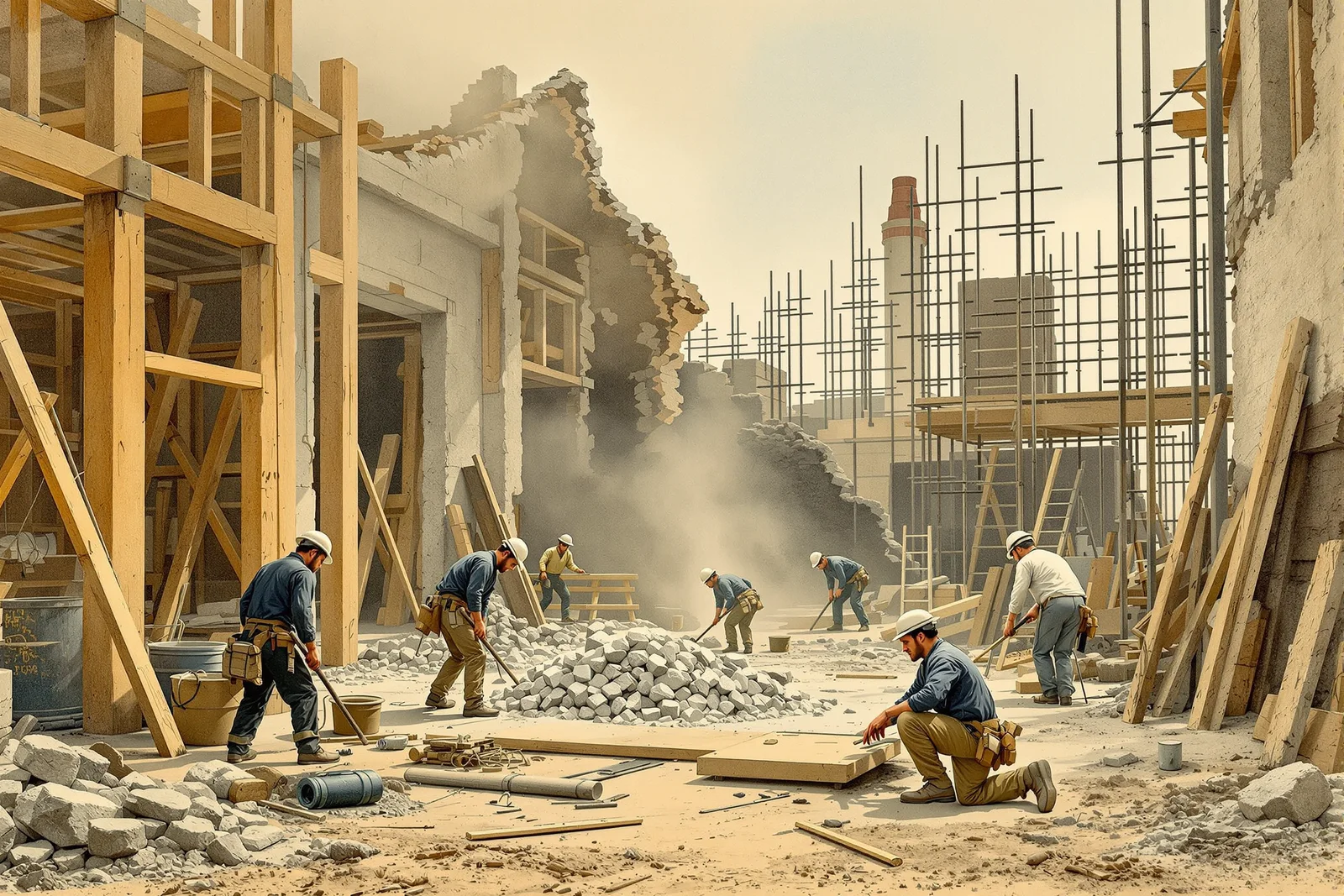
Complete Explosives, Blasting, and Controlled Demolition Guide
Explosives are tools of construction, not destruction. They clear land, break rock for mining and quarrying, demolish unsafe structures, create road cuts, and build foundations. This campaign covers the chemistry, production, safe handling, and application of explosives for righteous construction purposes.
Chapter 1: Explosive Types
| Type | Velocity of Detonation | Initiation | Primary Use |
|---|---|---|---|
| Black powder (low explosive) | 400 m/s (deflagrates, does not detonate) | Flame, spark, friction | Blasting (quarry), propellant, fuse |
| Dynamite | 5,000-6,000 m/s | Blasting cap (detonator) | Rock blasting, mining, construction |
| ANFO (ammonium nitrate + fuel oil) | 4,500 m/s | Booster + detonator | Large-scale quarrying, mining |
| Nitroglycerin | 7,700 m/s | Shock, heat (very sensitive) | Component of dynamite (stabilized) |
| TNT | 6,900 m/s | Detonator | Military, demolition |
| Blasting gelatin | 7,000-8,000 m/s | Detonator | Underwater, wet conditions |
Chapter 2: Black Powder for Blasting
Same composition as ammunition powder (75% potassium nitrate, 15% charcoal, 10% sulfur) but used in larger quantities and coarser granulation (Fg or cannon grade).
| Application | Charge Size | Hole Diameter | Hole Depth | Stemming |
|---|---|---|---|---|
| Boulder breaking | 1-4 oz per hole | 1 inch | 6-12 inches | Tamp with clay/sand |
| Rock face (quarry) | 1-5 lbs per hole | 1.5-2 inches | 3-6 feet | Clay plug, 12+ inches |
| Stump removal | 1-2 lbs under stump | Multiple holes around base | Below root ball | Soil backfill |
| Ditch blasting (soft ground) | 1-3 lbs per charge, spaced 3-5 feet | 2-3 inches | 2-4 feet | Minimal (propagation) |
Chapter 3: Fuse and Initiation
| Type | Speed | Use | Construction |
|---|---|---|---|
| Safety fuse (Bickford) | 30-40 seconds per foot | Time delay, black powder charges | Core of black powder in textile wrapping, waterproofed |
| Quick match | Near-instantaneous | Connecting multiple charges | Black powder on cotton string, in paper tube |
| Electric detonator | Instantaneous (on command) | Precise timing, remote firing | Wire to bridge wire in explosive charge |
| Blasting cap (plain) | Instantaneous when fuse reaches it | Initiates high explosives | Small metal tube with primary explosive |
Safety fuse burn rate MUST be tested before use (cut 1 foot, time the burn). Never trust printed specifications without verification.
Chapter 4: Drilling Blast Holes
| Method | Equipment | Rate in Hard Rock | Hole Diameter |
|---|---|---|---|
| Hand steel (hammer and chisel) | Drill steel, sledgehammer | 6-12 inches/hour | 1-1.5 inches |
| Star drill (rotary hand) | Star-point drill bit, hammer | 12-24 inches/hour | 1-2 inches |
| Pneumatic (jackhammer) | Compressor, jackhammer | 3-6 feet/hour | 1.5-3 inches |
| Rotary drill | Engine-powered drill | 5-15 feet/hour | 2-6 inches |
Hand drilling technique: One person holds and rotates the drill steel 1/4 turn between each hammer blow. Second person strikes with sledgehammer. Pour water in hole periodically to flush cuttings and cool the bit.
Chapter 5: Blast Pattern Design
| Pattern | Hole Spacing | Burden (distance to free face) | Use |
|---|---|---|---|
| Single hole | N/A | 2/3 of hole depth | Single boulder, small job |
| Line drilling | 2-3 feet | 2-4 feet | Trench, road cut |
| Square pattern | 4-6 feet | 3-5 feet | Bench blasting (quarry) |
| Staggered pattern | 4-6 feet | 3-5 feet | Better fragmentation |
| V-cut (tunnel) | Converging holes | Center of face | Tunnel advance |
Burden rule: distance from charge to nearest free face should be 25-35x the charge diameter. Too little burden = flyrock danger. Too much burden = poor breakage.
Chapter 6: Loading and Firing
| Step | Action | Safety Rule |
|---|---|---|
| 1 | Drill holes to plan | Never drill into a misfired hole |
| 2 | Clean holes (blow out cuttings) | Check for water (may need waterproof explosive) |
| 3 | Load primer (charge with detonator/fuse) | Gently lower, never drop or force |
| 4 | Load remaining explosive | Tamp gently with wooden rod (NEVER metal) |
| 5 | Stem hole (plug with clay/sand) | Minimum 12 inches stemming (confines blast) |
| 6 | Connect fuse/wire | Check all connections |
| 7 | Clear blast area | Minimum 500 feet for surface, all personnel accounted for |
| 8 | Sound warning (3 blasts of horn) | Wait for all-clear confirmation |
| 9 | Fire | From protected position |
| 10 | Wait (minimum 5 minutes after last shot) | Misfires may have delayed ignition |
| 11 | Inspect | Check for misfires before approaching |
Chapter 7: Controlled Demolition
| Structure | Method | Key Principle |
|---|---|---|
| Concrete wall | Drill pattern, small charges at rebar spacing | Cut rebar with charges, wall falls |
| Steel beam | Linear shaped charge or cutting torch | Sever at connection points |
| Brick chimney | Charges at base on one side | Falls toward the weakened side |
| Bridge pier | Charges at waterline and base | Remove support, gravity does the rest |
| Tree (large) | Bore hole at base, small charge | Equivalent to directional felling cut |
Chapter 8: Safety Protocols
| Rule | Reason |
|---|---|
| Never carry detonators and explosives together | Prevent accidental initiation |
| Store explosives in locked, ventilated, dry magazine | Prevent theft, deterioration, accident |
| Never use metal tools to tamp charges | Metal can spark and initiate explosive |
| Always account for all explosives (inventory) | Prevent theft or loss |
| Never return to a misfire for 30 minutes (fuse) or 1 hour (electric) | Delayed detonation risk |
| Post guards during blasting operations | Prevent entry to danger zone |
| Never smoke near explosives | Obvious |
| Destroy deteriorated explosives (burn in small quantities, never in bulk) | Old explosives become unstable |
Reference Card
- Black powder (75/15/10) is sufficient for most quarrying and construction blasting
- Always test fuse burn rate before use (cut 1 foot, time it)
- Burden (distance to free face) = 25-35x charge diameter
- NEVER tamp with metal tools; use wooden rods only
- Minimum stemming (plug) = 12 inches of clay or sand above the charge
- Clear area minimum 500 feet; sound 3 warning blasts before firing
- Wait minimum 5 minutes after last shot before approaching (30 min for misfires)
- Store detonators and explosives separately; never carry together