Sovereignty Module: Capture the Light
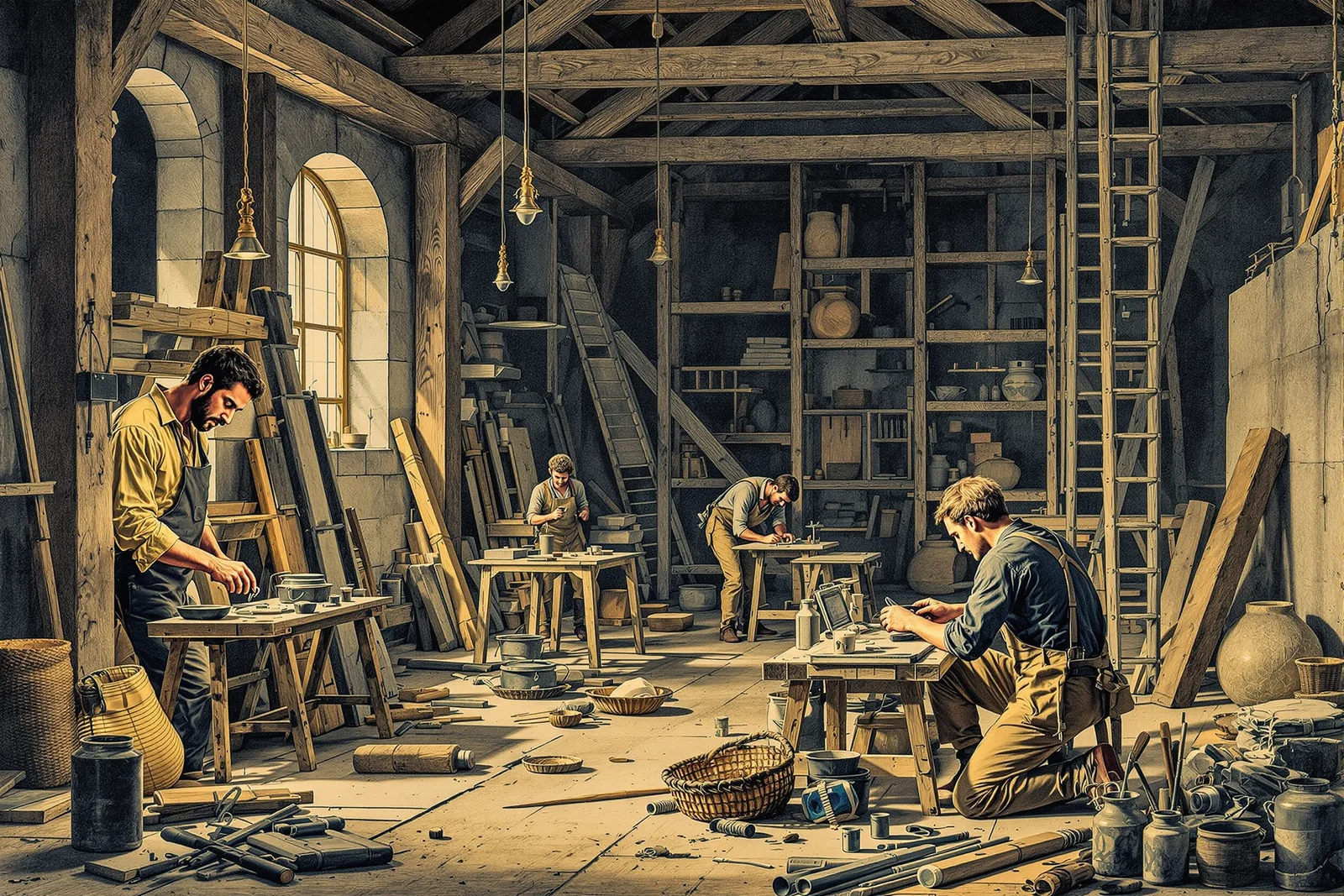
Capture the Light
Complete Photography, Camera Construction, and Darkroom Processing Guide
Complete Photography, Camera Construction, and Darkroom Processing Guide
Photography documents knowledge, records events, enables science, and preserves memory. This campaign covers building cameras from scratch, producing photosensitive materials, and developing photographs using basic chemistry.
Chapter 1: Camera Types
| Type | Complexity | Image Quality | Best For |
|---|---|---|---|
| Pinhole camera | Minimal (box + tiny hole) | Soft, infinite depth of field | Learning, art, long exposures |
| Camera obscura | Low (box + lens) | Good (with quality lens) | Drawing aid, projection |
| Plate camera (large format) | Moderate | Excellent (large negative) | Portraits, landscapes, documentation |
| Box camera (roll film) | Moderate | Good | General photography |
| View camera (bellows) | High | Excellent (adjustable) | Architecture, precision work |
Chapter 2: Pinhole Camera Construction
| Component | Material | Specification |
|---|---|---|
| Body | Light-tight box (wood, metal, or cardboard painted black inside) | Any size; larger = larger image |
| Pinhole | Thin metal (aluminum foil, brass shim) | 0.3-0.5mm diameter (smaller = sharper but dimmer) |
| Film/paper holder | Flat surface inside box opposite pinhole | Holds photosensitive material flat |
| Shutter | Flap of opaque material over pinhole | Manual open/close |
Exposure times: Bright sun: 1-5 seconds (fast paper), 1-30 seconds (film). Overcast: 10-60 seconds. Indoor: minutes to hours. Pinhole cameras require long exposures but produce unique images with infinite depth of field.
Chapter 3: Photosensitive Materials
| Material | Sensitivity | Resolution | Availability | Process |
|---|---|---|---|---|
| Silver chloride paper | Low (contact printing) | Moderate | Make from silver nitrate + salt | Print-out (darkens in light) |
| Silver bromide emulsion | High (camera use) | High | Silver nitrate + potassium bromide in gelatin | Develop in chemical bath |
| Cyanotype (blueprint) | Moderate | Low-moderate | Ferric ammonium citrate + potassium ferricyanide | Wash in water |
| Albumen print | Low | High | Egg white + silver nitrate | Contact print, gold tone |
| Collodion (wet plate) | High | Very high | Collodion + silver nitrate on glass | Process while wet (10-15 min window) |
Chapter 4: Silver Gelatin Emulsion (Standard Film/Paper)
| Step | Action | Chemical |
|---|---|---|
| 1 | Dissolve gelatin in warm water | Food-grade gelatin |
| 2 | Add potassium bromide solution | KBr dissolved in water |
| 3 | Add silver nitrate solution slowly while stirring | AgNO3 dissolved in water |
| 4 | Silver bromide crystals form in gelatin (light-sensitive) | AgBr (the active ingredient) |
| 5 | Wash emulsion (remove excess chemicals) | Running water |
| 6 | Reheat and coat onto paper or glass | Warm, pour/brush in darkroom |
| 7 | Dry in complete darkness | Air dry, dark |
All steps after adding silver nitrate must be done in darkness or under red safelight.
Chapter 5: Darkroom Processing
| Step | Chemical | Time | Temperature | Purpose |
|---|---|---|---|---|
| Develop | Metol + hydroquinone + sodium sulfite + sodium carbonate | 5-10 minutes | 68F (20C) | Converts exposed silver halide to metallic silver (image appears) |
| Stop bath | Dilute acetic acid (vinegar works) | 30 seconds | 68F | Stops development instantly |
| Fix | Sodium thiosulfate (hypo) | 5-10 minutes | 68F | Dissolves unexposed silver halide (makes image permanent) |
| Wash | Running water | 20-30 minutes | Any | Removes all chemicals |
| Dry | Air | Until dry | Room temperature | Final step |
Chapter 6: Chemical Sources
| Chemical | Source | Use |
|---|---|---|
| Silver nitrate | Dissolve silver in nitric acid (silver coins + acid) | Light-sensitive compound |
| Potassium bromide | Chemical supply or extract from seawater/brine | Forms silver bromide |
| Sodium thiosulfate (hypo) | Chemical supply; also found in some hot springs | Fixer |
| Acetic acid | Vinegar (5% acetic acid) | Stop bath |
| Sodium sulfite | Chemical supply or reduce sodium bisulfite | Developer preservative |
| Hydroquinone | Chemical supply; historically from quinone | Developer agent |
| Ferric ammonium citrate | Chemical supply | Cyanotype sensitizer |
| Potassium ferricyanide | Chemical supply | Cyanotype sensitizer |
Chapter 7: Cyanotype Process (Simplest)
| Step | Action | Details |
|---|---|---|
| 1 | Mix Solution A: ferric ammonium citrate in water | 25g per 100ml |
| 2 | Mix Solution B: potassium ferricyanide in water | 10g per 100ml |
| 3 | Combine equal parts A + B (in dim light) | Mix just before use |
| 4 | Coat paper with combined solution | Brush evenly, dry in dark |
| 5 | Place negative or objects on coated paper | Contact printing (direct contact) |
| 6 | Expose to sunlight (10-30 minutes) | Paper turns dark blue-gray where light hits |
| 7 | Wash in running water (5 minutes) | Unexposed areas wash away (white); exposed areas = Prussian blue |
| 8 | Dry | Result: blue and white print (blueprint) |
Reference Card
- A pinhole camera is a light-tight box with a tiny hole: no lens needed, infinite depth of field
- Silver bromide in gelatin is the standard photographic emulsion (light-sensitive)
- All silver-based processes require darkness after sensitizing (work under red safelight)
- Developer makes the image appear; fixer makes it permanent; washing removes chemicals
- Cyanotype (blueprint) is the simplest photographic process: two chemicals, sunlight, water
- Silver nitrate is made by dissolving silver (coins, jewelry) in nitric acid
- Exposure times for pinhole: seconds in bright sun, minutes in shade, hours indoors
- Photography enables documentation of knowledge, events, medical conditions, and maps
TransmissionCOMPLETE — unaltered & unabridged
Words993 — every one of them
SHA-256 of source textada0fc778fe4c3ab498862f94b91b6e4f8eb19978e65234db075f72d1d528405
Canonical textdownload campaign-photography.md — byte-identical to what this page renders