Sovereignty Module: Draw the Blade
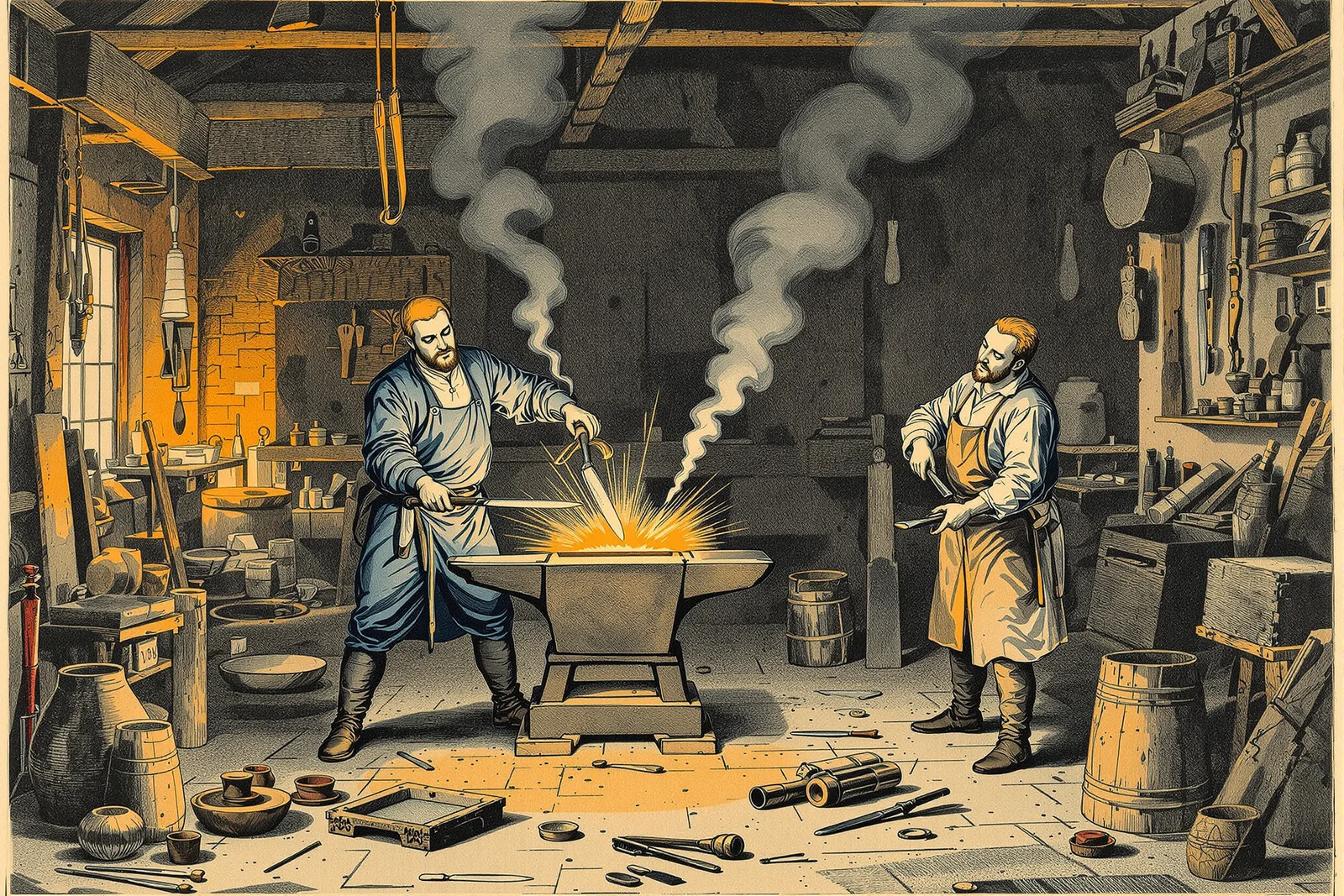
Complete Draw Knife and Shaving Tool Forging: From Bar to Shave
The draw knife is one of the most versatile woodworking tools, used for shaping chair legs, shingles, barrel staves, and timber framing. This campaign covers draw knife forging, spokeshave making, and edge geometry.
Chapter 1: Shaving Tool Types
| Tool | Blade Length | Use | Difficulty | Material Removal |
|---|---|---|---|---|
| Draw knife (standard) | 8-12 inches | General shaping, debarking, shingles | Moderate | Heavy |
| Draw knife (small/inshave) | 4-6 inches | Curved work, bowl interiors | Moderate | Moderate |
| Spokeshave (flat) | 2-3 inches | Smoothing flat and convex surfaces | Moderate-high | Light-moderate |
| Spokeshave (round) | 2-3 inches | Smoothing concave surfaces | Moderate-high | Light-moderate |
| Scorp (curved draw knife) | 3-6 inches | Hollowing bowls, seats | Moderate | Moderate-heavy |
| Froe | 8-12 inches | Splitting shingles, staves | Low-moderate | N/A (splitting) |
Chapter 2: Draw Knife Forging
Draw knife forging process: 1) Start with high carbon steel bar (1/4 x 1.5 inch, 16-20 inches long). 2) Mark center 8-12 inches for blade. 3) Heat one end to bright orange. 4) Draw out tang: taper from blade width to 3/8 inch round, 4-5 inches long. 5) Bend tang 90 degrees (perpendicular to blade). 6) Repeat for opposite end. 7) Both tangs bend the same direction (toward user when cutting). 8) Shape blade: even thickness (3/32-1/8 inch at edge). 9) Grind bevel on one side (flat back, beveled front). 10) Heat treat: harden blade section only (not tangs). 11) Temper to straw/dark straw (400-430°F). 12) Forge or fit handles on tangs (wood, 4-5 inches long).
| Component | Dimension | Material | Notes |
|---|---|---|---|
| Blade | 8-12 inches long, 1.5 inches wide | High carbon steel (1075, 1084) | Flat back, single bevel |
| Tangs | 4-5 inches long, 3/8 inch round | Same bar (drawn out) | Bent 90° same direction |
| Handles | 4-5 inches long, 1-1.5 inch diameter | Hardwood (maple, cherry) | Drilled for tang, peened or epoxied |
| Bevel angle | 25-30 degrees | N/A | Single bevel (flat back) |
Chapter 3: Spokeshave Forging
| Component | Material | Purpose | Specification |
|---|---|---|---|
| Body | Cast iron or hardwood | Holds blade, provides grip | 8-10 inches wide, ergonomic |
| Blade (iron) | High carbon steel | Cutting edge | 2-3 inches wide, 1/8 inch thick |
| Cap iron | Mild steel | Holds blade, breaks chip | Matches blade width |
| Adjustment mechanism | Thumbscrews or wedge | Set blade depth | Fine adjustment preferred |
| Sole (flat or curved) | Part of body | Reference surface | Flat for convex work, curved for concave |
Wooden spokeshave: 1) Select dense hardwood block (maple, beech) 9x2x1.5 inches. 2) Shape ergonomic handles on each end. 3) Cut blade slot (mortise) through center. 4) Blade slot angled at 45 degrees (bevel down). 5) Mouth opening: 1/16 inch (tight for fine shaving). 6) Forge blade from high carbon steel (2.5 inches wide). 7) Harden and temper blade (straw). 8) Fit blade into slot, secure with wedge or cap iron. 9) Adjust blade depth by tapping (deeper = more aggressive cut).
Chapter 4: Froe Forging
Froe forging: 1) Start with high carbon steel bar (1/4 x 2 inch, 10-14 inches long). 2) Forge eye on one end (wrap around mandrel, forge weld). 3) Eye is perpendicular to blade (handle sticks up, blade extends horizontally). 4) Blade remains flat and wide (splitting tool, not cutting). 5) Grind single bevel on blade (30-35 degrees). 6) Heat treat: harden and temper to bronze/purple (tougher than a knife). 7) Handle: straight hardwood, 14-18 inches, inserted through eye. 8) Use: place froe on end grain, strike with froe club (wooden mallet). 9) Froe splits wood along grain (shingles, staves, chair parts).
Chapter 5: Edge Geometry and Sharpening
| Tool | Bevel Angle | Bevel Side | Sharpening Method | Sharpness |
|---|---|---|---|---|
| Draw knife | 25-30° | Front (away from user) | Flat stone on back, bevel on stone | Very sharp |
| Spokeshave | 25-30° | Bevel down (usually) | Remove blade, sharpen like plane iron | Very sharp |
| Froe | 30-35° | One side | Quick touch-up, not razor sharp | Moderate |
| Scorp | 25-30° | Inside curve | Slip stone (curved) | Sharp |
Reference Card
- The draw knife is the fastest hand shaping tool (a draw knife removes wood faster than any other hand tool; it is the primary tool for shaping green wood into chair legs, shingles, and timber). 2. Both tangs bend the same direction (the tangs must bend toward the user so the handles are above the blade; this allows the user to pull the blade toward themselves with control). 3. Flat back is essential (the back of a draw knife must be perfectly flat; the flat back registers against the wood and controls the depth of cut). 4. Harden the blade, not the tangs (the blade must be hard to hold an edge; the tangs must be soft and tough to resist bending and breaking in the handles). 5. The froe splits, it does not cut (a froe is driven into end grain and twisted to split wood along the grain; splitting produces stronger pieces than sawing because the grain is not severed). 6. Green wood is easier to work (freshly cut wood is softer and easier to shave with a draw knife; let the shaped piece dry after shaping). 7. The spokeshave is a short-soled plane (a spokeshave works like a hand plane with a very short sole; it follows curves that a long plane cannot). 8. Pull toward yourself with control (the draw knife is pulled toward the user's body; always maintain control and keep hands behind the blade edge).