Sovereignty Module: Dress the Kill
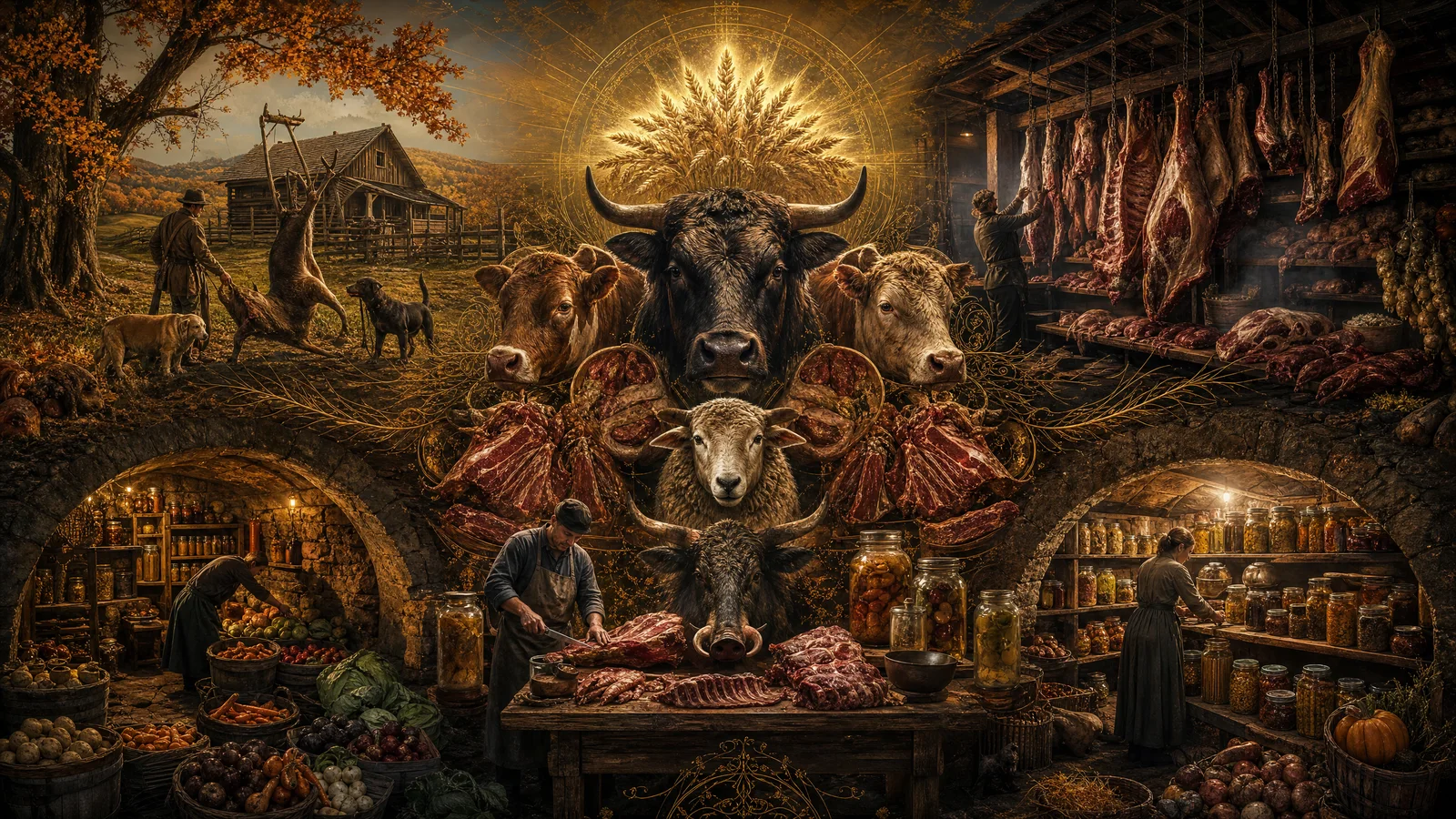
Complete Butchering and Meat Preservation: From Field to Freezer
Proper butchering maximizes yield and quality from every animal harvested. This campaign covers field dressing, skinning, butchering cuts, and preservation methods.
Chapter 1: Field Dressing
| Step | Action | Time | Tools | Critical Factor |
|---|---|---|---|---|
| 1 | Confirm animal is dead (approach carefully) | 1 min | Caution | Safety first |
| 2 | Position on back (uphill if on slope) | 2 min | Hands | Gravity assists drainage |
| 3 | Cut around anus (free intestine) | 5 min | Sharp knife | Don't puncture intestine |
| 4 | Open abdomen (sternum to pelvis) | 5 min | Sharp knife | Cut skin and muscle only, not organs |
| 5 | Cut diaphragm (membrane separating chest/abdomen) | 3 min | Knife | Free chest organs |
| 6 | Reach into chest, cut windpipe and esophagus | 3 min | Knife | Frees everything for removal |
| 7 | Roll out organs (gravity assists) | 5 min | Hands | Save heart, liver, kidneys if desired |
| 8 | Drain blood (prop cavity open) | 5 min | Prop stick | Remove as much blood as possible |
| 9 | Cool carcass (shade, air circulation) | Ongoing | Shade, prop open | Heat is the enemy of meat quality |
Critical timing: 1) Field dress within 30 minutes of kill (bacteria multiply rapidly in warm organs). 2) Cool meat to below 40°F within 24 hours (faster in warm weather). 3) Hang/age at 34-38°F for 7-14 days (beef, deer) or process immediately (small game, poultry). 4) Never let meat sit in direct sun. 5) Flies = contamination (use game bags or cheesecloth).
Chapter 2: Skinning and Quartering
| Method | Animal Size | Time | Equipment | Difficulty |
|---|---|---|---|---|
| Hanging skin (gravity) | Medium-large (deer, elk) | 30-60 min | Gambrel, tree/beam, knife | Moderate |
| Ground skinning | Any | 30-60 min | Knife, clean surface | Low-moderate |
| Case skinning | Small (rabbit, squirrel) | 5-15 min | Knife | Low |
| Plucking (poultry) | Birds | 15-30 min | Hot water (145°F), hands | Low |
Deer skinning (hanging): 1) Hang by hind legs (gambrel through hock tendons). 2) Cut skin around hocks (just below joint). 3) Cut down inside of each hind leg to vent. 4) Peel skin down from hind legs (pull and use fist between skin and meat). 5) Work skin down over back and sides (knife only where needed). 6) Pull skin over front legs and neck. 7) Cut off head at atlas joint. 8) Skin should come off in one piece (save for tanning). 9) Trim any hair or debris from carcass. 10) Rinse with clean water if available.
Chapter 3: Primal and Retail Cuts
| Primal Cut (Beef/Deer) | Location | Tenderness | Best Cooking | Retail Cuts |
|---|---|---|---|---|
| Loin (backstrap) | Along spine, behind ribs | Very tender | Grill, roast, pan-sear | Steaks, roasts |
| Tenderloin | Inside body cavity, along spine | Most tender | Grill, pan-sear | Filet mignon, medallions |
| Rib | Ribcage area | Tender | Roast, grill | Rib roast, rib steaks |
| Shoulder/chuck | Front shoulder | Moderate (connective tissue) | Braise, stew, grind | Roasts, stew meat, ground |
| Round (hindquarter) | Rear leg | Moderate-tough | Roast, braise, jerk | Roasts, steaks, ground |
| Flank/belly | Underside | Tough (thin) | Braise, grind, jerk | Flank steak, ground |
| Shank | Lower legs | Very tough | Braise, soup stock | Osso buco, soup bones |
| Neck | Neck | Tough | Braise, grind, stock | Ground, stew, stock |
Chapter 4: Preservation Methods
| Method | Shelf Life | Equipment | Difficulty | Flavor Change | Best For |
|---|---|---|---|---|---|
| Freezing | 6-12 months | Freezer, wrapping | Very low | Minimal | All cuts |
| Smoking (hot) | 1-2 weeks (refrigerated) | Smokehouse, wood | Moderate | Significant (smoky) | Sausage, fish, jerky |
| Smoking (cold) | 1-6 months | Cold smoker | Moderate-high | Moderate (smoky) | Bacon, ham, salmon |
| Salt curing (dry) | 3-12 months | Salt, cool storage | Low | Significant (salty) | Ham, bacon, fish |
| Brine curing (wet) | 2-4 weeks | Salt, water, container | Low | Moderate (salty) | Corned beef, pickled |
| Jerky (dried) | 1-6 months | Dehydrator or air | Low | Significant (concentrated) | Lean meat strips |
| Canning (pressure) | 1-5 years | Pressure canner, jars | Moderate | Moderate (cooked) | Stew, ground, chunks |
| Pemmican | 1-5 years | Dried meat, rendered fat | Low | Significant | Trail food, emergency |
| Confit | 3-6 months | Rendered fat, container | Low | Moderate (rich) | Duck, goose, pork |
Jerky making: 1) Select lean meat (fat goes rancid; trim all visible fat). 2) Slice thin (1/8 to 1/4 inch) against the grain. 3) Marinate: salt + pepper + optional spices (4-24 hours). 4) Dry: dehydrator at 160°F for 4-8 hours, or hang in dry, breezy shade for 1-3 days. 5) Done when it bends and cracks but doesn't break (leathery, not brittle). 6) Store in airtight container. 7) Properly dried jerky keeps 1-6 months at room temperature.
Pemmican (ultimate survival food): 1) Make jerky (dried very hard, brittle). 2) Pound/grind jerky into powder (or very fine shreds). 3) Render fat (tallow from beef or deer). 4) Mix: equal parts by weight dried meat powder and melted tallow. 5) Optional: add dried berries (10-20% by volume). 6) Press into bars or balls. 7) Let cool and harden. 8) Pemmican provides complete nutrition (protein + fat + carbs if berries added). 9) Stores for years in cool, dry conditions. 10) The original energy bar (sustained Indigenous peoples and fur traders for centuries).
Chapter 5: Sausage Making
| Type | Grind | Fat % | Casing | Cooking | Shelf Life |
|---|---|---|---|---|---|
| Fresh sausage | Medium-coarse | 20-30% | Natural or collagen | Cook before eating | 3-5 days (refrigerated) |
| Smoked sausage | Medium | 25-35% | Natural | Hot smoked (cooked) | 2-4 weeks (refrigerated) |
| Dry/cured sausage | Fine-medium | 30-40% | Natural | Air dried (no cooking) | 2-6 months |
| Emulsified (hot dog) | Very fine (paste) | 25-35% | Collagen or cellulose | Cooked | 2 weeks (refrigerated) |
Basic sausage recipe: 1) Grind meat (70-80% lean) and fat (20-30%) through medium plate. 2) Season: 2% salt by weight + pepper + spices of choice. 3) Mix thoroughly (develops bind; mixture should be sticky). 4) Stuff into casings (natural hog casings soaked in water). 5) Twist into links (6-8 inch lengths). 6) Refrigerate or freeze immediately. 7) Cook to 160°F internal temperature before eating.
Reference Card
- Cool meat fast (bacteria double every 20 minutes at warm temperatures; get to 40°F within 24 hours). 2. Sharp knife is essential (dull knives slip, waste meat, and make messy cuts; sharpen constantly). 3. Fat goes rancid (trim fat for jerky and dried products; fat is fine for fresh, frozen, or canned). 4. Salt preserves (2-3% salt inhibits most bacteria; higher concentrations for longer preservation). 5. Smoke adds flavor and preservation (smoke contains antimicrobial compounds; combine with salt for best results). 6. Pemmican is the ultimate (dried meat + rendered fat = complete nutrition that stores for years). 7. Use everything (bones for stock, organs for nutrition, hide for leather, fat for tallow; waste nothing). 8. Aging improves beef and venison (7-14 days at 34-38°F breaks down connective tissue; tenderness and flavor improve).