Sovereignty Module: Know the Fungus
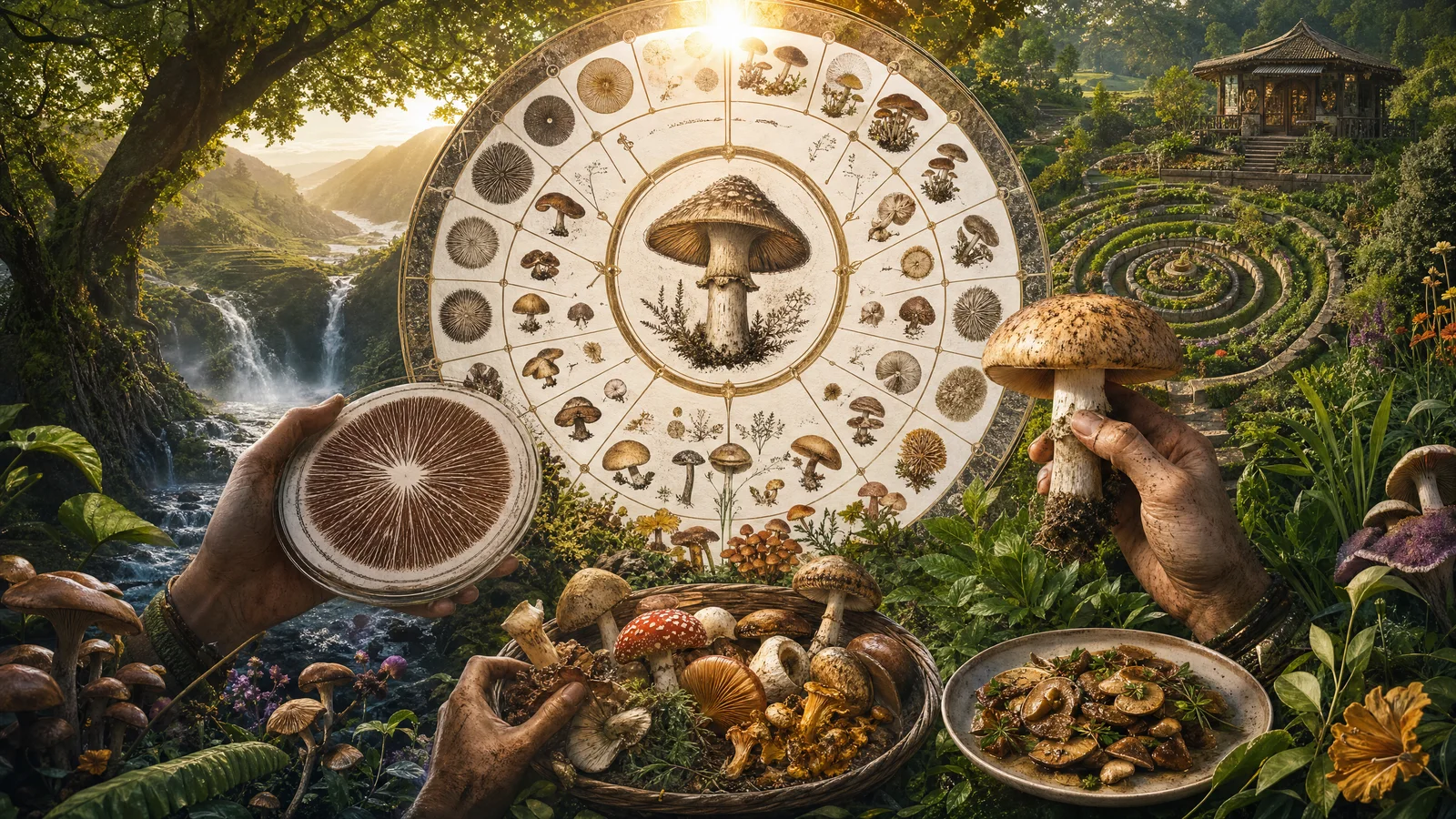
Complete Mushroom Identification and Foraging: From Spore Print to Safe Plate
Mushrooms can be food, medicine, or deadly poison. This campaign covers identification methods, safe foraging practices, and the essential species every forager must know.
Chapter 1: Identification Fundamentals
| Feature | What to Observe | Why It Matters |
|---|---|---|
| Cap shape | Convex, flat, funnel, bell, conical | Narrows identification |
| Cap surface | Smooth, scaly, sticky, dry, hairy | Species-specific |
| Gills/pores/teeth | Gill attachment, spacing, color; pore size; teeth length | Key identification feature |
| Spore print color | White, cream, pink, brown, black, rust | Critical for ID (eliminates many lookalikes) |
| Stem features | Ring (annulus), volva (cup at base), solid/hollow | Ring + volva = possible Amanita (danger) |
| Flesh color | White, yellow, blue-staining, red-staining | Staining reactions aid ID |
| Odor | Mushroomy, anise, fishy, chemical, none | Some species have distinctive odors |
| Habitat | Tree species, soil type, season, dead/living wood | Many species are host-specific |
| Growth pattern | Solitary, clustered, fairy ring, shelf | Aids identification |
Spore print method: 1) Cut cap from stem. 2) Place cap gill-side down on paper (half white, half dark paper to see any color). 3) Cover with bowl or glass (prevents air currents). 4) Wait 4-12 hours. 5) Carefully lift cap. 6) Spores will have fallen in gill pattern. 7) Note color: white, cream, yellow, pink, brown, purple-brown, black, rust. 8) Spore print color is one of the most reliable identification features.
Chapter 2: Safe Edible Species (Beginner)
| Species | Season | Habitat | Key Features | Lookalikes | Confidence |
|---|---|---|---|---|---|
| Chicken of the Woods | Summer-fall | Dead/dying hardwoods | Bright orange/yellow shelf, no gills | Few (all non-toxic) | Very high |
| Hen of the Woods (maitake) | Fall | Base of oaks | Grey-brown overlapping fans | Black-staining polypore (edible) | Very high |
| Giant puffball | Summer-fall | Fields, meadows | White, round, 4-20 inches, solid white inside | Must be solid white inside (no outline of mushroom) | Very high |
| Morel | Spring | Hardwood forests, burn areas | Honeycomb cap, hollow inside | False morel (brain-like, not honeycomb) | High |
| Chanterelle | Summer-fall | Hardwood forests | Golden, funnel-shaped, false gills (ridges) | Jack-o-lantern (true gills, grows in clusters on wood) | High |
| Oyster mushroom | Year-round | Dead hardwood | White-grey, shelf-like, decurrent gills | Angel wings (thinner, on conifers) | High |
| Lion's mane | Fall | Dead/dying hardwoods | White, shaggy teeth (no cap/gills) | None (distinctive) | Very high |
| Porcini (king bolete) | Summer-fall | Under conifers/hardwoods | Brown cap, white pores, thick stem, no blue staining | Bitter bolete (looks similar, very bitter) | High |
Chapter 3: Deadly Species to Avoid
| Species | Toxin | Symptoms | Onset | Fatality Rate | Key Features |
|---|---|---|---|---|---|
| Death cap (Amanita phalloides) | Amatoxin | Liver/kidney failure | 6-24 hours (delayed!) | 50-90% untreated | Green-yellow cap, white gills, ring, volva (cup at base) |
| Destroying angel (Amanita bisporigera) | Amatoxin | Liver/kidney failure | 6-24 hours | 50-90% untreated | All white, ring, volva, white spore print |
| Autumn skullcap (Galerina marginata) | Amatoxin | Liver/kidney failure | 6-24 hours | High | Small brown, ring, grows on wood, brown spore print |
| Deadly webcap (Cortinarius rubellus) | Orellanine | Kidney failure | 2-14 DAYS (very delayed) | High without dialysis | Brown-orange, cobwebby veil, rust spore print |
| False morel (Gyromitra esculenta) | Gyromitrin | Liver damage, seizures | 6-12 hours | 10-30% | Brain-like cap (not honeycomb), not hollow |
| Jack-o-lantern (Omphalotus olearius) | Illudin | Severe GI distress | 30 min-2 hours | Very low (not usually fatal) | Orange, true gills, clustered on wood, bioluminescent |
Chapter 4: Foraging Rules
| Rule | Explanation | Consequence of Breaking |
|---|---|---|
| 100% certain or don't eat | If there is ANY doubt, do not eat it | Possible death |
| Learn deadly species first | Know what will kill you before learning what's edible | Avoids fatal mistakes |
| Spore print everything | Spore color eliminates many dangerous lookalikes | Misidentification without it |
| Check ALL features | Cap, gills, stem, ring, volva, spore print, habitat | Single feature is never enough |
| Start with easy species | Begin with unmistakable species (puffball, chicken of woods) | Builds skills safely |
| Learn from experts | Forage with experienced mycologists first | Books alone are insufficient |
| Try small amounts first | Even correctly identified new species can cause individual reactions | Allergic reaction possible |
| Never eat raw wild mushrooms | Many edible species are toxic raw | GI distress |
| Dig up the whole mushroom | The volva (cup at base) is hidden underground | Missing the volva misses Amanita identification |
Chapter 5: Preservation
| Method | Shelf Life | Best For | Flavor Change | Difficulty |
|---|---|---|---|---|
| Drying (dehydrator/air) | 1-2 years | Most species | Concentrated, intensified | Very low |
| Freezing (sautéed first) | 6-12 months | Most species | Minimal | Very low |
| Pickling (vinegar) | 6-12 months | Firm species | Tangy, preserved | Low |
| Powder (dried + ground) | 1-2 years | Any dried mushroom | Concentrated (seasoning) | Very low |
| Tincture (alcohol) | 2-5 years | Medicinal species | N/A (medicine) | Low |
| Freeze-drying | 5-10 years | Any species | Minimal | High (equipment) |
Drying mushrooms: 1) Clean mushrooms (brush, don't wash if possible). 2) Slice thin (1/4 inch or less). 3) Arrange on dehydrator trays (or oven racks at lowest setting, door cracked). 4) Dry at 110-135°F for 4-8 hours. 5) Done when cracker-dry (snap, don't bend). 6) Store in airtight jars with desiccant packet. 7) Rehydrate: soak in warm water 20-30 minutes. 8) Save soaking liquid (concentrated mushroom broth).
Reference Card
- When in doubt, throw it out (no mushroom meal is worth your life; 100% certainty or don't eat). 2. Learn the killers first (know death cap, destroying angel, and autumn skullcap before learning any edible species). 3. Spore print is essential (spore color is one of the most reliable identification features; never skip it). 4. Dig up the whole mushroom (the volva at the base identifies deadly Amanitas; it's hidden underground). 5. Start with the easy five (chicken of the woods, hen of the woods, giant puffball, morel, lion's mane; these are distinctive). 6. Delayed symptoms are the most dangerous (amatoxin symptoms appear 6-24 hours after eating; by then, liver damage has begun). 7. No universal test for edibility (there is no simple test; silver spoons, peeling, and other folk tests are myths). 8. Cook all wild mushrooms (many edible species are toxic raw; cooking destroys heat-labile toxins).