Sovereignty Module: Turn the Wheel
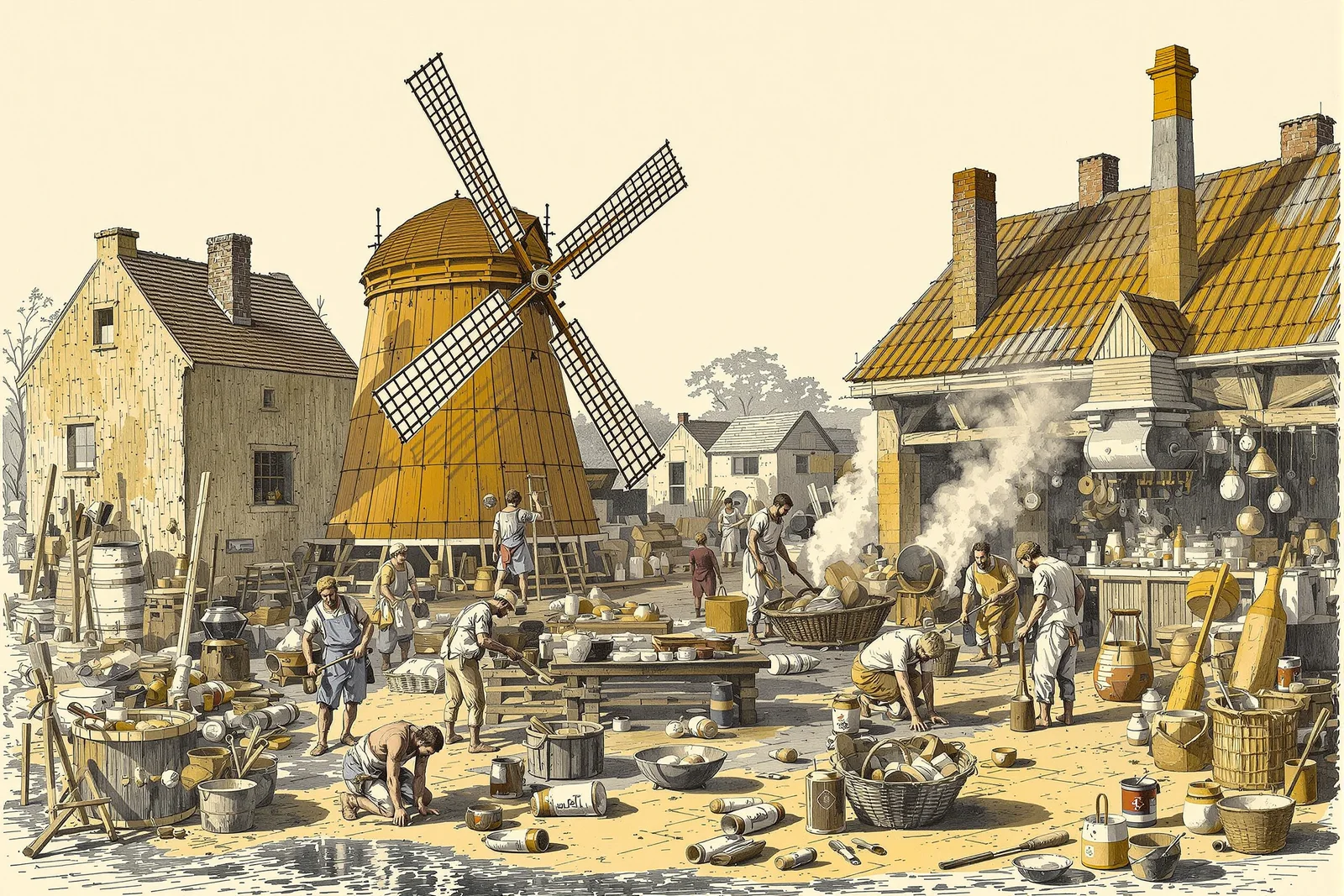
Complete Windmill and Water Wheel Construction: From Current to Crankshaft
Wind and water provide free, renewable mechanical power. This campaign covers water wheel types, windmill design, power transmission, and practical applications.
Chapter 1: Water Wheel Types
| Type | Head Required | Efficiency | Flow Needed | Complexity | Best For |
|---|---|---|---|---|---|
| Undershot | 0-3 ft (current only) | 15-30% | High volume | Low | Rivers, streams |
| Breastshot | 3-8 ft | 35-65% | Moderate | Moderate | Moderate head sites |
| Overshot | 8-30+ ft | 60-90% | Low-moderate | Moderate-high | High head sites (best efficiency) |
| Pelton wheel | 30-1,000+ ft | 80-95% | Low | High | Very high head, low flow |
| Turbine (Francis) | 10-300 ft | 85-95% | Moderate-high | Very high | Power generation |
Overshot water wheel: 1) Water delivered to TOP of wheel via flume or pipe. 2) Water fills buckets on one side. 3) Weight of water turns wheel (gravity power). 4) Buckets empty at bottom. 5) Water exits through tailrace. 6) Most efficient type (60-90% of water's energy captured). 7) Requires head (height difference between water source and wheel). 8) Wheel diameter should be slightly less than available head.
Chapter 2: Water Wheel Construction
| Component | Material | Function | Sizing |
|---|---|---|---|
| Wheel (rim) | Wood or steel | Carries buckets, transfers force | Diameter = available head minus 1-2 ft |
| Buckets/paddles | Wood, sheet metal | Catch water | 12-24 per wheel, angled to retain water |
| Axle (shaft) | Steel or hardwood | Transfers rotation | Diameter based on load (2-6 inch) |
| Bearings | Bronze, wood (lignum vitae), or modern | Support axle, allow rotation | Must handle weight and thrust |
| Frame/support | Timber, stone, concrete | Holds wheel and axle | Must be rigid and level |
| Flume/penstock | Wood trough or pipe | Delivers water to wheel | Sized for flow volume |
| Tailrace | Channel | Carries water away | Must drain freely |
| Gearing | Wood or metal gears | Changes speed/torque | Ratio depends on application |
Power calculation: 1) Measure head (H): height difference in feet between water entry and exit. 2) Measure flow (Q): cubic feet per second (time how long to fill a known container). 3) Power (HP) = H × Q × 62.4 ÷ 550 × efficiency. 4) Example: 10 ft head, 2 cfs flow, 70% efficiency: 10 × 2 × 62.4 ÷ 550 × 0.7 = 1.59 HP. 5) 1 HP = 746 watts. 6) This example produces about 1,186 watts (enough for a small household). 7) Water power is available 24/7 (unlike solar or wind).
Chapter 3: Windmill Design
| Type | Efficiency | Wind Speed Range | Complexity | Application |
|---|---|---|---|---|
| Savonius (vertical axis) | 10-15% | Low-moderate | Very low | Water pumping, low power |
| American farm windmill | 15-30% | Moderate | Moderate | Water pumping |
| Dutch/post mill | 20-35% | Moderate-high | High | Grain milling, sawing |
| Horizontal axis (modern) | 35-45% | Moderate-high | Very high | Electricity generation |
| Darrieus (vertical axis) | 25-35% | Moderate-high | High | Electricity generation |
Simple Savonius windmill: 1) Cut 55-gallon drum in half vertically (two half-cylinders). 2) Offset halves on vertical axis (S-shape when viewed from top). 3) Mount on vertical shaft with bearings (top and bottom). 4) Wind catches open face of each half, pushes it around. 5) Advantages: works in any wind direction, simple construction, low wind startup. 6) Disadvantages: low efficiency, limited power. 7) Good for: water pumping (connect to pump via crank), small generator charging. 8) Can be built from scrap materials in a few hours.
Chapter 4: Power Transmission
| Method | Speed Change | Efficiency | Complexity | Distance |
|---|---|---|---|---|
| Direct drive | 1:1 | Very high | Very low | Zero (same shaft) |
| Belt and pulley | Variable (ratio of diameters) | 90-95% | Low | Short (feet) |
| Gear train | Variable (ratio of teeth) | 85-95% per stage | Moderate-high | Zero (same housing) |
| Chain and sprocket | Variable (ratio of teeth) | 95-98% | Moderate | Short (feet) |
| Shaft and universal joint | 1:1 | 95%+ | Moderate | Medium (yards) |
| Rope drive | Variable | 85-90% | Low | Medium (yards) |
Belt and pulley system: 1) Driver pulley on power source (water wheel, windmill). 2) Driven pulley on machine (mill, saw, pump). 3) Belt connects the two (leather, rubber, or flat woven). 4) Speed ratio = driver diameter ÷ driven diameter. 5) Example: 24-inch driver, 8-inch driven = 3:1 speed increase. 6) Torque is inversely proportional (3x speed = 1/3 torque). 7) Belt tension must be correct (too loose = slips; too tight = bearing wear). 8) Crossed belt reverses rotation direction.
Chapter 5: Applications
| Application | Power Needed | Speed Needed | Mechanism | Output |
|---|---|---|---|---|
| Grain milling | 1-5 HP | 100-150 RPM (stones) | Gear up from wheel | Flour |
| Water pumping | 0.1-1 HP | 20-60 strokes/min | Crank + connecting rod | Pumped water |
| Sawmill | 3-10 HP | 300-600 RPM (blade) | Gear up + reciprocating | Lumber |
| Bellows (forge) | 0.5-1 HP | 10-20 strokes/min | Crank + connecting rod | Forced air |
| Electricity generation | 0.5-5+ HP | 1,800 RPM (generator) | Gear up significantly | Electricity |
| Lathe | 0.5-2 HP | 200-1,000 RPM | Belt + pulley | Turned wood/metal |
| Hammer (trip) | 1-3 HP | 30-60 strikes/min | Cam on shaft | Forging |
Reference Card
- Head times flow equals power (water power is proportional to both height and volume; measure both accurately). 2. Overshot is most efficient (if you have the head, overshot wheels capture 60-90% of water's energy). 3. Water power runs 24/7 (unlike solar or wind, a stream provides constant power day and night, rain or shine). 4. Savonius is simplest (a split barrel on a vertical shaft works in any wind direction; build it from scrap). 5. Gear ratios change speed and torque (speed up for generators and saws; keep slow for millstones and pumps). 6. Belt tension matters (too loose = slipping and lost power; too tight = bearing failure; check regularly). 7. Start with water pumping (the simplest and most valuable application; a windmill or water wheel pumping water transforms a homestead). 8. Free power forever (after construction, wind and water cost nothing; the original renewable energy).