Complete Greenhouse Construction: From Cold Frame to Year-Round Growing
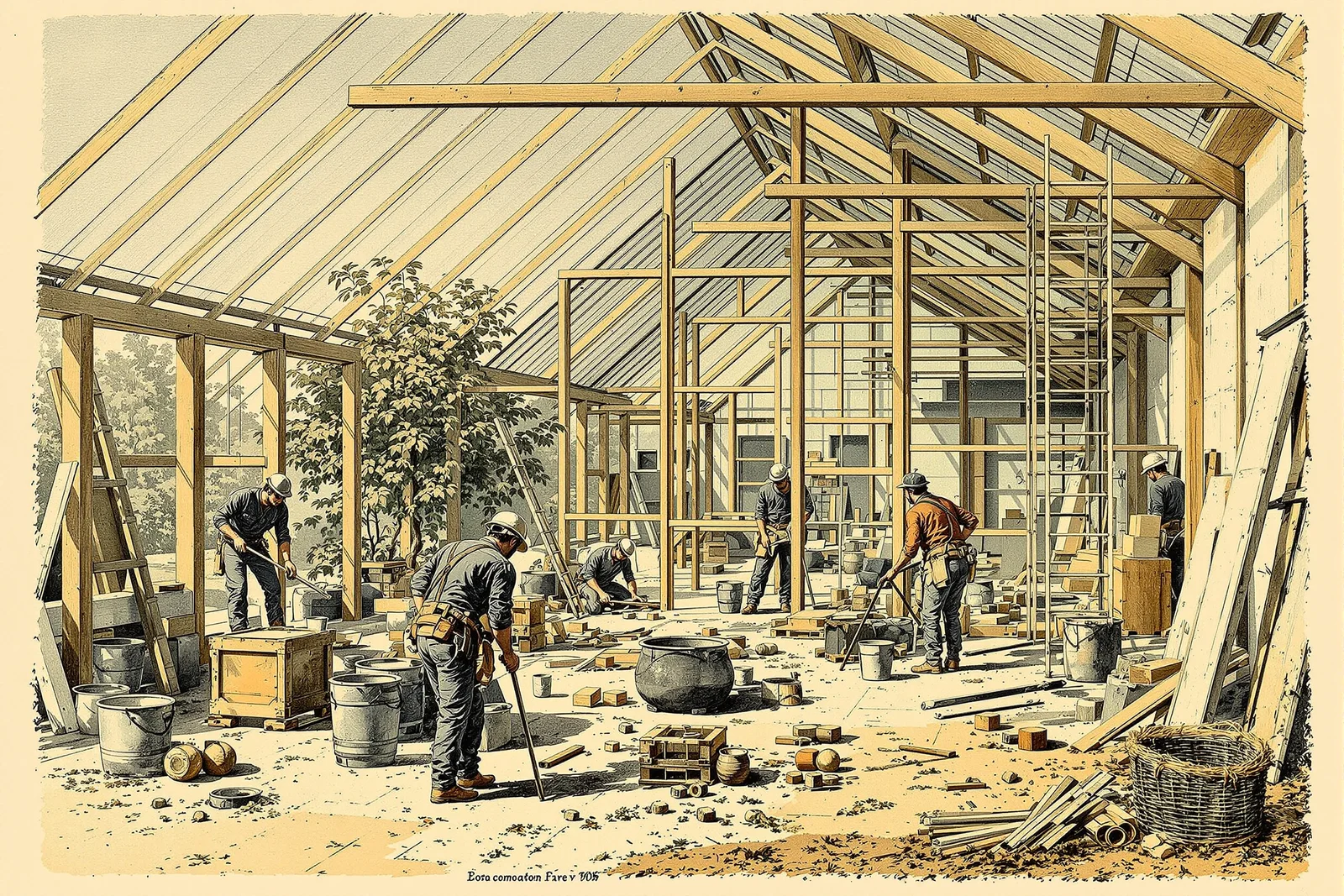
⟁ cover painted for this edition — the source module carried no illustrations
Complete Greenhouse Construction: From Cold Frame to Year-Round Growing
Greenhouses extend growing seasons and enable food production in any climate. This campaign covers cold frames, hoop houses, greenhouse design, heating, and year-round growing strategies.
Chapter 1: Season Extension Structures
Structure
Cost
Difficulty
Temperature Gain
Season Extension
Lifespan
Row cover (fabric)
Very low
Very low
2-8°F
2-4 weeks
1-3 seasons
Cold frame
Low
Low
10-20°F
4-8 weeks
5-20 years
Hot bed (heated cold frame)
Low
Low-moderate
20-40°F
8-16 weeks
5-20 years
Low tunnel (mini hoop)
Low
Low
5-15°F
4-8 weeks
2-5 years
High tunnel (hoop house)
Moderate
Moderate
10-25°F
8-16 weeks
5-15 years
Greenhouse (unheated)
Moderate-high
Moderate-high
15-30°F
Year-round (mild climates)
10-30 years
Greenhouse (heated)
High
High
Any (controlled)
Year-round (any climate)
10-30 years
Chapter 2: Hoop House Construction
Component
Material
Sizing
Cost
Hoops
EMT conduit (1-1.5 inch), PVC (1.5-2 inch), or steel pipe
Spacing: 4 ft on center
Low-moderate
Ground posts
Rebar or pipe driven into ground
2 ft deep, inside hoop ends
Very low
Covering
6-mil greenhouse poly (UV-stabilized)
Single or double layer
Low
End walls
Framed lumber + poly or polycarbonate
Full height, with door
Low-moderate
Base boards
Treated lumber (2×6 or 2×8)
Perimeter
Low
Hip boards
Lumber at base of hoops
Secures poly at sides
Low
Ventilation
Roll-up sides, end vents, ridge vent
Critical for temperature control
Low
Hoop house construction (14×30 ft): 1) Level site, mark footprint. 2) Drive rebar stakes every 4 ft along both long sides (2 ft deep, 1 ft above ground). 3) Bend EMT conduit or PVC into arches, slip over opposing rebar stakes. 4) Install ridge pole (purlin) along top for stability. 5) Install base boards along sides. 6) Frame end walls with door. 7) Pull poly over hoops on a calm day. 8) Secure poly to base boards with wiggle wire channel or lath strips. 9) Install roll-up sides for ventilation (critical). 10) Add end wall poly or polycarbonate. 11) Total cost: $500-2,000 depending on materials.
Chapter 3: Greenhouse Design
Factor
Recommendation
Why
Orientation
Long axis east-west
Maximum south-facing glazing (Northern Hemisphere)
Glazing angle
Perpendicular to winter sun angle
Maximum light transmission in winter
Thermal mass
Water barrels, stone, concrete
Absorbs heat during day, releases at night
Insulation
North wall insulated (no glazing)
Reduces heat loss, reflects light inward
Ventilation
15-20% of floor area in vents
Prevents overheating, controls humidity
Foundation
Insulated perimeter
Reduces ground heat loss
Glazing material
Double-wall polycarbonate or double poly
Better insulation than single layer
Passive solar greenhouse: 1) Orient long axis east-west. 2) South wall: maximum glazing (glass or polycarbonate). 3) North wall: insulated, solid (no glazing), painted white or reflective inside. 4) Thermal mass along north wall: 55-gallon drums filled with water, painted black. 5) Water absorbs solar heat during day. 6) Water releases heat at night (moderates temperature). 7) Insulated foundation (rigid foam, 2-4 ft deep around perimeter). 8) Ventilation: ridge vent at top, low vents on south side. 9) This design can maintain above-freezing temperatures in zone 5-6 without supplemental heat.
Chapter 4: Heating and Cooling
Method
Cost
Effectiveness
Fuel
Best For
Thermal mass (water barrels)
Low
Moderate (buffer)
Free (solar)
Mild climates
Compost heating
Very low
Moderate
Compost materials
Supplemental heat
Rocket mass heater
Low
Good
Wood (small amount)
Cold climates, DIY
Propane heater
Moderate
Very good
Propane
Emergency/cold snaps
Electric heater
Moderate-high
Very good
Electricity
Small greenhouses
Wood stove
Low-moderate
Very good
Wood
Cold climates
Roll-up sides (cooling)
Very low
Very good
None
Summer ventilation
Shade cloth (cooling)
Low
Good
None
Summer heat reduction
Evaporative cooling
Low-moderate
Good (dry climates)
Water + electricity
Hot, dry climates
Chapter 5: Year-Round Growing
Season
Strategy
Crops
Temperature
Spring
Start transplants, grow cool crops
Lettuce, spinach, broccoli, peas
40-70°F
Summer
Ventilate heavily, grow warm crops
Tomatoes, peppers, cucumbers
70-90°F
Fall
Extend harvest, plant cool crops
Lettuce, kale, carrots, radishes
40-70°F
Winter
Grow cold-hardy crops, minimal heat
Spinach, mache, claytonia, kale
25-50°F
Reference Card
Ventilation is more important than heating (overheating kills more greenhouse plants than cold; ventilate aggressively in warm weather). 2. Orient east-west (long axis east-west maximizes south-facing glazing for winter sun capture). 3. Thermal mass moderates temperature (water barrels absorb daytime heat and release it at night; the cheapest heating system). 4. Double layer glazing (double poly or twin-wall polycarbonate cuts heat loss nearly in half compared to single layer). 5. Insulate the north wall (no light comes from the north in winter; insulate it and paint the inside white to reflect light). 6. Cold-hardy crops in winter (don't try to grow tomatoes in January; grow spinach, kale, and lettuce that thrive in cold). 7. Hoop houses are cost-effective (a simple hoop house extends the season 2-3 months on each end for a fraction of greenhouse cost). 8. The greenhouse is a tool (it doesn't grow food by itself; you must manage ventilation, watering, and pest control actively).