Sovereignty Module: Bound the Land
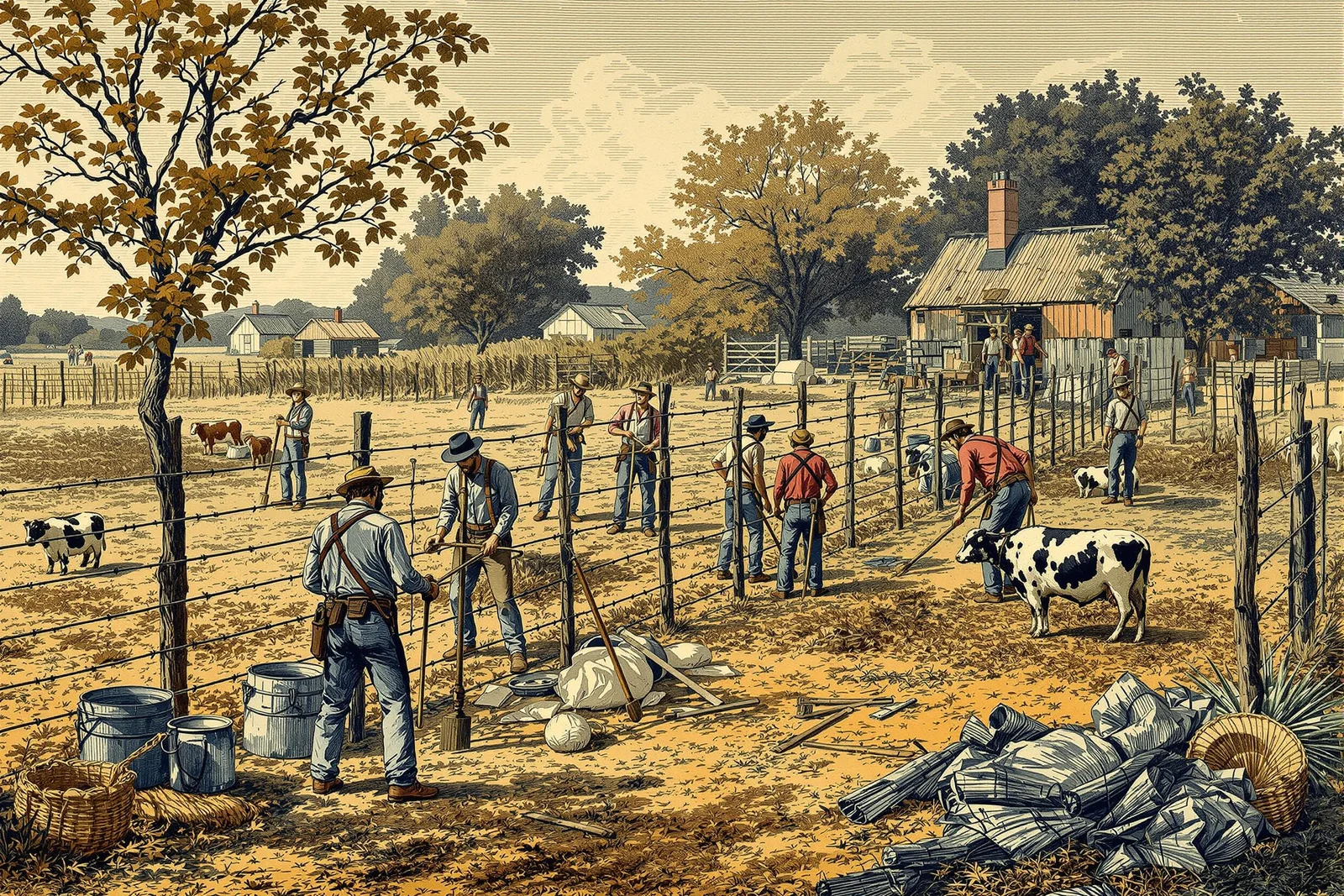
Complete Fence Building, Livestock Containment, and Boundary Construction Guide
Fences define civilization. They protect crops from animals, contain livestock, mark boundaries, and provide security. Without fences, agriculture fails. This campaign covers every fencing method from living hedges to post-and-rail.
Chapter 1: Fence Types Compared
| Fence Type | Height | Lifespan | Materials | Labor | Contains |
|---|---|---|---|---|---|
| Living hedge (hawthorn) | 4-8 feet | Indefinite (with maintenance) | Plants, time | High (years to establish) | Cattle, sheep, horses |
| Post and rail (wood) | 4-5 feet | 15-30 years | Posts, rails (split or sawn) | Moderate | Horses, cattle |
| Woven wire (field fence) | 4-5 feet | 20-30 years | Wire, posts | Moderate | All livestock |
| Barbed wire | 4-5 feet (3-4 strands) | 20-30 years | Wire, posts | Low-moderate | Cattle (not sheep/horses) |
| Electric (single wire) | 3-4 feet | 10-20 years (wire), longer (posts) | Wire, posts, energizer | Low | All (trained animals) |
| Stone wall | 3-5 feet | 100+ years | Stone | Very high | Sheep, cattle |
| Wattle (hurdle) | 3-5 feet | 3-8 years | Hazel, willow rods | Moderate | Sheep, temporary |
| Picket fence | 3-4 feet | 15-25 years | Sawn lumber | Moderate | Dogs, visual boundary |
| Board fence | 4-5 feet | 15-25 years | Lumber, posts | Moderate-high | Horses |
| Bamboo fence | 4-6 feet | 5-15 years | Bamboo poles | Low-moderate | Visual, light containment |
Chapter 2: Post Setting
| Method | Depth | Best Soil | Strength | Lifespan |
|---|---|---|---|---|
| Tamped earth | 1/3 of post length (min 2 feet) | Clay, firm soil | Good | Same as post |
| Concrete collar | 2-3 feet deep, 8-12 inch diameter | Any soil | Excellent | Outlasts post |
| Gravel/crushed rock | 2-3 feet deep | Wet or clay soil | Good (drains well) | Extends post life |
| Driven (pointed post) | 2-3 feet | Soft soil | Moderate | Good |
| Rock pile (cairn) | Surface | Rocky ground (cannot dig) | Moderate | Indefinite |
Post materials ranked by lifespan: Black locust (50+ years), cedar (25-40 years), white oak (15-25 years), treated pine (20-30 years), untreated pine (5-10 years).
Corner and end posts must be braced (diagonal brace to buried deadman, or H-brace assembly) because they bear the tension of the entire fence line.
Chapter 3: Wattle Hurdle Making
| Step | Action | Details |
|---|---|---|
| 1 | Cut uprights (stakes): 5-7 feet long, 2-3 inch diameter | Hazel, oak, or any straight hardwood |
| 2 | Sharpen bottom ends | For driving into ground or base rail |
| 3 | Set uprights in base rail or ground (9-12 inches apart) | 6 feet wide panel typical |
| 4 | Weave flexible rods (weavers) in and out of uprights | Hazel, willow, 6-8 feet long, 1/2-1 inch diameter |
| 5 | Alternate starting side with each row | Creates balanced panel |
| 6 | Pack weavers down tightly with each row | No gaps for livestock to push through |
| 7 | Twist and tuck ends at edges | Secures weavers |
| 8 | Continue to desired height (3-5 feet) | 4 feet for sheep, 5 feet for goats |
One person can make 8-12 hurdle panels per day. Panels are portable, reusable, and last 5-8 years.
Chapter 4: Living Hedge (Hawthorn)
| Step | Action | Time |
|---|---|---|
| 1 | Prepare ground: dig trench 18 inches wide, 12 inches deep | Fall/winter |
| 2 | Plant hawthorn seedlings 6-9 inches apart in double row (staggered) | Late fall/early spring (dormant) |
| 3 | Cut back to 6 inches after first growing season | End of year 1 |
| 4 | Allow regrowth for 2-3 years | Years 2-4 |
| 5 | Lay hedge: partially cut stems near base, bend horizontal, weave between stakes | Year 4-5 (when stems are 2-3 inch diameter) |
| 6 | Drive stakes vertically every 18 inches through laid stems | Holds horizontal stems in place |
| 7 | Bind top with twisted hazel or willow rods (heathering) | Finishes top edge |
| 8 | Trim annually to maintain density | Every winter |
A properly laid hedge is stock-proof, provides wildlife habitat, produces berries, acts as windbreak, and lasts indefinitely with maintenance. Hawthorn thorns deter all livestock.
Chapter 5: Stone Wall (Dry Stack)
| Component | Description | Function |
|---|---|---|
| Foundation stones | Largest, flattest stones, set below grade | Stable base |
| Through stones (tie stones) | Long stones spanning full wall width | Tie two faces together (every 3-4 feet) |
| Face stones | Flat side out, angled slightly inward | Creates stable battered (tapered) wall |
| Fill (hearting) | Small stones packed tightly in center | Fills void between two faces |
| Capstones (coping) | Heavy stones on top, set on edge | Locks wall together, sheds water |
| Batter | Wall tapers inward (wider at base) | Stability (base = 24-30 inches, top = 14-18 inches) |
Build rule: Two faces leaning against each other with fill between. Every stone touches at least two below it. No running joints (stagger like brickwork). Through stones every 3-4 feet in both directions.
Chapter 6: Gate Construction
| Component | Material | Specification |
|---|---|---|
| Gate posts | Largest, strongest posts (6-8 inch diameter) | Set 3 feet deep in concrete, braced |
| Frame | Lumber or poles (4x4 minimum) | Rectangle with diagonal brace |
| Diagonal brace | Runs from bottom of hinge side to top of latch side | Prevents sagging (MUST go this direction) |
| Hinges | Strap hinges or pin hinges | Heavy-duty, rust-resistant |
| Latch | Drop latch, chain, or slide bolt | Operable from both sides |
| Width | Minimum 4 feet (person), 12 feet (vehicle), 16 feet (equipment) | Match intended use |
Gate diagonal brace rule: The brace ALWAYS runs from the bottom of the hinge post to the top of the latch post. This transfers the weight of the gate back to the hinge post. Reversed = gate sags immediately.
Reference Card
- Post depth = 1/3 of total post length (minimum 2 feet in ground)
- Corner posts must be braced: they bear the tension of the entire fence line
- Black locust posts last 50+ years without treatment (best natural fence post)
- Living hedge: plant hawthorn 6-9 inches apart, lay after 4-5 years of growth
- Stone wall batter: base 24-30 inches wide, top 14-18 inches (tapers inward)
- Through stones every 3-4 feet tie the two faces of a dry stone wall together
- Gate brace: bottom of hinge side to top of latch side (prevents sagging)
- Wattle hurdles: portable, reusable panels for temporary livestock containment