Sovereignty Module: Flatten the Disc
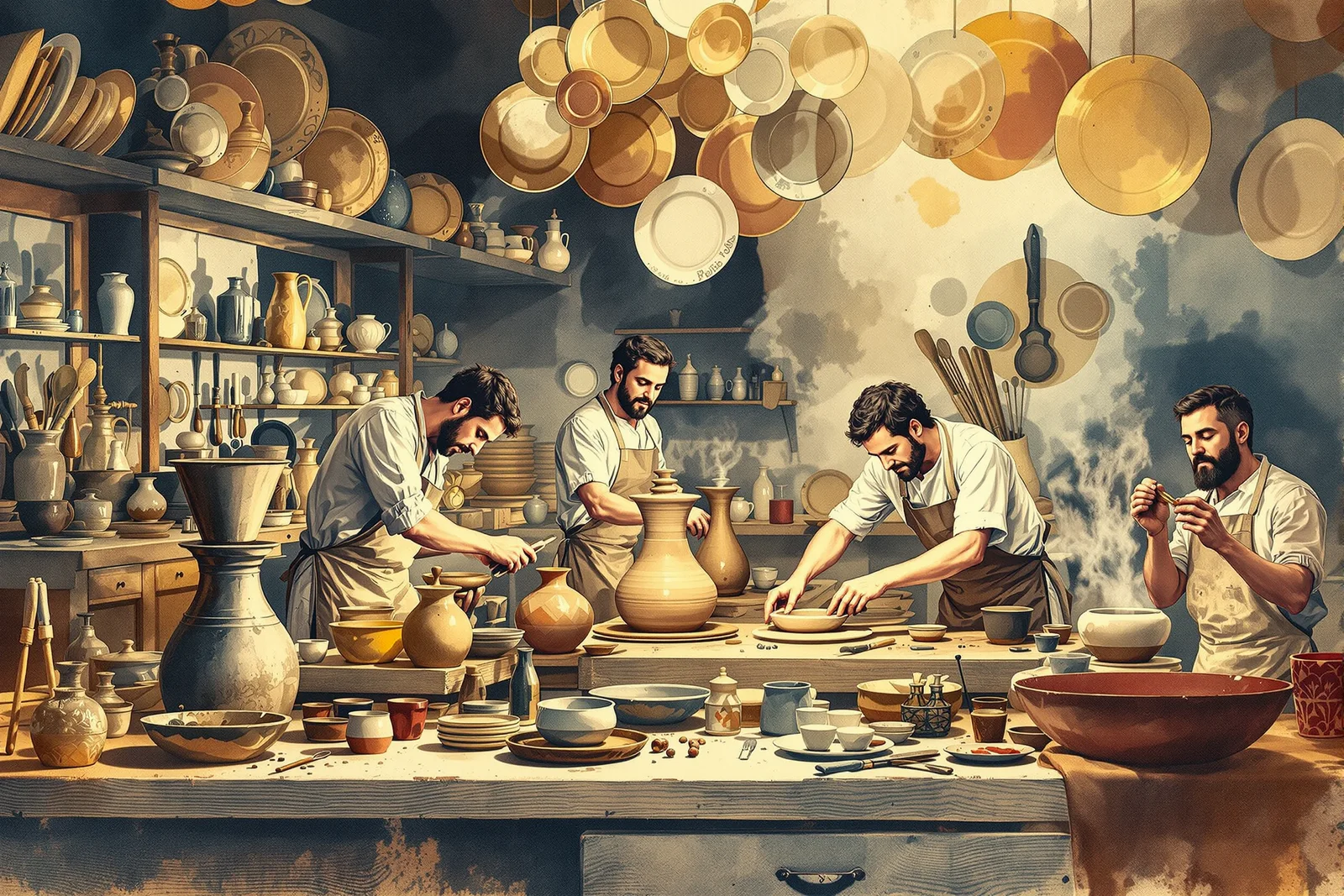
Complete Plate and Platter Making: From Wheel to Tableware
Plates and platters are among the most challenging forms to throw due to their wide, flat profile. This campaign covers throwing technique, warping prevention, trimming, and design.
Chapter 1: Plate Types
| Type | Diameter | Rim Width | Depth | Use |
|---|---|---|---|---|
| Bread plate | 6-7 inches | 3/4 inch | 1/2 inch | Bread, appetizer |
| Salad plate | 8-9 inches | 1 inch | 3/4 inch | Salad, dessert |
| Dinner plate | 10-11 inches | 1-1.5 inches | 1 inch | Main course |
| Charger | 12-14 inches | 1.5-2 inches | 1/2 inch | Decorative, under-plate |
| Platter (oval) | 12-16 inches | 1-1.5 inches | 1 inch | Serving |
| Platter (round) | 14-18 inches | 1.5-2 inches | 1-1.5 inches | Large serving |
Chapter 2: Throwing Technique
Plate throwing: 1) Center 2-4 pounds of clay (more for larger plates). 2) Flatten centered clay into thick disc (not cylinder). 3) Open wide and flat (push outward, not down). 4) Leave 3/8 inch bottom thickness (critical for warping prevention). 5) Pull floor outward (not upward). 6) Floor must be even thickness throughout. 7) Pull rim upward at outer edge. 8) Rim provides structural rigidity. 9) Use rib to compress and smooth floor. 10) Compression prevents cracking during drying.
| Plate Size | Clay Weight | Floor Thickness | Rim Height | Compression Passes |
|---|---|---|---|---|
| Bread (6-7 inch) | 1.5-2 lbs | 1/4 inch | 3/4 inch | 3-4 |
| Salad (8-9 inch) | 2-2.5 lbs | 1/4 inch | 1 inch | 4-5 |
| Dinner (10-11 inch) | 3-4 lbs | 5/16 inch | 1-1.5 inches | 5-6 |
| Platter (14+ inch) | 5-8 lbs | 3/8 inch | 1.5-2 inches | 6-8 |
Chapter 3: Warping Prevention
| Cause | Prevention | Method |
|---|---|---|
| Uneven floor thickness | Consistent pulling | Use rib to check thickness |
| Insufficient compression | Multiple rib passes | Compress floor firmly with rib |
| Uneven drying | Dry slowly, flip | Cover loosely, flip daily |
| Too-thin floor | Adequate thickness | Minimum 1/4 inch |
| S-crack (center crack) | Compress center | Extra rib pressure at center |
| Rapid drying | Slow, even drying | Dry on plaster bat, cover |
S-crack prevention: 1) S-cracks form at the center of plates during drying. 2) Caused by differential shrinkage between center and rim. 3) Prevention: compress the floor thoroughly with a rib. 4) Compression aligns clay particles and reduces stress. 5) Also: cut plate from wheel with wire while wheel turns slowly. 6) This releases tension in the floor. 7) Dry plates very slowly (cover loosely for several days).
Chapter 4: Trimming
Plate trimming: 1) Wait until leather-hard (firm but carvable). 2) Invert plate on wheel. 3) Center carefully (plates are difficult to center inverted). 4) Secure with clay wads. 5) Trim foot ring: wide and shallow (stability). 6) Foot ring diameter: 50-60% of plate diameter. 7) Trim exterior to refine profile. 8) Floor should be even thickness (tap to check). 9) Sign or stamp bottom.
| Trimming Spec | Bread Plate | Dinner Plate | Platter |
|---|---|---|---|
| Foot ring diameter | 3-4 inches | 5-6 inches | 7-9 inches |
| Foot ring height | 3/16 inch | 1/4 inch | 1/4-3/8 inch |
| Foot ring width | 3/8 inch | 1/2 inch | 5/8 inch |
Chapter 5: Glazing and Stacking
| Glazing Method | Coverage | Drip Risk | Best For |
|---|---|---|---|
| Dipping | Full coverage | Low (if waxed foot) | Production |
| Pouring | Full coverage | Medium | Single pieces |
| Brushing | Selective | Low | Decorative |
| Spraying | Even, thin coats | Low | Large pieces |
Kiln stacking: 1) Plates take up significant kiln space. 2) Stack with kiln posts between shelves. 3) Minimum clearance: 1/2 inch above tallest plate rim. 4) Plates can be fired rim-down (saves space). 5) If rim-down: wax rim, fire on wadding. 6) Or fire right-side-up on kiln wash-coated shelf.
Reference Card
- Compression is the key to crack-free plates (the wide, flat floor of a plate is prone to cracking during drying; thorough compression with a rib aligns clay particles and reduces internal stress). 2. Even floor thickness prevents warping (a plate with thick and thin spots warps during drying and firing; use a rib to check and maintain consistent floor thickness). 3. The rim provides structural rigidity (a plate without a rim is a disc that warps easily; the upturned rim acts as a stiffening ring that helps the plate maintain its shape). 4. Dry plates very slowly (plates have a large surface area relative to their thickness; they dry quickly and unevenly, leading to warping and cracking; cover loosely and dry over several days). 5. A wide foot ring prevents rocking (plates need a wide foot ring (50-60% of diameter) for stability; a narrow foot ring causes the plate to rock on the table). 6. Cut from the wheel while spinning (cutting a plate from the wheel with a wire while the wheel turns slowly releases tension in the floor; this simple step prevents many S-cracks). 7. Plates are the potter's precision test (throwing a flat, even, warp-free plate requires mastery of centering, opening, pulling, compression, and drying; a perfect plate proves the potter's skill). 8. Plates are the foundation of tableware (every meal is served on plates; a set of handmade plates transforms daily dining into a tactile, aesthetic experience).