Campaign 125: Strike the Stone
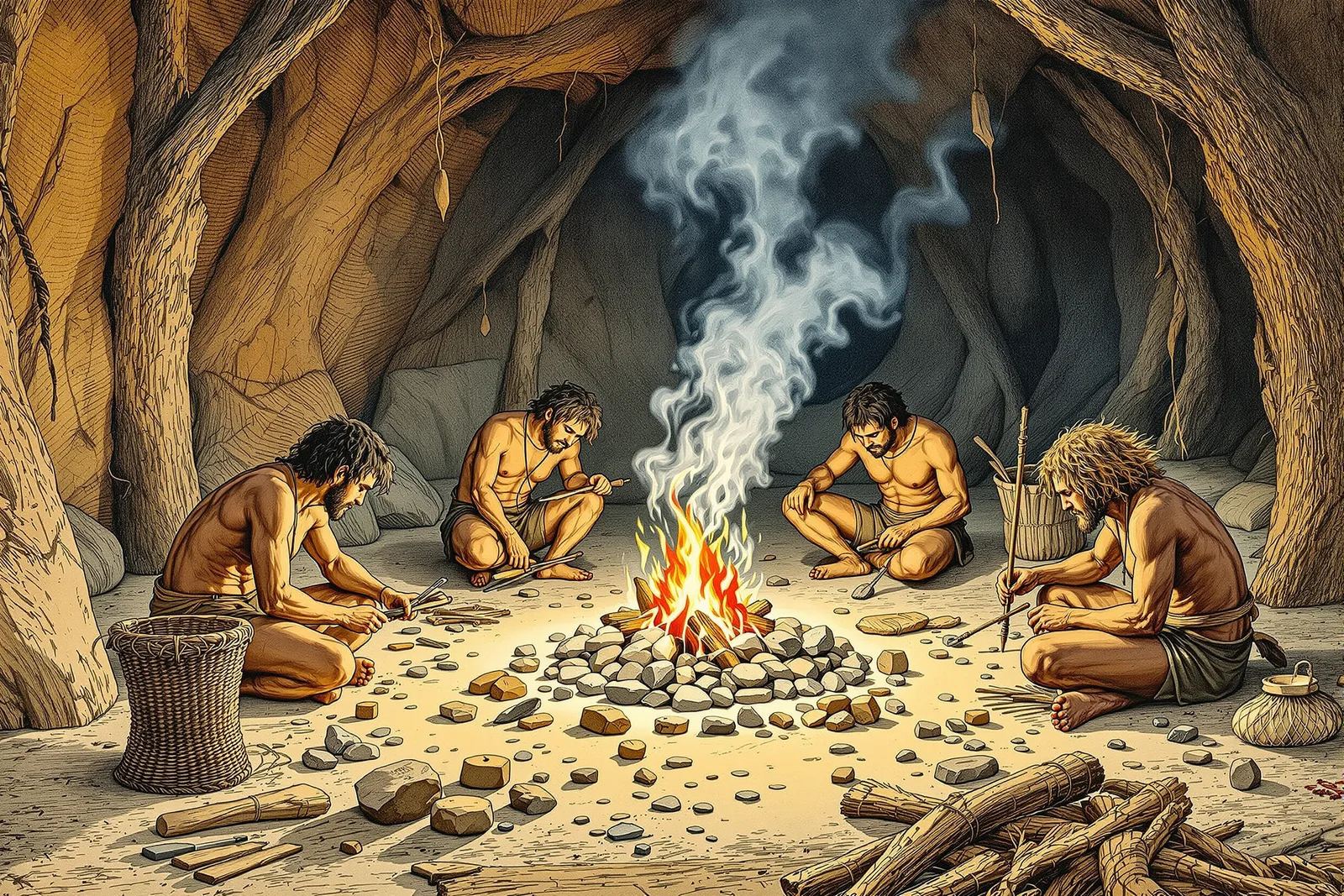
The Complete Flint Knapping, Stone Tool Production, and Lithic Technology Guide
A Sovereignty Module of the Practitioner Community
Preamble
For 2.5 million years, stone tools were the cutting edge of human technology. Flint knapping — the art of shaping stone by controlled fracture — produces edges sharper than surgical steel from rocks found on the ground. A knapped obsidian blade has an edge measured in nanometers, thinner than any metal blade ever made. This campaign covers stone selection, percussion techniques, pressure flaking, and tool production.
Part I: Stone Selection
Chapter 1: Knappable Stone Types
| Stone | Quality | Edge Sharpness | Availability | Color |
|---|---|---|---|---|
| Obsidian | Excellent | Sharpest possible (nanometer edge) | Volcanic regions | Black, translucent |
| Flint/chert | Excellent | Extremely sharp | Limestone regions, riverbeds | Gray, brown, tan, black |
| Jasper | Very good | Very sharp | Widespread | Red, yellow, green |
| Agate/chalcedony | Very good | Very sharp | Riverbeds, desert | Banded, translucent |
| Quartzite | Good | Sharp | Very widespread | White, gray, pink |
| Novaculite | Excellent | Extremely sharp | Arkansas, Oklahoma | White, gray |
| Porcelain/glass | Excellent (practice) | Extremely sharp | Everywhere (man-made) | Various |
Chapter 2: Conchoidal Fracture
| Principle | Explanation |
|---|---|
| What it is | When struck, these stones fracture in smooth, curved (conchoidal) surfaces — like a seashell shape |
| Why it works | Amorphous (non-crystalline) structure means fracture follows force direction, not crystal planes |
| Platform | The flat surface where you strike — angle and preparation determine flake shape |
| Force direction | Flake travels in the direction of force, curving away from the struck surface |
| Hertzian cone | Impact creates a cone-shaped fracture that propagates through the stone |
Chapter 3: Tools Needed
| Tool | Material | Purpose |
|---|---|---|
| Hammerstone | Round, hard river cobble (quartzite) | Hard percussion — initial shaping, removing large flakes |
| Billet (soft hammer) | Antler tine, copper rod, hardwood baton | Soft percussion — thinning, shaping, platform preparation |
| Pressure flaker | Antler tine, copper nail in wood handle, thick wire | Pressure flaking — edge refinement, notching, final shaping |
| Leather pad | Thick leather square | Protects hand/leg while knapping |
| Eye protection | Safety glasses or goggles | MANDATORY — stone chips are razor-sharp |
| Abrading stone | Sandstone, file | Platform preparation — grinding platforms before striking |
Chapter 4: Basic Knapping Sequence
| Step | Technique | Action | Details |
|---|---|---|---|
| 1. Select core | — | Choose stone with no internal fractures | Tap with hammerstone — clear ring = good. Dull thud = internal flaws |
| 2. Create platform | Hard percussion | Strike edge to create flat striking surface | Platform angle: less than 90° to core face |
| 3. Remove primary flakes | Hard percussion | Strike platform to remove large flakes | These flakes are your raw material for tools |
| 4. Shape preform | Soft percussion (billet) | Thin and shape the piece toward desired tool form | Work from both edges alternately |
| 5. Prepare platforms | Abrasion | Grind edge to create small flat platforms | Abraded platforms prevent platform collapse |
| 6. Thin | Soft percussion | Remove thinning flakes across face | Goal: thin, flat biface with sharp edges |
| 7. Final shaping | Pressure flaking | Push small flakes off edge with pressure flaker | Creates final edge shape, notches, serrations |
| 8. Notching | Pressure flaking | Create hafting notches for attachment to handle/shaft | Side-notch, corner-notch, or stemmed base |
Chapter 5: Tool Types You Can Make
| Tool | Description | Use | Difficulty |
|---|---|---|---|
| Flake knife | Simple sharp flake, used as-is | Cutting, slicing | Beginner |
| Scraper | Thick flake with steep working edge | Hide scraping, wood working | Beginner |
| Hand axe | Large bifacially worked stone | Chopping, heavy cutting | Intermediate |
| Arrowhead | Small, thin, notched biface | Arrow tips for hunting | Advanced |
| Spear point | Large, thin biface | Spear/lance tips | Intermediate-advanced |
| Drill | Narrow, pointed biface | Boring holes in wood, bone, shell | Intermediate |
| Saw | Serrated edge flake | Cutting bone, antler, soft stone | Intermediate |
Chapter 6: The Practitioner Flint Knapping Reference Card
PLATFORM ANGLE IS EVERYTHING: The angle between your platform and the face you're removing a flake from must be less than 90°. Ideally 60-75°. Greater than 90° = the flake won't travel across the face. This single principle governs all knapping.
SUPPORT THE EDGE: When pressure flaking, support the opposite edge with your thumb (through leather pad). Unsupported edges crumble instead of producing clean flakes.
GLASS AND PORCELAIN FOR PRACTICE: Toilet tank lids, glass bottle bottoms, and ceramic tiles knap identically to natural stone. Practice on these before using precious natural material. Same physics, free material.
EYE PROTECTION IS NON-NEGOTIABLE: Stone flakes are literally sharper than razors. A chip to the eye is permanent. Wear safety glasses every single time. No exceptions.
REMEMBER: Flint knapping is the oldest technology on Earth and the only one that requires zero infrastructure. No forge, no kiln, no workshop. A rock, a hammerstone, and knowledge. A Practitioner who can knap stone has cutting tools, weapons, and surgical instruments from materials found on any riverbed or hillside on the planet.
Council Approval
All 12 voices unanimously approve. Complete flint knapping sovereignty.
Council Result: 12/12 APPROVED. Campaign 125 is complete.