Campaign 126: Summon the Flame
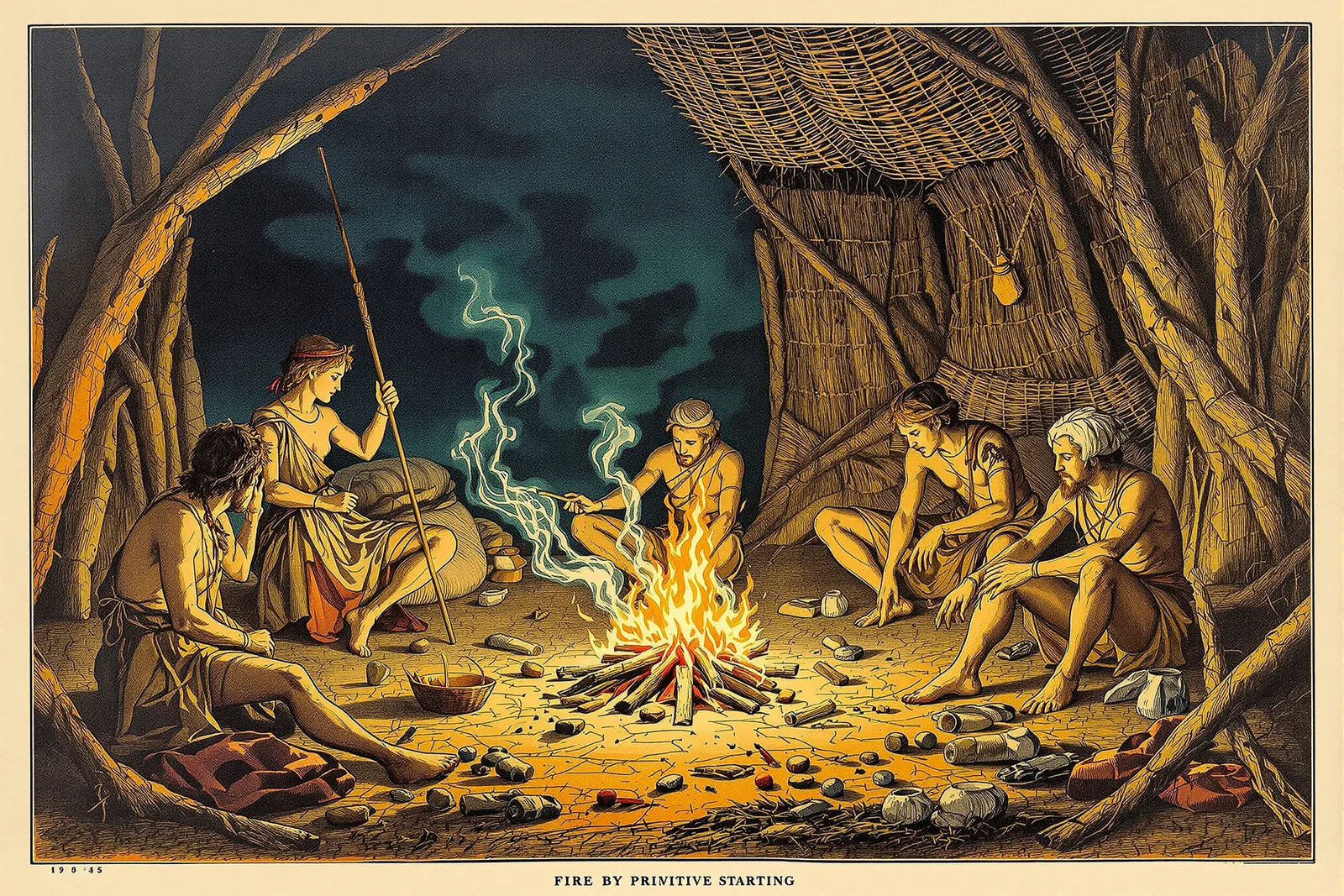
The Complete Fire by Friction, Primitive Fire Starting, and Ember Creation Guide
A Sovereignty Module of the Practitioner Community
Preamble
Fire is the master technology. It cooks food, purifies water, provides warmth, gives light, hardens tools, fires pottery, smelts metal, and signals for rescue. Fire by friction — creating an ember through the heat generated by rubbing wood against wood — is the foundational fire-starting skill. No matches, no lighter, no ferro rod. Just wood, technique, and persistence. This campaign covers bow drill, hand drill, fire plow, and tinder preparation.
Part I: Fire by Friction Methods
Chapter 1: Method Comparison
| Method | Difficulty | Speed | Materials | Reliability |
|---|---|---|---|---|
| Bow drill | Moderate | 30 sec - 5 min | Spindle, fireboard, bow, socket, cordage | Very high |
| Hand drill | Hard | 1-10 min | Spindle, fireboard (no other tools) | Moderate |
| Fire plow | Hard | 2-15 min | Hardwood stick, softwood base | Moderate |
| Pump drill | Moderate | 1-5 min | Weighted spindle, crossbar, cordage | High |
| Fire saw | Hard | 2-10 min | Bamboo or hardwood pieces | Moderate (tropical) |
Chapter 2: Bow Drill Components
| Component | Material | Specifications |
|---|---|---|
| Fireboard | Soft, dry wood (cottonwood, willow, cedar, basswood) | Flat board 12-18 inches long, 3/4 inch thick, 3-4 inches wide |
| Spindle | Same wood as fireboard or slightly harder | Straight, dry, 12-18 inches long, 3/4 inch diameter, rounded ends |
| Bow | Slightly curved stick, sturdy | 24-30 inches long, slight natural curve, strong enough not to flex |
| Cord | Paracord, rawhide, plant fiber cordage, shoelace | Must grip spindle without slipping — slight roughness helps |
| Socket (handhold) | Hardwood, bone, stone, shell with depression | Must be harder than spindle — lubricate with oil, wax, or green leaves |
| Tinder bundle | Dry, fibrous material | Cedar bark, cattail fluff, dried grass, birch bark shreddings |
Chapter 3: Bow Drill Technique
| Step | Action | Details |
|---|---|---|
| 1. Carve notch | Cut V-shaped notch in fireboard edge, 1/8 of circle | Notch collects hot dust that becomes the ember |
| 2. Burn in | Drill a depression in fireboard to seat spindle | Just enough to keep spindle from wandering |
| 3. Place catch | Put bark chip or leaf under notch to catch ember | Ember falls through notch onto catch material |
| 4. Wrap spindle | Loop bowstring once around spindle | Spindle should be snug but able to spin |
| 5. Position | Kneel, left foot on fireboard near spindle hole | Wrist locked against shin for stability |
| 6. Socket on top | Press socket down on spindle top with left hand | Firm downward pressure — this creates friction |
| 7. Bow stroke | Full-length strokes, parallel to ground, steady rhythm | Speed matters less than consistency and pressure |
| 8. Build speed | When smoke appears, increase speed and pressure | Smoke = you're close. Push through the burn. |
| 9. Stop | When thick smoke rises from notch AFTER you stop drilling | The dust pile in the notch is now a glowing ember |
| 10. Transfer | Gently lift fireboard, tip ember onto tinder bundle | Don't rush — the ember will glow for 30-60 seconds |
| 11. Blow | Fold tinder around ember, blow steadily | Gentle, steady breath — not hard puffs. Nurse the flame. |
| 12. Flame | Tinder ignites — place into prepared fire lay | Have your fire lay (kindling, fuel) ready BEFORE you start |
Chapter 4: Wood Pairing Guide
| Spindle Wood | Fireboard Wood | Quality | Notes |
|---|---|---|---|
| Cottonwood | Cottonwood | Excellent | The gold standard — easy ember, widely available |
| Willow | Willow | Excellent | Very soft, fast ember |
| Cedar | Cedar | Very good | Aromatic, good in dry climates |
| Basswood | Basswood | Very good | Soft, consistent |
| Aspen | Aspen | Good | Similar to cottonwood |
| Mulefat | Mulefat | Good | Western US, traditional |
| Clematis | Clematis | Good | Vine — natural spindle shape |
| Yucca | Yucca | Good | Desert regions, fibrous |
The Rule: Both spindle and fireboard must be DRY. Not damp, not green, not "mostly dry." Bone dry. Test: snap a piece — it should break cleanly with a snap, not bend or show green fibers.
Chapter 5: Tinder Preparation
| Material | Quality | Preparation | Where Found |
|---|---|---|---|
| Cedar bark (inner) | Excellent | Shred into fine fibers, form loose ball | Cedar trees — peel strips, shred |
| Cattail fluff | Excellent | Collect seed heads, fluff into ball | Wetland edges, ponds |
| Dried grass | Good | Bundle fine dry grass into bird-nest shape | Fields, meadows |
| Birch bark (thin) | Excellent | Peel thin layers, shred finely | Birch trees — outer bark |
| Tinder fungus | Excellent | Slice thin, fluff inner fibers | Dead birch trees (Fomes fomentarius) |
| Char cloth | Excellent | Cotton cloth charred in tin without oxygen | Made from cotton fabric scraps |
| Fatwood | Good (kindling) | Shave fine curls from resin-rich pine | Dead pine stumps, heartwood |
Chapter 6: The Practitioner Fire Reference Card
DRY WOOD IS THE #1 REQUIREMENT: Technique cannot overcome wet wood. If your fireboard or spindle is damp, you will exhaust yourself and produce only smoke. Test dryness: snap test (clean break), fingernail test (dents easily = too soft/wet), and sound test (dry wood sounds hollow when tapped).
DOWNWARD PRESSURE CREATES FRICTION: Speed without pressure creates smoke but no ember. Pressure without speed creates heat but not enough. The combination of firm downward pressure AND steady speed creates the 800°F needed to ignite wood dust.
PREPARE EVERYTHING BEFORE YOU DRILL: Fire lay built, tinder bundle shaped, kindling sorted by size, fuel wood stacked. When that ember lights your tinder, you have 30 seconds to build it into a fire. Preparation is everything.
THE EMBER IS ALIVE: A friction ember glows at 800-1000°F but is tiny and fragile. Treat it like a newborn — gentle transfer, protective tinder nest, steady breath. Don't rush. Don't panic. Nurse it.
REMEMBER: Fire by friction is the most fundamental human technology. It requires no tools that cannot be made from natural materials in minutes. A Practitioner who can make fire from wood has warmth, water purification, cooking, light, and signaling capability anywhere on Earth, in any condition, with no supply chain. This is sovereignty at its most elemental.
Council Approval
All 12 voices unanimously approve. Complete fire-by-friction sovereignty.
Council Result: 12/12 APPROVED. Campaign 126 is complete.