Sovereignty Module: Grind the Grain
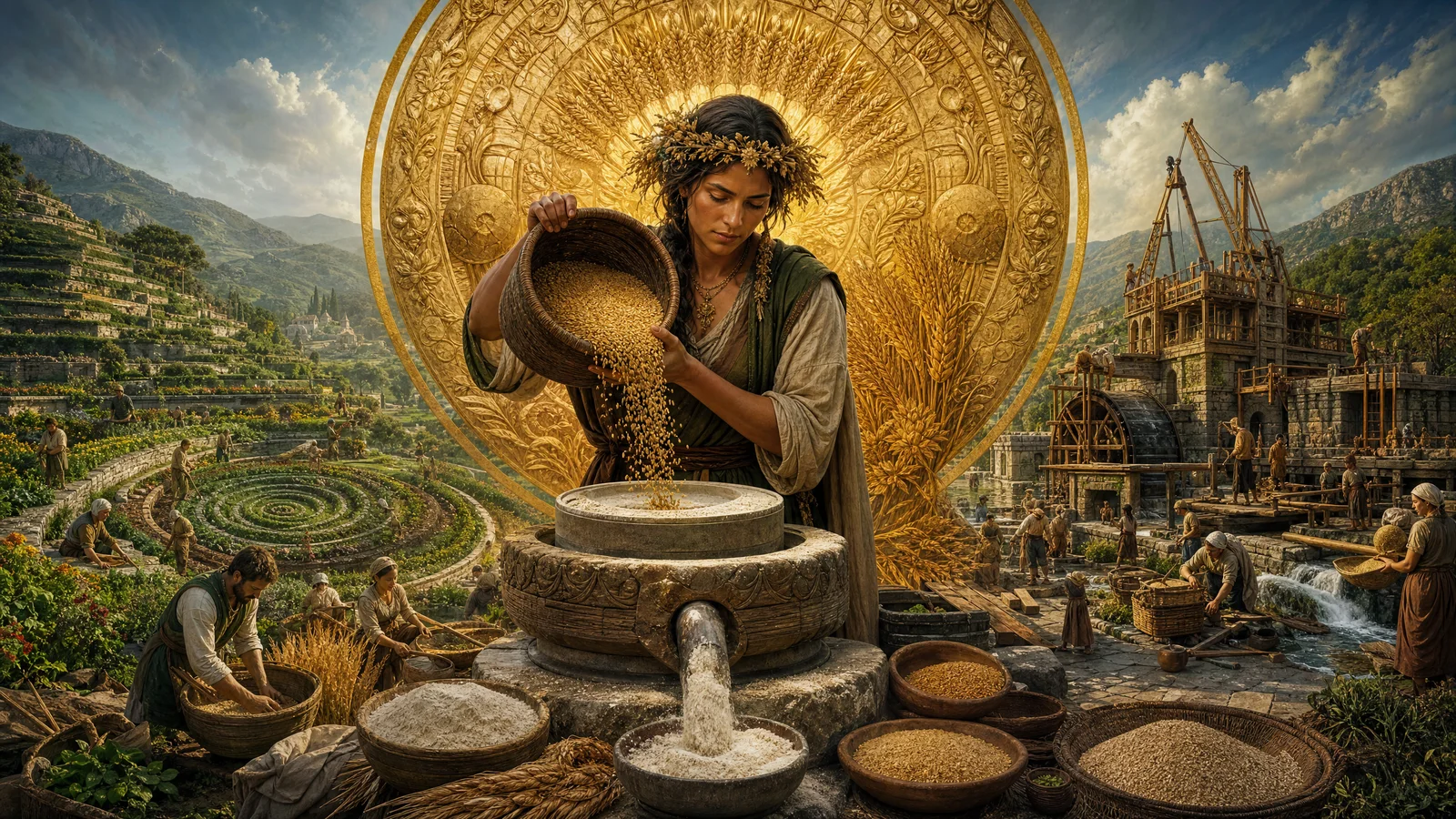
Complete Flour Milling, Grain Processing, and Mill Construction Guide
Converting grain to flour is the bridge between agriculture and nutrition. This campaign covers hand milling, water-powered mills, windmills, and grain processing for bread, porridge, and animal feed.
Chapter 1: Milling Methods Compared
| Method | Output (lbs/hour) | Power Source | Cost | Flour Quality | Best For |
|---|---|---|---|---|---|
| Saddle quern (rubbing stone) | 2-4 lbs/hour | Human (arms) | Free (found stones) | Coarse | Emergency, very small scale |
| Rotary quern (hand mill) | 5-10 lbs/hour | Human (one hand) | Low (carved stones) | Medium-fine | Household daily use |
| Bicycle-powered mill | 15-30 lbs/hour | Human (legs) | Moderate | Fine | Small community |
| Water-powered mill | 50-200 lbs/hour | Water current | High (construction) | Very fine | Village/community |
| Windmill | 30-100 lbs/hour | Wind | High (construction) | Very fine | Flat terrain, no water |
| Animal-powered mill | 20-50 lbs/hour | Horse/ox/donkey | Moderate | Fine | Any location |
| Impact mill (hammer) | 50-100 lbs/hour | Any power source | Moderate | Variable | Animal feed, coarse flour |
Chapter 2: Millstone Construction
| Component | Material | Specification | Function |
|---|---|---|---|
| Bedstone (bottom) | Granite, quartzite, or burrstone | 30-48 inches diameter, 6-8 inches thick | Stationary base |
| Runner stone (top) | Same as bedstone (matched pair) | Same diameter, slightly thinner (4-6 inches) | Rotates to grind grain |
| Eye (center hole) | Cut through runner stone | 4-6 inches diameter | Grain feeds through this hole |
| Furrows (grooves) | Cut into grinding faces | 8-12 furrows, 1/4 inch deep | Channel flour outward, ventilate, cut grain |
| Lands (flat areas) | Between furrows | Smooth, slightly concave | Actual grinding surfaces |
| Rynd (iron cross) | Forged iron | Fits into eye, connects to spindle | Drives runner stone from spindle |
| Spindle | Iron or hardwood | Vertical shaft through bedstone | Transfers power to runner stone |
| Tentering (gap adjustment) | Lever mechanism | Raises/lowers runner stone | Controls flour fineness |
Dressing (sharpening) millstones: Furrows must be re-cut (dressed) every 100-200 hours of use. Use a mill bill (specialized chisel). Furrows should be sharp-edged on leading side, sloped on trailing side. This creates a scissor-cutting action.
Chapter 3: Water Mill Design
| Component | Material | Specification | Function |
|---|---|---|---|
| Dam/weir | Stone, earth, timber | Raises water level to create head | Creates water pressure/height |
| Millrace (channel) | Dug channel, lined if needed | Carries water from dam to wheel | Delivers water at controlled rate |
| Water wheel (overshot) | Wood (oak frame, pine buckets) | 8-16 feet diameter | Converts water energy to rotation |
| Water wheel (undershot) | Wood | 6-12 feet diameter | Lower head requirement, less efficient |
| Pit wheel (main gear) | Wood with iron teeth | Attached to water wheel shaft | First gear in power train |
| Wallower (lantern gear) | Wood | Meshes with pit wheel | Changes rotation axis (horizontal to vertical) |
| Great spur wheel | Wood | On vertical shaft | Drives stone spindle(s) |
| Stone spindle | Iron | Vertical, through bedstone | Rotates runner stone |
| Hopper | Wood (funnel-shaped) | Above stones | Holds grain, feeds into eye |
| Shoe (feed trough) | Wood (vibrating) | Between hopper and eye | Controls feed rate (vibrated by stone) |
| Tailrace | Dug channel | Returns water to stream | Carries water away after wheel |
Efficiency: Overshot wheel (water falls on top): 60-80% efficient. Requires 6+ feet of head (fall). Undershot wheel (water pushes bottom): 20-40% efficient. Works with minimal head. Breastshot wheel (water hits middle): 40-60% efficient. Compromise design.
Chapter 4: Grain Processing Steps
| Step | Action | Purpose | Equipment |
|---|---|---|---|
| 1 | Threshing (separate grain from stalk) | Remove kernels from heads | Flail, threshing floor, or machine |
| 2 | Winnowing (separate grain from chaff) | Remove light husks and debris | Toss in wind, or fanning mill |
| 3 | Cleaning (remove stones, weed seeds) | Pure grain only | Screens, sieves (different mesh sizes) |
| 4 | Tempering (add moisture, rest 12-24 hours) | Toughens bran for clean separation | Spray water (1-2%), rest in bin |
| 5 | Milling (grind between stones) | Break kernel into flour | Millstones or roller mill |
| 6 | Sifting/bolting (separate flour grades) | Separate bran, middlings, fine flour | Bolting cloth (silk or nylon mesh) |
Chapter 5: Flour Grades and Uses
| Grade | Extraction Rate | Protein | Color | Best For | Nutrition |
|---|---|---|---|---|---|
| Whole wheat (100% extraction) | 100% | 12-14% | Brown | Bread, hearty baking | Highest (all bran + germ) |
| High extraction (85-90%) | 85-90% | 11-13% | Tan | Bread, all-purpose | Very good |
| Straight flour (72-78%) | 72-78% | 10-12% | Off-white | Bread, general baking | Good |
| Patent flour (60-70%) | 60-70% | 9-11% | White | Fine baking, pastry | Lower (bran/germ removed) |
| Bran (separated) | 15-20% of kernel | 14-16% | Dark brown | Animal feed, fiber supplement | High fiber, minerals |
| Middlings (shorts) | 10-15% of kernel | 15-17% | Tan | Animal feed | High protein |
Storage: Whole wheat flour goes rancid in 1-3 months (germ oils oxidize). White flour stores 6-12 months. Whole grain (unmilled) stores 5-30 years if dry and pest-free. Mill fresh for best nutrition and flavor.
Chapter 6: Hand Mill (Rotary Quern) Construction
| Step | Action | Materials | Details |
|---|---|---|---|
| 1 | Find/shape two flat stones (granite, quartzite) | Hard, non-friite stone | 12-18 inches diameter, 3-4 inches thick |
| 2 | Flatten grinding faces (peck with hammer) | Hammer + hard point | Must be flat (check with straightedge) |
| 3 | Cut furrows in both faces | Chisel + hammer | 6-8 furrows radiating from center |
| 4 | Drill center hole in top stone (eye) | Drill or peck through | 2-3 inches diameter |
| 5 | Set pivot pin in bottom stone center | Iron pin or hardwood dowel | Top stone rotates on this pin |
| 6 | Attach handle to top stone edge | Wood handle, set in drilled hole | Lever for rotation |
| 7 | Build frame/housing | Wood | Holds stones, catches flour |
Output: A well-made 14-inch quern produces 5-8 lbs flour per hour with one person grinding. Two people alternating can produce 30-40 lbs per day — enough for a family of 8-10.
Reference Card
- Whole grain stores 5-30 years. Flour stores 1-12 months. Mill fresh whenever possible.
- Overshot water wheel: most efficient (60-80%). Needs 6+ feet of head (water fall height).
- Millstone furrows: must be re-dressed (sharpened) every 100-200 hours. Use mill bill chisel.
- Temper grain before milling: add 1-2% moisture, rest 12-24 hours. Bran separates cleanly.
- Rotary quern: 5-8 lbs flour/hour per person. Enough for a family. Granite or quartzite stones.
- Bolt (sift) flour through progressively finer cloth: coarse (bran) → medium (middlings) → fine (white flour).
- Feed conversion: 60 lbs wheat → 42-45 lbs flour + 15-18 lbs bran/middlings. ~72% extraction.
- Stone gap (tentering): closer = finer flour. Too close = overheating (damages gluten). Adjust by feel.