Sovereignty Module: Harness the Beast
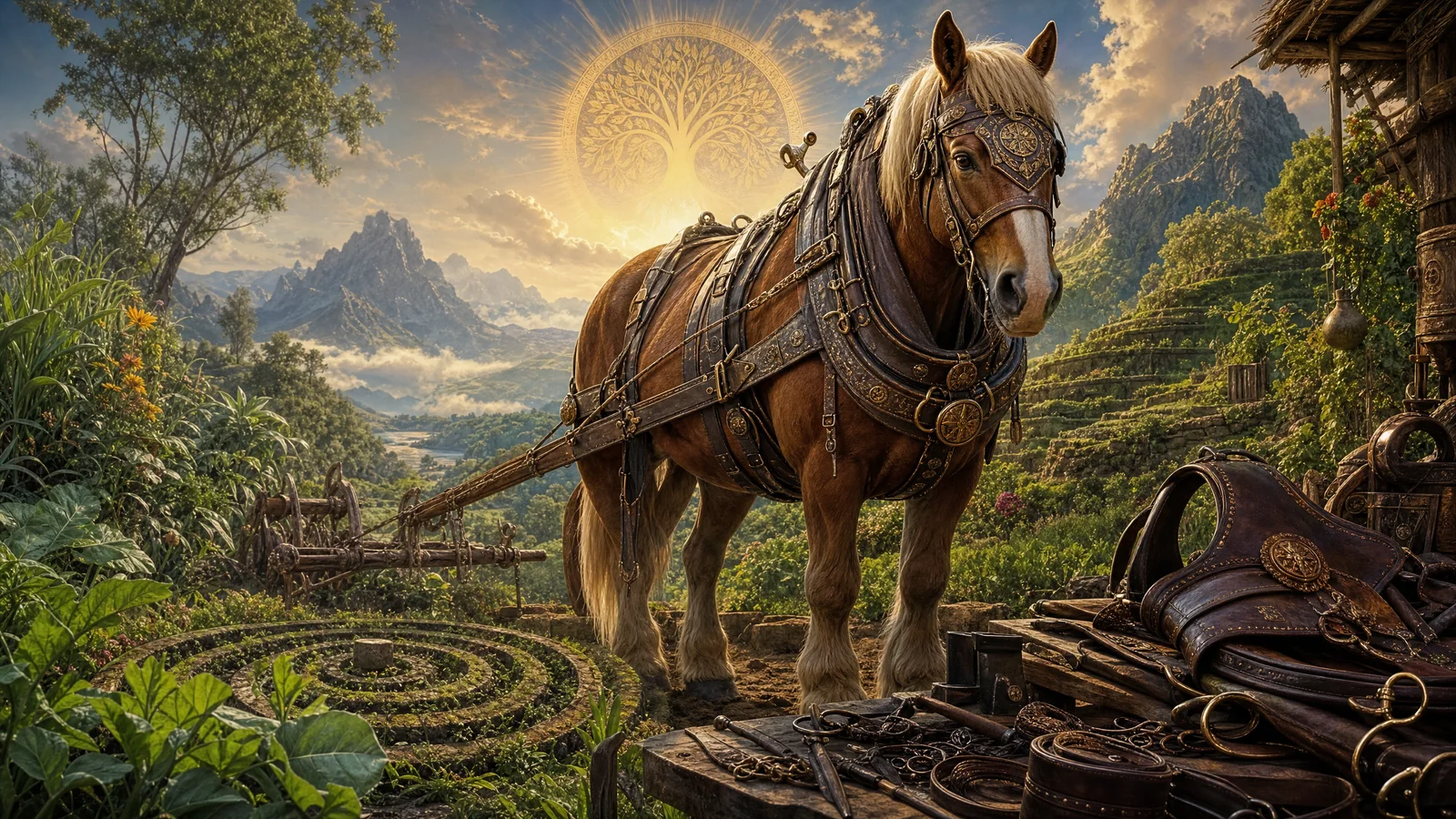
Harness the Beast
Complete Saddlery, Harness Making, and Draft Animal Equipment Guide
Complete Saddlery, Harness Making, and Draft Animal Equipment Guide
Draft animals multiply human labor tenfold. This campaign covers saddle construction, harness fitting, yoke building, and working animal management.
Chapter 1: Draft Animal Comparison
| Animal | Pull Capacity | Speed | Endurance | Feed Requirement | Terrain | Best For |
|---|---|---|---|---|---|---|
| Heavy horse (draft) | 1,500-2,000 lbs | 2-4 mph | 6-8 hours/day | 20-30 lbs grain + hay/day | Flat, soft ground | Plowing, heavy hauling |
| Light horse | 800-1,200 lbs | 3-6 mph | 8-10 hours/day | 15-25 lbs grain + hay/day | All terrain | Transport, light farming |
| Mule | 1,000-1,500 lbs | 2-4 mph | 10-12 hours/day | 15-20 lbs grain + hay/day | Rough terrain | Mountains, heat, endurance |
| Ox (pair) | 2,000-3,000 lbs | 1.5-2.5 mph | 6-8 hours/day | Hay/pasture (no grain needed) | Any (slow) | Heavy work, poor feed areas |
| Donkey | 200-400 lbs | 2-3 mph | 8-10 hours/day | 5-10 lbs hay (minimal grain) | Rough, dry terrain | Pack, light cart, guard |
| Water buffalo | 1,500-2,000 lbs | 1.5-3 mph | 6-8 hours/day | Hay/pasture + water access | Wet, muddy (rice paddies) | Wet agriculture |
Chapter 2: Collar Harness Construction
| Component | Material | Dimensions | Function |
|---|---|---|---|
| Collar | Leather-covered, straw/kapok stuffed | Fitted to individual horse (measured) | Distributes pull force across shoulders |
| Hames | Wood or metal (curved to fit collar) | Match collar curvature | Attach traces to collar |
| Traces (tugs) | Heavy leather or chain | Long enough to reach singletree | Transfer pull from hames to implement |
| Backband | Leather strap over back | Fits over back behind withers | Supports traces, prevents dragging |
| Breeching | Leather strap around hindquarters | Fits around rump | Braking/backing (holds back load on hills) |
| Belly band | Leather strap under belly | Snug but not tight | Holds shafts up (single horse) |
| Reins (lines) | Leather or rope | Long enough to reach driver | Steering and control |
| Bridle + bit | Leather + metal | Fitted to head | Control and communication |
Chapter 3: Yoke Construction (Oxen)
| Yoke Type | Best For | Construction | Fitting |
|---|---|---|---|
| Head yoke | Young/training oxen | Single beam, attached behind horns with straps | Must fit behind horn base, padded |
| Neck yoke (bow yoke) | Mature working oxen (American style) | Beam + U-shaped bows under neck | Bow must fit loosely (2 fingers clearance) |
| Withers yoke | Heavy pulling (European style) | Beam resting on withers, padded | Padded well, distributes weight on shoulders |
Bow yoke construction: Beam (oak or hickory): 4×6 inches, length = span between oxen + 8 inches per side. Bows (hickory, steamed and bent): U-shape, 3/4 inch diameter. Holes in beam for bow ends. Pin bows with wooden keys. Rings or staples for chain attachment at center and ends.
Chapter 4: Saddle Construction
| Component | Material | Function | Construction Notes |
|---|---|---|---|
| Tree (frame) | Wood (beech, poplar) covered in rawhide | Structural skeleton | Must fit horse's back. Two bars + fork + cantle. |
| Bars | Wood, shaped to horse's back | Distribute rider weight | Angle must match horse's back slope |
| Fork (pommel) | Wood, front arch | Clears withers, front attachment | Must clear withers by 2-3 fingers |
| Cantle | Wood, rear arch | Rear support for rider | Height varies by style (Western: high, English: low) |
| Seat | Leather over padding | Rider comfort | Stretched wet, shaped, dried to form |
| Skirts | Heavy leather | Protect horse from stirrup bars | Lined with sheepskin or felt |
| Rigging (cinch) | Leather + metal rings | Holds saddle on horse | Position: 7/8, 3/4, or center-fire |
| Stirrups | Wood, metal, or leather-covered | Foot support for rider | Hung from bars via fenders |
| Fenders | Leather panels | Protect rider's legs from sweat | Between stirrup leathers and horse |
Chapter 5: Fitting and Care
| Issue | Symptom | Cause | Solution |
|---|---|---|---|
| Collar too tight | White hair, sores on shoulders | Collar pressing on bone | Refit collar (larger or reshape stuffing) |
| Collar too loose | Slides side to side, rubs | Collar too large | Pad or restuff to fit snugly |
| Saddle bridging | Sores at front and back of bars | Bars don't match back curve | Refit tree or add shimming |
| Saddle too narrow | Pinching at withers, muscle atrophy | Tree too narrow for horse | Wider tree required |
| Girth sores | Raw skin behind elbows | Dirty girth, poor fit, too tight | Clean girth, proper tension, sheepskin cover |
| Bit too harsh | Head tossing, mouth sores | Bit too severe for horse | Softer bit (snaffle), check hands |
Chapter 6: Working Animal Management
| Principle | Rule | Reason |
|---|---|---|
| Conditioning | Build work gradually (2-4 weeks) | Prevents injury, builds muscle |
| Rest | 1 day off per 6 days worked | Recovery, prevents burnout |
| Water | Offer water every 2 hours during work | Dehydration reduces performance 30%+ |
| Feed | Grain 1 hour before work, hay after | Full stomach during work = colic risk |
| Hoof care | Trim every 6-8 weeks, shoe if on hard ground | Lameness = no work |
| Harness inspection | Check daily before work | Worn leather breaks under load = runaway |
| Heat management | Stop work if panting/sweating excessively | Heat stroke kills working animals |
| Weight limits | Pull: 10-15% of body weight (sustained) | Overloading causes injury and breakdown |
Reference Card
- Collar fit: must sit on shoulders (not windpipe). Two fingers between collar and neck at sides.
- Ox yoke: bow must fit loosely (2 fingers clearance). Tight bow = choking. Loose = slipping.
- Saddle tree must match horse's back. Wrong fit = sores, muscle atrophy, behavioral problems.
- Draft horse pull capacity: 10-15% of body weight for sustained work. Short bursts: up to 50%.
- Mules: superior to horses in heat, rough terrain, and endurance. Eat less. Fewer injuries. Smarter.
- Oxen: no grain needed (pasture/hay only). Slower but cheaper to maintain. Eat their retirement (beef).
- Condition animals gradually: 2-4 weeks of increasing work before full days. Prevents injury.
- Inspect harness daily: one broken strap under load = runaway = death/destruction.
TransmissionCOMPLETE — unaltered & unabridged
Words1,147 — every one of them
SHA-256 of source text70e540d45044080c2c4e66451424ce340b4ee07797da4346253b6143a5f94f83
Canonical textdownload campaign-saddlery.md — byte-identical to what this page renders