Sovereignty Module: Shape the Light
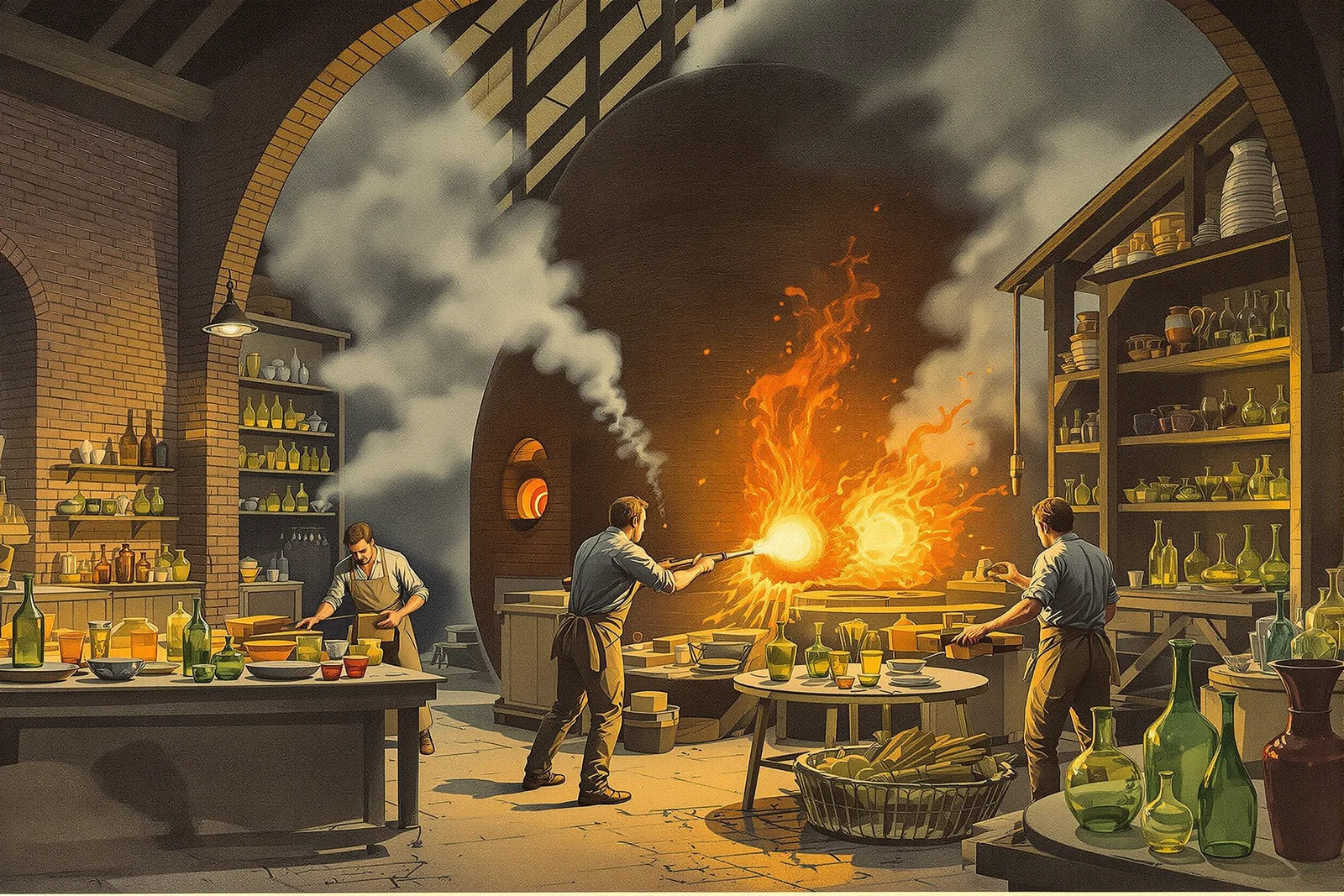
Complete Glassmaking, Lens Grinding, and Optical Instruments Guide
The Philosophy of Glass
Glass is solidified light. It is the only material that is simultaneously transparent, impermeable, chemically inert, and infinitely recyclable. Glass gives us windows (light without weather), containers (storage without contamination), lenses (vision correction, magnification, telescopes, microscopes), and laboratory equipment (chemistry becomes possible). A community that can make glass has access to advanced optics, sealed storage, scientific instruments, and solar energy concentration. This campaign covers glass production from raw sand to finished optical instruments.
Chapter 1: Glass Composition and Raw Materials
Basic Glass Formula:
| Component | Percentage | Source | Function |
|---|---|---|---|
| Silica (SiO2) | 70-75% | Clean sand, crushed quartz | Glass former (the actual glass) |
| Soda (Na2O) | 12-15% | Soda ash (burned seaweed), natron, or washing soda | Flux (lowers melting point from 1,700C to 1,000-1,200C) |
| Lime (CaO) | 8-12% | Limestone, chalk, crusite shells | Stabilizer (prevents glass from dissolving in water) |
| Alumina (Al2O3) | 1-3% | Feldspar, clay | Improves durability and chemical resistance |
Alternative Flux Sources (if soda ash unavailable):
| Source | Active Component | Preparation |
|---|---|---|
| Wood ash (hardwood) | Potash (K2O) | Burn hardwood, leach ash, evaporate liquid |
| Seaweed ash (kelp) | Soda (Na2O) | Burn dried seaweed, collect ash |
| Natron (mineral) | Sodium carbonate | Mine from dry lake beds |
| Borax (mineral) | Boron oxide | Mine or purchase |
| Lead oxide | PbO | From lead smelting (produces lead crystal glass) |
Sand Quality Requirements:
| Property | Requirement | Test |
|---|---|---|
| Silica content | 95%+ | White or clear sand (not brown/red) |
| Iron content | Below 0.1% (for clear glass) | Brown/green tint = too much iron |
| Grain size | Fine, uniform | Sieve through fine mesh |
| Organic matter | None | Wash thoroughly, no dark particles |
Best sources: beach sand (washed), crushed quartz/quartzite, sandstone (crushed and washed).
Chapter 2: Furnace Construction
Glass Furnace Types:
| Type | Temperature | Fuel | Capacity | Complexity |
|---|---|---|---|---|
| Pot furnace | 1,000-1,200C | Wood, charcoal, coal, gas | 10-100 lbs per pot | Moderate |
| Tank furnace | 1,200-1,500C | Gas, coal | Continuous production | High |
| Crucible (small scale) | 1,000-1,200C | Charcoal + forced air | 1-5 lbs | Low |
Building a Simple Pot Furnace:
- Foundation: Fireproof base (firebrick or stone)
- Firebox: Lower chamber where fuel burns (with grate and ash pit below)
- Melting chamber: Upper chamber containing the crucible/pot with glass batch
- Flue: Chimney directing exhaust upward (creates draft)
- Ports: Openings for adding batch, gathering glass, and stoking fire
- Insulation: Thick walls of firebrick or refractory clay (12+ inches)
Refractory Materials (withstand high temperature):
| Material | Max Temperature | Source |
|---|---|---|
| Firebrick (alumina-silica) | 1,500-1,700C | Purchased or salvaged from kilns |
| Refractory clay (kaolin) | 1,400-1,600C | Natural clay deposits (white/grey clay) |
| Castable refractory | 1,500C+ | Portland cement + alumina aggregate |
| Vermiculite insulation | 1,100C | Purchased (lightweight, insulating) |
Chapter 3: Melting and Working Glass
Batch Preparation:
- Weigh ingredients precisely (70% sand, 15% soda ash, 12% limestone, 3% other)
- Mix thoroughly (dry mixing)
- Add cullet (broken glass) at 20-50% of batch weight (lowers melting point, improves homogeneity)
- Load into preheated crucible/pot gradually (batch expands as it melts)
Melting Process:
| Stage | Temperature | Duration | What Happens |
|---|---|---|---|
| Batch melting | 800-1,000C | 2-4 hours | Raw materials begin to fuse |
| Fining (refining) | 1,200-1,400C | 2-6 hours | Bubbles rise and escape; glass becomes clear |
| Working temperature | 900-1,100C | Maintained | Glass is viscous enough to shape |
| Annealing | 450-550C | Hours to days | Slow cooling removes internal stress |
Glass Working Techniques:
| Technique | Method | Products |
|---|---|---|
| Free blowing | Gather molten glass on blowpipe, inflate with breath, shape with tools | Bottles, vessels, ornaments |
| Mold blowing | Blow glass into a mold (wood, metal, or clay) | Uniform bottles, jars |
| Casting | Pour molten glass into a mold | Flat glass (windows), thick pieces |
| Drawing | Pull molten glass into sheets or tubes | Window glass, tubing |
| Pressing | Press molten glass into a mold with a plunger | Lenses, flat pieces, dishes |
| Lampworking | Melt glass rod/tube in a flame, shape with tools | Small items, laboratory glass, beads |
Chapter 4: Flat Glass (Windows)
Crown Glass Method (traditional):
- Gather a large ball of glass on the blowpipe
- Blow into a large bubble
- Transfer to a pontil (solid iron rod) on the opposite side
- Open the bubble where the blowpipe was attached
- Spin rapidly: centrifugal force opens the bubble into a flat disk (up to 5 feet diameter)
- Cut rectangular panes from the disk (the center "bullseye" where the pontil was attached is thicker)
Cylinder Glass Method (larger, flatter panes):
- Blow a large elongated bubble (cylinder shape)
- Cut off both ends while hot
- Slit the cylinder lengthwise
- Reheat in a flattening oven until it opens and lies flat
- Anneal slowly
- Result: flat sheet of glass, cut to desired pane size
Float Glass (modern method, if rebuilding industry):
Molten glass is poured onto a bath of molten tin. Glass floats on the tin (perfectly flat on both sides) and gradually cools as it moves along the bath. Produces perfectly flat, uniform glass. Requires industrial scale.
Chapter 5: Lens Making
Lens Types and Uses:
| Lens Type | Shape | Effect | Use |
|---|---|---|---|
| Convex (converging) | Thicker in middle | Focuses light to a point | Magnifying glass, reading glasses, telescope objective |
| Concave (diverging) | Thinner in middle | Spreads light apart | Nearsightedness correction, telescope eyepiece |
| Plano-convex | Flat one side, curved other | Focuses light (simpler to make) | Simple magnifier, burning lens |
| Double convex (biconvex) | Both sides curved outward | Strong focusing | Magnifying glass, camera lens |
| Meniscus | One side convex, other concave | Corrects aberrations | Eyeglasses |
Grinding a Lens:
- Start with a disk of clear glass (cast or cut from flat glass)
- Rough grind: rub against a curved tool (concave for convex lens) with coarse abrasive (silicon carbide grit, 80-120 grit) and water
- Fine grind: progressively finer abrasives (220, 400, 600 grit) to remove scratches from previous stage
- Polish: use cerium oxide or rouge (iron oxide) on a pitch lap (layer of pitch on a flat tool) until surface is optically clear
- Test: look through lens at a distant point source of light; if image is sharp and round, the lens is good
Focal Length:
The distance from the lens to the point where parallel light rays converge. Determined by the curvature of the lens surfaces. Flatter curves = longer focal length. Steeper curves = shorter focal length.
Chapter 6: Optical Instruments
Simple Magnifying Glass:
A single convex lens. Magnification = 25cm (normal reading distance) divided by focal length. A 5cm focal length lens gives 5x magnification.
Telescope (refracting):
| Component | Type | Function |
|---|---|---|
| Objective lens | Large convex (long focal length) | Gathers light, forms image |
| Eyepiece lens | Small convex (short focal length) | Magnifies the image |
| Tube | Any opaque tube | Holds lenses at correct distance apart |
Magnification = Objective focal length / Eyepiece focal length Example: 100cm objective / 2cm eyepiece = 50x magnification
Galileo built his first telescope from spectacle lenses in a lead tube. It changed human understanding of the universe.
Microscope (compound):
| Component | Type | Function |
|---|---|---|
| Objective lens | Very short focal length convex (close to specimen) | Creates magnified image |
| Eyepiece lens | Short focal length convex | Further magnifies the image |
| Stage | Flat platform with hole | Holds specimen |
| Mirror/light | Concave mirror or lamp below stage | Illuminates specimen from below |
Total magnification = Objective magnification x Eyepiece magnification Example: 40x objective x 10x eyepiece = 400x total (enough to see bacteria)
Spectacles (vision correction):
| Condition | Lens Type | Focal Length |
|---|---|---|
| Farsightedness (cannot read up close) | Convex (converging) | Positive (longer = weaker correction) |
| Nearsightedness (cannot see far) | Concave (diverging) | Negative |
| Presbyopia (age-related, cannot focus close) | Convex (reading glasses) | +1 to +3 diopters typically |
Chapter 7: Laboratory Glassware
Essential Items for Chemistry:
| Item | Construction | Use |
|---|---|---|
| Beaker | Open cylinder, pour spout | Mixing, heating, measuring |
| Flask (round bottom) | Sphere with neck | Distillation, reactions |
| Flask (Erlenmeyer) | Cone with narrow neck | Mixing (swirl without spilling) |
| Condenser | Tube within tube (water jacket) | Cooling vapors to liquid |
| Retort | Flask with built-in downward spout | Simple distillation |
| Test tube | Small closed-end tube | Small-scale reactions, testing |
| Funnel | Cone with stem | Filtering, pouring |
| Thermometer | Sealed tube with bulb containing colored alcohol | Temperature measurement |
| Graduated cylinder | Tall cylinder with volume markings | Precise volume measurement |
Lampworking (making lab glass):
Using a torch (propane, MAPP gas, or oxy-propane), heat glass rod or tubing until soft. Shape by blowing, pulling, bending, and joining. This is how all laboratory glassware was traditionally made. A skilled lampworker can produce any piece of lab equipment from glass rod and tubing.
Chapter 8: Glass as Solar Energy Collector
Burning Lens (solar concentrator):
A large convex lens focuses sunlight to a point, achieving temperatures of 1,000-2,000C at the focal point. Uses:
- Fire starting (instant, any weather with sun)
- Metal melting (small quantities)
- Soldering and brazing
- Water purification (solar still with lens-heated evaporation)
- Cauterization (medical)
A 6-inch diameter lens can melt copper. A 12-inch lens can melt steel.
Greenhouse Effect:
Glass transmits visible light (short wavelength) but blocks infrared radiation (long wavelength, heat). Sunlight enters through glass, heats objects inside, which re-radiate as infrared, which cannot escape. Result: interior temperature rises 20-40F above ambient. Applications: food growing (extended season), solar water heating, solar drying.
Chapter 9: Glass Recycling
Glass is 100% recyclable with no loss of quality. Cullet (broken glass) melts at a lower temperature than raw batch, saving 25-30% of energy.
Process:
- Collect broken glass (sort by color if possible: clear, green, brown)
- Remove non-glass contaminants (metal caps, labels, ceramics, stones)
- Crush to small pieces
- Add to furnace batch (replace 20-80% of raw materials with cullet)
- Melt and work as normal
Color Removal:
| Glass Color | Cause | Can It Be Decolorized? |
|---|---|---|
| Green | Iron + chromium | Partially (add manganese dioxide as decolorizer) |
| Brown/amber | Iron + sulfur + carbon | Partially (oxidizing conditions) |
| Blue | Cobalt | No (must dilute with clear cullet) |
| Clear | Low iron, decolorizers added | Already clear |
Chapter 10: Production Planning
Glass Production for a Community:
| Product | Annual Need (50 people) | Glass Required | Notes |
|---|---|---|---|
| Window panes | 20-50 panes | 50-150 lbs | For new construction and replacement |
| Storage containers (jars, bottles) | 100-200 | 50-100 lbs | Food preservation, medicine storage |
| Drinking vessels | 20-50 | 10-25 lbs | Replacement of broken items |
| Laboratory equipment | 5-20 pieces | 5-10 lbs | Chemistry, medicine, distillation |
| Lenses (spectacles, instruments) | 5-10 | 1-2 lbs | Vision correction, scientific instruments |
| Lamp chimneys | 10-20 | 5-10 lbs | For oil/kerosene lamps |
| Total annual production | 120-300 lbs | Achievable with small furnace |
Fuel Requirements:
| Fuel | Amount per lb of Glass | Notes |
|---|---|---|
| Charcoal | 5-8 lbs per lb of glass | Most available fuel |
| Coal | 3-5 lbs per lb of glass | More efficient if available |
| Wood | 10-15 lbs per lb of glass | Least efficient |
| Natural gas | 3-4 cubic feet per lb | Most efficient (if available) |
Reference Card
GLASSMAKING ESSENTIALS:
- Glass = Sand (70%) + Soda (15%) + Lime (12%) melted at 1,000-1,200C
- Cullet (broken glass) lowers melting temperature and improves quality (always add 20%+)
- Anneal all glass slowly (cool from 550C to room temp over hours/days) or it will shatter
- Iron in sand = green/brown glass; use white sand for clear glass
- A convex lens focuses light; a concave lens spreads it
- Telescope = large convex lens (far) + small convex lens (eye)
- Glass is 100% recyclable with zero quality loss
- A 6-inch burning lens can melt copper; a 12-inch lens can melt steel
This campaign provides the complete knowledge to produce glass, lenses, and optical instruments from raw sand. A community with glassmaking capability has windows, sealed storage, scientific instruments, vision correction, solar energy concentration, and the foundation for chemistry and advanced manufacturing. Glass is the material that makes science possible.