Sovereignty Module: Bind the Knowledge
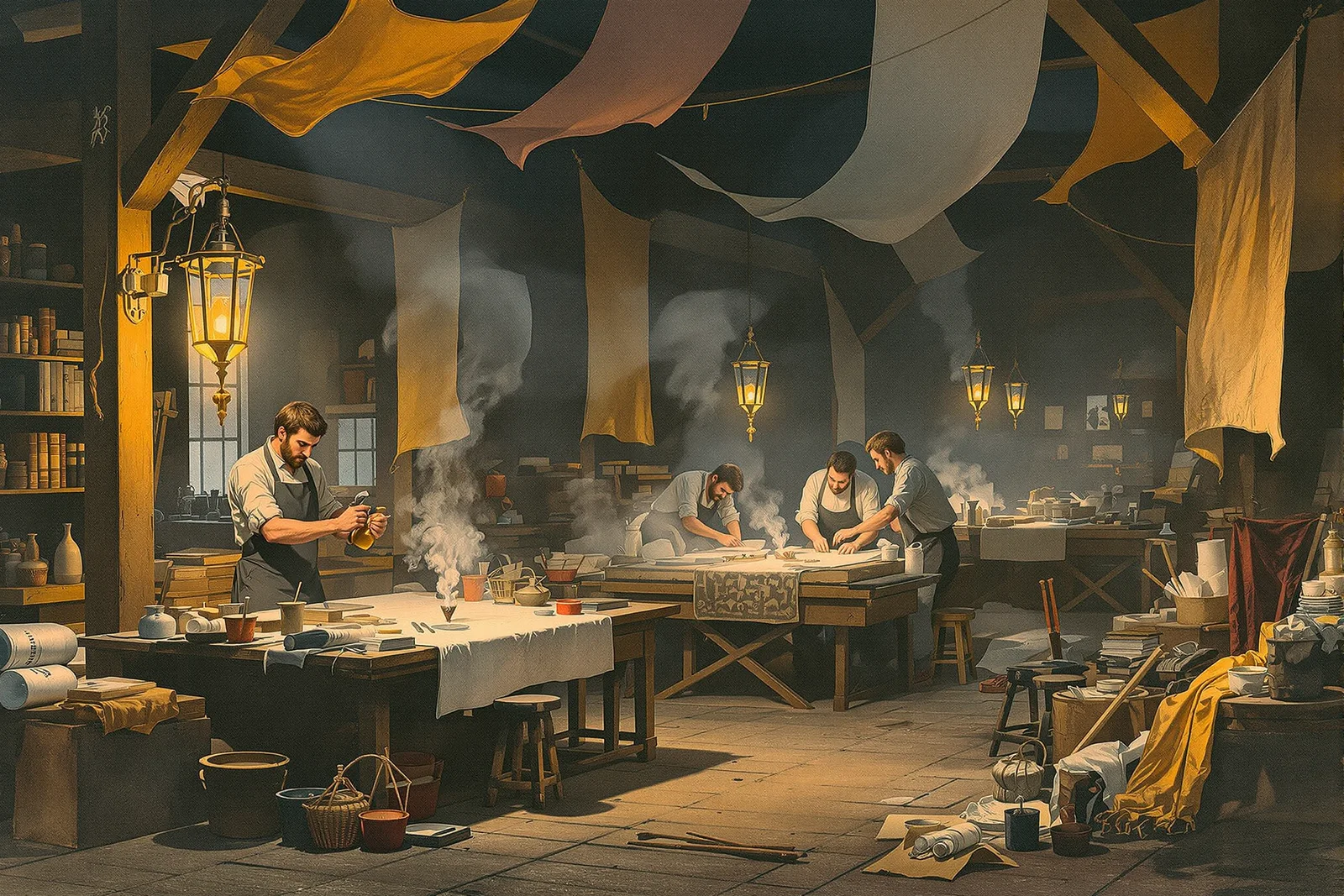
Complete Papermaking, Ink Production, and Bookbinding Guide
The Philosophy of Paper
Knowledge that exists only in memory dies with the knower. Paper is the technology that makes knowledge immortal. A single book can teach a thousand people across a thousand years. Without paper, every generation must relearn everything from scratch. With paper, each generation stands on the shoulders of all who came before. This campaign covers the complete chain from raw plant fiber to bound books ready for a library shelf.
Chapter 1: Fiber Sources for Paper
Plant Fibers Suitable for Papermaking:
| Source | Fiber Quality | Availability | Preparation | Paper Quality |
|---|---|---|---|---|
| Cotton/linen rags | Excellent (long, strong fibers) | Worn-out clothing | Cut, wash, ferment | Archival (lasts centuries) |
| Wood (softwood: pine, spruce) | Good (long fibers) | Abundant | Chip, cook with alkali | Standard (acidifies over decades without treatment) |
| Wood (hardwood: birch, aspen) | Moderate (shorter fibers) | Abundant | Chip, cook with alkali | Smooth, good for printing |
| Hemp/flax stalks | Excellent | Cultivated | Ret, strip bark, cook | Very strong, archival |
| Bamboo | Good | Tropical/subtropical | Split, soak, cook | Strong, smooth |
| Straw (wheat, rice, oat) | Moderate | Agricultural waste | Cook with alkali | Acceptable, slightly weak |
| Papyrus | Good (not true paper) | Wetlands | Slice, layer, press | Ancient method, limited |
| Bark (mulberry, kozo) | Excellent | Trees | Strip, cook, beat | Japanese-style, very strong |
| Corn stalks | Moderate | Agricultural waste | Cook with alkali | Acceptable |
Chapter 2: Pulp Preparation
The Process (overview):
Raw fiber → Cooking (breaks down lignin) → Washing → Beating (fibrillates fibers) → Pulp slurry → Sheet forming → Pressing → Drying → Paper
Cooking (Chemical Pulping):
| Method | Chemical | Temperature | Duration | Result |
|---|---|---|---|---|
| Soda process | Sodium hydroxide (lye) 10-15% | 170-180C (pressure vessel) or boiling for longer | 2-6 hours (pressure) or 8-24 hours (open) | Dissolves lignin, frees cellulose fibers |
| Lime process | Calcium hydroxide (slaked lime) | Boiling | 12-48 hours | Gentler, suitable for rags and soft fibers |
| Fermentation (retting) | Water + bacteria | Ambient | 2-6 weeks | Slowest, no chemicals needed, for rags/bast fibers |
Lye Source: Wood ash leached with water produces potassium hydroxide (potash lye). Stronger: react potash with slaked lime to get caustic potash.
Beating (Fibrillation):
After cooking, fibers must be beaten to separate and fray them. This creates the tiny fibrils that interlock when dried, giving paper its strength.
| Method | Speed | Quality | Scale |
|---|---|---|---|
| Hand beating (wooden mallet on stone) | Slow (hours per batch) | Good | Small |
| Stamping mill (water-powered hammers) | Moderate | Excellent | Medium |
| Hollander beater (rotating blades in trough) | Fast | Excellent (adjustable) | Large |
| Blender (modern, salvaged) | Fast | Good | Small-medium |
Beat until a pinch of pulp in water shows translucent, hair-like fibers when held to light. Under-beating = weak, coarse paper. Over-beating = slow-draining, brittle paper.
Chapter 3: Sheet Forming
Western Method (laid/wove paper):
- Dilute beaten pulp in water (1-3% fiber concentration in a large vat)
- Stir the vat to suspend fibers evenly
- Dip the mould (wooden frame with wire screen) into the vat
- Lift horizontally, allowing water to drain through the screen
- Shake gently side-to-side and front-to-back (interlocks fibers, evens thickness)
- Allow to drain until surface loses wet sheen
- Couch (transfer): flip mould onto a felt/blanket, press to release sheet
- Stack alternating sheets and felts
- Press the stack to remove water (screw press or weighted boards)
- Separate sheets and hang to dry (or dry on smooth boards)
Mould Construction:
| Component | Material | Function |
|---|---|---|
| Frame (mould) | Hardwood, waterproofed | Holds screen, defines sheet size |
| Screen (laid) | Parallel brass/copper wires + cross-wires | Supports pulp, drains water |
| Screen (wove) | Fine wire mesh (window screen works) | Smoother paper surface |
| Deckle | Removable frame on top of mould | Contains pulp, defines sheet edges |
Japanese Method (nagashizuki):
Uses a flexible bamboo screen (su) on a hinged frame. Pulp contains mucilage (from tororo-aoi root) that slows drainage. The papermaker dips, scoops, and rocks the mould multiple times, building up thin layers. Produces extremely thin, strong, uniform paper.
Chapter 4: Paper Sizing and Finishing
Why Size Paper?
Unsized paper absorbs liquid like a sponge (blotting paper). For writing or printing, paper must resist ink penetration so letters remain sharp.
| Sizing Agent | Application Method | Effectiveness | Source |
|---|---|---|---|
| Gelatin (animal glue) | Dip dried sheets in warm gelatin solution | Excellent | Boiled hides, bones, hooves |
| Rosin + alum | Add to pulp before sheet forming (internal sizing) | Good | Pine resin + alum mineral |
| Starch (rice, wheat) | Brush or dip | Good | Grain |
| Egg white (albumen) | Brush on surface | Moderate | Eggs |
| Beeswax (for waterproofing) | Rub or melt onto surface | Excellent waterproofing | Beehives |
Surface Finishing:
| Treatment | Method | Result |
|---|---|---|
| Calendering (burnishing) | Rub with smooth stone or pass between polished rollers | Smooth, glossy surface |
| Hot pressing | Press between heated metal plates | Very smooth, slight gloss |
| Coating (for printing) | Apply clay/chalk slurry, dry, calender | Ultra-smooth (coated paper) |
Chapter 5: Ink Production
Carbon Ink (most permanent):
| Ingredient | Amount | Source | Function |
|---|---|---|---|
| Lampblack (carbon soot) | 1 part | Burn oil/resin, collect soot from a cold surface | Pigment (permanent, lightfast) |
| Gum arabic | 1/2 part | Acacia tree sap (or substitute: cherry gum, honey) | Binder (holds carbon to paper) |
| Water | 3-4 parts | Clean water | Vehicle (carries pigment) |
Preparation: Grind lampblack with gum arabic and small amount of water on a flat stone until perfectly smooth. Gradually add remaining water. Strain through cloth. Age improves quality.
Iron Gall Ink (traditional European writing ink):
| Ingredient | Amount | Source | Function |
|---|---|---|---|
| Oak galls (or tannin-rich bark) | 3 parts | Oak trees (round growths caused by wasps) | Tannin source |
| Iron sulfate (copperas/vitriol) | 1 part | Green crystals from iron + sulfuric acid, or natural mineral | Reacts with tannin to form black |
| Gum arabic | 1 part | Acacia sap | Binder, flow agent |
| Water | 10 parts | Clean water | Solvent |
Preparation: Crush galls, soak in water 3-7 days (or boil 1 hour). Strain. Dissolve iron sulfate in the tannin liquid. Add gum arabic. Ink starts pale but darkens permanently on paper as it oxidizes. Extremely permanent (survives centuries).
Printing Ink (oil-based, for press):
| Ingredient | Function | Source |
|---|---|---|
| Lampblack or bone black | Pigment | Soot or charred bones |
| Linseed oil (boiled/polymerized) | Vehicle/binder | Flax seed, heated until thick |
| Varnish (optional) | Improves flow and gloss | Boiled linseed oil + resin |
Must be thick and tacky (not watery like writing ink). Applied to type with a roller or dabber.
Chapter 6: Writing Instruments
| Instrument | Material | Preparation | Best For |
|---|---|---|---|
| Reed pen | Bamboo or reed stalk | Cut nib at 45°, split center | Large writing, calligraphy |
| Quill pen | Goose/turkey flight feather | Cure (heat/sand), cut nib, split | Fine writing |
| Steel nib pen | Steel (salvaged or forged) | Shape, temper, mount in holder | All writing |
| Brush | Animal hair (sable, squirrel) in bamboo handle | Bind hair bundle, insert in tube | Asian calligraphy, illustration |
| Pencil | Graphite + clay, baked, in wood casing | Mix graphite/clay, extrude, fire, encase | Drawing, erasable writing |
| Charcoal stick | Charred willow or vine | Char in sealed container | Sketching (impermanent) |
Chapter 7: Bookbinding
Book Structures:
| Type | Complexity | Durability | Best For |
|---|---|---|---|
| Pamphlet stitch (single section) | Lowest | Low | Short documents (1-5 sheets) |
| Multi-section (codex) | Moderate | High | Books of any length |
| Coptic binding (exposed spine) | Moderate | High | Lies flat when open |
| Case binding (hardcover) | High | Highest | Reference books, permanent library |
| Japanese stab binding | Low | Moderate | Single-sheet pages |
Multi-Section (Codex) Binding Process:
- Fold sheets into sections (signatures) of 4-6 sheets each (= 16-24 pages per signature)
- Mark sewing stations on spine edge (3-5 holes, evenly spaced)
- Sew sections together through the spine holes, linking each section to the previous one with thread
- Attach to cords/tapes (optional): sew around horizontal cords for extra strength
- Glue spine with PVA or wheat paste (flexible when dry)
- Attach endpapers (folded sheets at front and back)
- Trim edges (optional): cut with sharp blade against straight edge for even pages
- Round and back spine (optional): shape spine into a convex curve for better opening
- Attach headbands (optional): decorative/structural bands at top and bottom of spine
- Make covers: cut boards (cardboard, wood, or thick paper) slightly larger than text block
- Cover boards with cloth, leather, or decorative paper
- Attach text block to covers by gluing endpapers to inside of boards
Adhesives for Bookbinding:
| Adhesive | Strength | Flexibility | Reversibility | Source |
|---|---|---|---|---|
| Wheat paste | Good | Excellent | Yes (water) | Wheat flour + water, cooked |
| Rice paste | Good | Excellent | Yes (water) | Rice flour + water, cooked |
| PVA (white glue) | Excellent | Good | Difficult | Salvaged |
| Hide glue (animal) | Excellent | Moderate | Yes (heat + moisture) | Boiled hides/bones |
| Egg white | Moderate | Low | No | Eggs |
Chapter 8: Printing
Relief Printing (letterpress):
| Method | Speed | Setup Time | Best For |
|---|---|---|---|
| Woodblock (entire page carved) | Moderate | High per page | Illustrations, short runs |
| Movable type (individual letters) | High | Moderate (reusable) | Long texts, multiple copies |
| Linocut/rubber stamp | Moderate | Low | Simple designs, labels |
Making Movable Type:
- Carve a letter in relief on the end of a hard metal punch (steel)
- Strike the punch into a softer metal (copper) to create a matrix (mold)
- Pour molten type metal (lead-tin-antimony alloy) into the matrix
- Result: a single piece of type with one letter raised on its face
- Repeat for every letter, number, and punctuation mark (full font = 200+ pieces)
- Arrange type in a composing stick to spell out text
- Lock type into a frame (chase)
- Ink the type surface with a roller
- Press paper against inked type (screw press, lever press, or platen press)
- Result: printed page
Type Metal Alloy:
| Component | Percentage | Function |
|---|---|---|
| Lead | 60-70% | Base metal (soft, low melting point) |
| Tin | 5-15% | Improves flow into mold |
| Antimony | 15-25% | Hardens the alloy, expands slightly on cooling (fills mold completely) |
Melting point: approximately 240-260C (easily melted over a wood fire in a small crucible).
Chapter 9: Preservation and Archiving
Enemies of Paper:
| Enemy | Damage | Prevention |
|---|---|---|
| Water/humidity | Mold, foxing, warping, dissolution | Store below 50% RH; waterproof storage |
| Fire | Total destruction | Fireproof storage; multiple copies in separate locations |
| Light (UV) | Yellowing, brittleness | Store in dark; cover windows |
| Insects (silverfish, bookworms) | Eaten | Cedar/lavender repellent; sealed storage |
| Rodents | Eaten, nested in | Sealed containers; cats |
| Acid (in paper itself) | Brittleness, crumbling | Use alkaline paper; deacidify old paper |
| Handling | Tears, oils from hands, wear | Handle with clean hands; use book cradles |
Archival Storage Conditions:
| Parameter | Ideal | Acceptable |
|---|---|---|
| Temperature | 60-65F (15-18C) | 50-75F |
| Relative humidity | 30-40% | 25-50% |
| Light | None (dark storage) | Minimal, no direct sun |
| Air quality | Clean, filtered | No smoke, chemicals, or dust |
| Pest control | Sealed, monitored | Regular inspection |
Multiple Copy Strategy:
For critical knowledge (like this Codex), maintain minimum 3 copies in geographically separate locations. If one is destroyed, the others survive. This is how knowledge survived the burning of Alexandria, the sack of Constantinople, and every other catastrophe.
Chapter 10: Production Planning
Paper Mill Output (hand production):
| Scale | Workers | Daily Output | Annual Output |
|---|---|---|---|
| Single vat (small) | 2-3 | 100-200 sheets | 25,000-50,000 sheets |
| Two vats (medium) | 4-6 | 300-500 sheets | 75,000-125,000 sheets |
| Full mill (large) | 8-12 | 500-1,000 sheets | 125,000-250,000 sheets |
Book Production Estimate:
A 200-page book requires 50 sheets (printed both sides, folded into signatures of 4). At 200 sheets/day, a small operation produces 4 books worth of paper per day, or roughly 1,000 books per year (paper only; printing and binding are separate).
Community Library Goal:
| Category | Volumes Needed | Pages (approximate) |
|---|---|---|
| Essential reference (this Codex) | 20-30 | 15,000 |
| Agriculture and food | 10-20 | 5,000 |
| Medicine and health | 10-15 | 5,000 |
| History and philosophy | 20-30 | 10,000 |
| Science and mathematics | 15-20 | 8,000 |
| Literature and education | 20-30 | 10,000 |
| Total | 100-150 volumes | 50,000+ pages |
At small-mill production rates: 1 year to produce paper for the entire library. Printing and binding: 2-3 additional years for a small team. A community library is achievable within 5 years of establishing a paper mill.
Reference Card
PAPERMAKING ESSENTIALS:
- Paper = plant fiber (cellulose) beaten in water, formed into sheets, pressed, and dried
- Cook fiber with lye (wood ash water) to dissolve lignin and free cellulose
- Beat pulp until fibers are translucent and hair-like (this determines paper strength)
- Size paper with gelatin or starch so ink doesn't bleed
- Carbon ink (soot + gum arabic + water) is the most permanent ink known
- Iron gall ink penetrates paper and is nearly impossible to erase (ideal for documents)
- Movable type: carve punch → strike matrix → cast type → compose → print
- Store books cool, dry, dark, and sealed against pests (3 copies in 3 locations for critical works)
This campaign provides the complete knowledge to produce paper, ink, and bound books from raw materials. A community with papermaking and printing capability can preserve and distribute knowledge indefinitely, educate its children, maintain records, and ensure that no catastrophe can erase what has been learned. Paper is the technology of immortality.