Sovereignty Module: Staff of Life
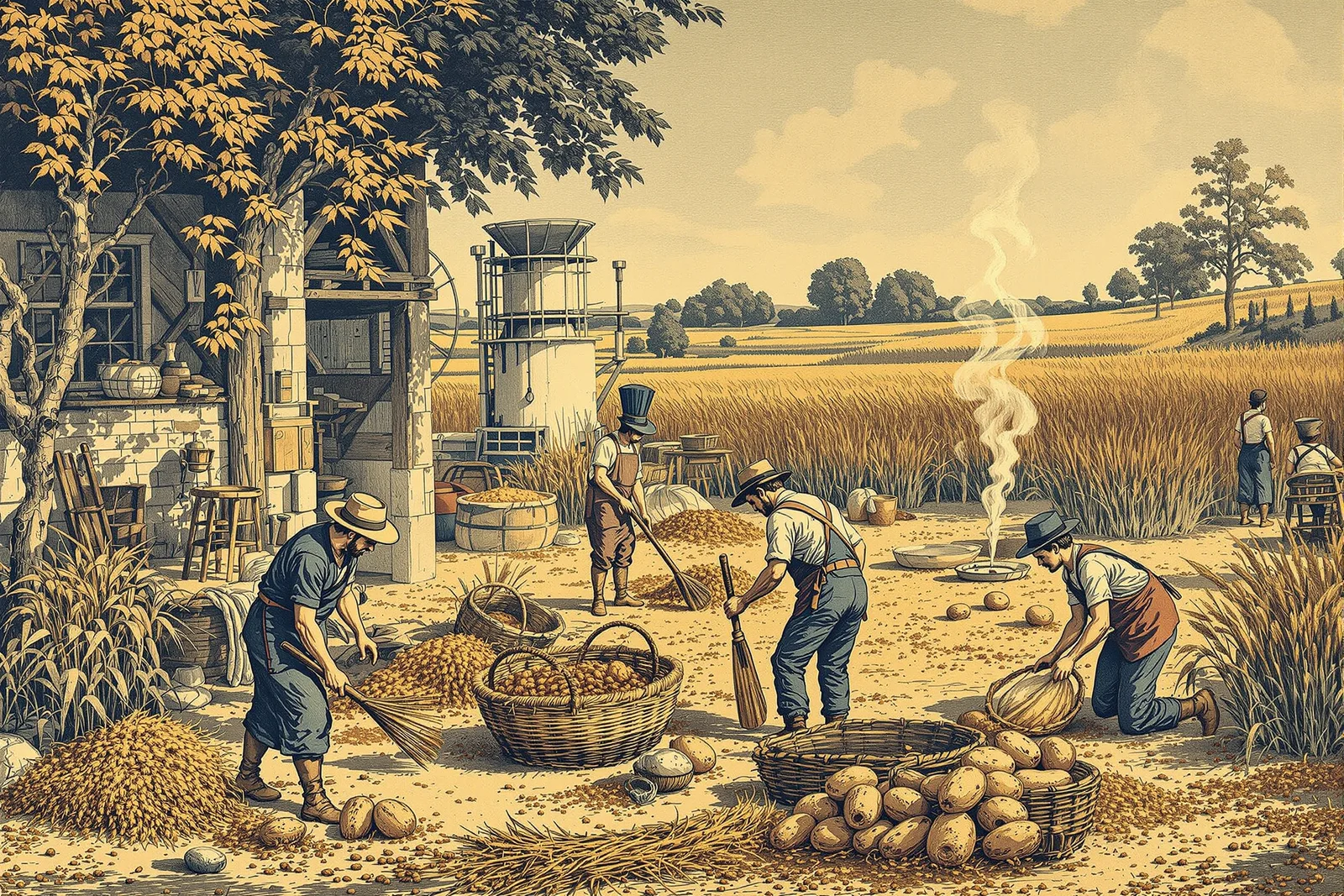
Complete Grain Growing, Harvesting, Milling, and Bread Making Guide
Grain is the foundation of civilization. Every great society was built on stored grain. This campaign covers the complete cycle from seed to loaf: growing, harvesting, threshing, milling, and baking.
Chapter 1: Grain Crops Compared
| Grain | Yield (lbs/acre) | Growing Season | Climate | Protein | Gluten | Calories/lb |
|---|---|---|---|---|---|---|
| Wheat (hard red) | 2,000-3,000 | 90-120 days (spring) or fall-planted | Temperate | 12-15% | Yes (bread) | 1,500 |
| Wheat (soft) | 2,000-3,000 | Same | Temperate (humid) | 8-11% | Yes (pastry) | 1,500 |
| Corn/maize | 3,000-5,000 | 90-120 days | Warm temperate-tropical | 9-10% | No | 1,650 |
| Rice (paddy) | 3,000-5,000 | 120-180 days | Tropical/subtropical (water) | 7-8% | No | 1,650 |
| Oats | 1,500-2,500 | 80-100 days | Cool temperate | 11-15% | No (minor) | 1,600 |
| Barley | 2,000-3,000 | 80-100 days | Cool-temperate | 10-12% | No | 1,500 |
| Rye | 1,500-2,500 | 90-120 days | Cold temperate (poor soil) | 10-12% | Yes (weak) | 1,500 |
| Millet | 1,000-2,000 | 60-90 days | Hot, dry (drought-tolerant) | 10-12% | No | 1,600 |
| Sorghum | 2,000-4,000 | 90-120 days | Hot, semi-arid | 10-12% | No | 1,600 |
| Buckwheat | 1,000-1,500 | 70-90 days | Any (short season) | 12-15% | No | 1,500 |
Chapter 2: Wheat Growing (Most Important Grain)
| Stage | Action | Timing | Details |
|---|---|---|---|
| 1 | Soil preparation: plow/till, remove weeds | 2-4 weeks before planting | Wheat needs firm, fine seedbed |
| 2 | Planting: broadcast or drill seed | Fall (winter wheat) or early spring | Seed rate: 60-120 lbs/acre (1.5 lbs/100 sq ft) |
| 3 | Germination and tillering | 7-14 days → 4-8 weeks | Each seed produces 3-5 stems (tillers) |
| 4 | Growth: stem elongation, heading | Spring (both types) | Keep weeds controlled |
| 5 | Flowering and grain fill | Late spring-early summer | Grain develops in head |
| 6 | Harvest: when grain is hard and dry (below 14% moisture) | Mid-late summer | Bite test: grain cracks hard, not dents |
| 7 | Cut stalks (sickle, scythe, or combine) | At maturity | Bundle into sheaves, stand in shocks to dry |
| 8 | Thresh: separate grain from straw | After drying (1-2 weeks) | Flail, trampling, or mechanical thresher |
| 9 | Winnow: separate grain from chaff | After threshing | Toss in wind or use fan — chaff blows away |
| 10 | Store: dry grain in rodent-proof containers | After cleaning | Below 14% moisture. Cool, dry, dark. |
Chapter 3: Threshing and Winnowing
| Method | Throughput | Equipment | Skill | Best For |
|---|---|---|---|---|
| Flailing (beating with hinged stick) | 10-20 lbs/hour | Flail (2 sticks joined by leather) | Low | Small batches, any grain |
| Trampling (animals walk on grain) | 50-100 lbs/hour | Animals + threshing floor | Low | Larger batches |
| Rubbing (hands or feet) | 5-10 lbs/hour | None | None | Very small batches |
| Mechanical thresher | 200-1,000 lbs/hour | Threshing machine | Moderate | Large-scale |
| Beating in bag/barrel | 10-20 lbs/hour | Bag or barrel + stick | Low | Small batches |
Winnowing: Pour grain slowly from height in breeze (or in front of fan). Heavy grain falls straight down into container. Light chaff blows away. Repeat until clean. Simple, effective, ancient.
Chapter 4: Milling (Grain to Flour)
| Method | Output | Flour Quality | Equipment | Effort |
|---|---|---|---|---|
| Saddle quern (stone on stone) | 1-2 lbs/hour | Coarse (whole grain) | 2 flat stones | Very high (exhausting) |
| Rotary quern (hand mill) | 3-5 lbs/hour | Medium-fine | Circular stones with handle | High |
| Mortar and pestle | 0.5-1 lb/hour | Coarse-medium | Large mortar + pestle | Very high |
| Impact mill (hammer mill) | 5-20 lbs/hour | Fine | Mechanical (powered) | Low (if powered) |
| Water/wind mill (stone) | 50-200 lbs/hour | Fine (adjustable) | Mill building + millstones | None (water/wind powered) |
| Steel burr mill (hand-cranked) | 3-8 lbs/hour | Fine (adjustable) | Hand-crank mill | Moderate |
Millstone dressing: Millstones must be re-cut (dressed) periodically. Grooves (furrows) cut in spiral pattern from center to edge. Furrows channel flour outward and ventilate heat. Flat areas (lands) between furrows do the grinding.
Chapter 5: Bread Making (Sourdough — No Commercial Yeast Needed)
| Step | Action | Time | Details |
|---|---|---|---|
| 1 | Create sourdough starter: flour + water, equal parts | 5-7 days | Mix 50g flour + 50g water in jar. Feed daily (discard half, add fresh flour + water). |
| 2 | Starter is ready when: doubles in 4-8 hours after feeding, smells sour/yeasty | Day 5-7 | Bubbles throughout, domed top |
| 3 | Mix dough: 500g flour + 350g water + 100g active starter + 10g salt | 10 minutes | Combine, rest 30 min (autolyse), add salt, mix |
| 4 | Bulk fermentation: stretch and fold every 30 min × 4, then rest | 4-8 hours (room temp) | Dough grows 50-75% in volume |
| 5 | Shape: pre-shape (round), rest 20 min, final shape (tight round or batard) | 30 minutes | Build surface tension (tight skin) |
| 6 | Cold proof (optional): refrigerate 8-16 hours | Overnight | Develops flavor, easier to score |
| 7 | Bake: preheat oven/dutch oven to 500F. Score dough. Bake covered 20 min, uncovered 20-25 min | 40-45 minutes | Steam (covered) creates crust. Uncover for browning. |
| 8 | Cool completely before cutting (1-2 hours) | 1-2 hours | Internal structure sets during cooling |
Sourdough starter: captures wild yeast and lactobacillus from flour and air. Once established, lives indefinitely with regular feeding. Kept in refrigerator between bakes (feed weekly). The same starter can last generations.
Chapter 6: Grain Storage
| Method | Duration | Protection From | Details |
|---|---|---|---|
| Metal bins (sealed) | 2-5 years | Rodents, insects, moisture | Must be airtight. Add diatomaceous earth for insects. |
| Clay pots (sealed with wax) | 1-3 years | Insects, some moisture | Traditional. Wax seal prevents air exchange. |
| Underground pit (lined) | 1-3 years | Temperature extremes | Lined with straw/clay. Sealed top. Cool and stable. |
| Mylar bags + O2 absorbers | 25-30 years | Everything | Gold standard for long-term. No oxygen = no insects, no oxidation. |
| Dry crib (elevated, ventilated) | 6-12 months | Ground moisture, some rodents | Corn on cob. Elevated on posts with rat guards. |
Critical: Grain must be below 14% moisture for storage. Above 14% = mold growth. Test: bite kernel — should crack hard, not dent. Or: weigh sample, oven-dry, re-weigh. Weight loss = moisture content.
Reference Card
- Wheat yield: 1,000 sq ft (small garden plot) produces ~30-50 lbs grain = 30-50 loaves of bread.
- Harvest when grain is hard (bite test: cracks, doesn't dent). Below 14% moisture.
- Thresh: beat with flail on hard surface. Winnow: pour in wind. Grain falls, chaff blows away.
- Sourdough starter: flour + water, feed daily for 5-7 days. No commercial yeast needed. Lasts forever.
- Bread formula: 500g flour + 350g water + 100g starter + 10g salt. Bulk ferment 4-8 hours. Bake 500F.
- Store grain below 14% moisture in sealed, rodent-proof containers. Cool, dark, dry.
- Hand mill: 3-8 lbs flour per hour. Enough for daily bread with 15-30 minutes of grinding.
- One acre of wheat feeds 4-6 people for a year (2,000-3,000 lbs grain = 2,000-3,000 loaves).