Sovereignty Module: Grow the Staff of Life
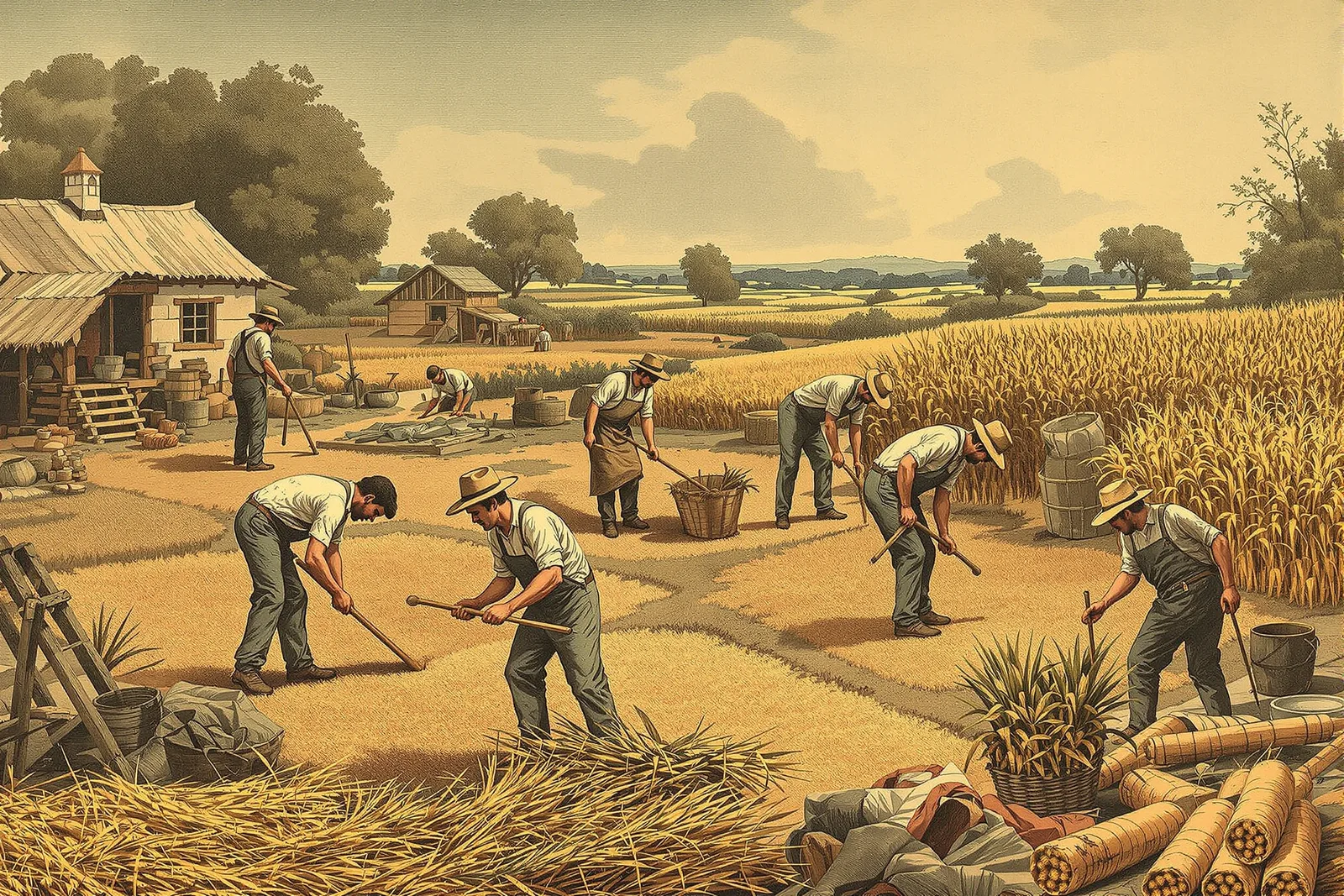
Complete Grain Agriculture, Cereal Crop Production, and Harvest Guide
Grain is civilization's foundation. Storable for years, calorie-dense, and growable at scale, cereal crops feed more people per acre than any other food. This campaign covers growing, harvesting, threshing, and storing grain.
Chapter 1: Grain Crops Compared
| Grain | Calories/acre | Water Need | Growing Season | Climate | Protein | Difficulty |
|---|---|---|---|---|---|---|
| Wheat | 4-6 million | Moderate | 90-120 days (spring), 240 (winter) | Temperate | 12-14% | Moderate |
| Rice (paddy) | 6-10 million | Very high (flooded) | 120-180 days | Tropical/subtropical | 7-8% | High |
| Corn (maize) | 6-8 million | Moderate-high | 60-100 days | Warm temperate-tropical | 9-10% | Low-moderate |
| Oats | 3-5 million | Moderate | 60-90 days | Cool temperate | 13-17% | Low |
| Barley | 3-5 million | Low-moderate | 60-90 days | Wide range (tolerant) | 10-12% | Low |
| Rye | 3-5 million | Low | 90-120 days (spring), 240 (winter) | Cold temperate | 10-12% | Very low |
| Millet | 3-4 million | Very low | 60-90 days | Hot, dry | 11-12% | Very low |
| Sorghum | 4-6 million | Low | 90-120 days | Hot, dry | 10-11% | Low |
| Buckwheat | 2-3 million | Low-moderate | 70-90 days | Cool temperate | 13% | Very low |
| Amaranth | 2-3 million | Low-moderate | 90-120 days | Warm | 14-16% | Low |
Chapter 2: Field Preparation
| Step | Action | Timing | Tools |
|---|---|---|---|
| 1 | Clear land (remove trees, brush, rocks) | Fall/winter before planting | Axe, mattock, hands |
| 2 | Break sod/soil (primary tillage) | 2-4 weeks before planting | Plow, mattock, digging stick |
| 3 | Harrow (break clods, level surface) | 1-2 weeks before planting | Drag harrow, rake |
| 4 | Add amendments if needed (lime, manure, compost) | With harrowing | Spreader or by hand |
| 5 | Create furrows or broadcast bed | At planting time | Plow, hoe, or rake |
Minimum field size for one person's annual grain (2,000 lbs wheat = 2,000 calories/day for one year): approximately 1-2 acres depending on yield.
Chapter 3: Planting
| Method | Seed Rate | Depth | Spacing | Best For |
|---|---|---|---|---|
| Broadcasting (scatter by hand) | 60-120 lbs/acre (wheat) | Rake in 1-2 inches | Random | Small grains (wheat, oats, barley) |
| Drill (rows) | 40-80 lbs/acre | 1-2 inches | 6-8 inch rows | Wheat, barley (if equipment available) |
| Hill planting | 2-3 seeds per hill | 1-2 inches | 12-36 inch hills | Corn, sorghum |
| Transplanting | N/A (seedlings) | Crown at soil level | 6-12 inches | Rice (paddy) |
Seed saving rule: Always save 10-15% of harvest as seed for next year. Select the best heads (largest, healthiest, earliest to mature) for seed stock. Never eat your seed grain.
Chapter 4: Harvest
| Step | Action | Timing | Tools |
|---|---|---|---|
| 1 | Determine ripeness (grain hard, straw golden, heads nodding) | When kernel is hard and dry (bite test: cracks, not dents) | Observation |
| 2 | Cut grain (reaping) | When ripe, before shatter | Sickle, scythe, or knife |
| 3 | Bundle into sheaves (tie with straw band) | Immediately after cutting | Hands |
| 4 | Shock (stand sheaves upright in groups to dry) | Same day | Stack 6-10 sheaves together |
| 5 | Dry in shock for 1-3 weeks | Until straw is completely dry | Weather-dependent |
| 6 | Transport to threshing floor | When dry | Cart, carry |
Chapter 5: Threshing and Winnowing
| Step | Action | Tools | Details |
|---|---|---|---|
| 1 | Thresh (separate grain from straw) | Flail, trampling (animals), beating on surface | Flail: hinged stick, swing against sheaves on hard floor |
| 2 | Rake away straw (large debris) | Rake, pitchfork | Remove stems and large chaff |
| 3 | Winnow (separate grain from chaff) | Wind, winnowing basket, fan | Toss grain in air on breezy day: heavy grain falls, light chaff blows away |
| 4 | Screen (remove remaining debris) | Sieves of different mesh sizes | Large screen removes big pieces, fine screen removes small seeds |
| 5 | Dry to storage moisture (below 14%) | Sun-dry on tarps, or heated air | Bite test: grain cracks cleanly = dry enough |
| 6 | Store in sealed containers | Bins, jars, bags (rodent-proof) | Cool, dry, dark |
One person with a flail can thresh approximately 50-100 lbs of grain per day. One person with a scythe can harvest approximately 1/2 to 1 acre per day.
Chapter 6: Yield Expectations
| Grain | Poor Yield | Average Yield | Good Yield | Exceptional |
|---|---|---|---|---|
| Wheat | 500 lbs/acre | 1,000-1,500 lbs/acre | 2,000-3,000 lbs/acre | 4,000+ lbs/acre |
| Corn | 1,000 lbs/acre | 2,000-3,000 lbs/acre | 4,000-6,000 lbs/acre | 8,000+ lbs/acre |
| Rice | 1,000 lbs/acre | 2,000-3,000 lbs/acre | 4,000-6,000 lbs/acre | 8,000+ lbs/acre |
| Oats | 500 lbs/acre | 1,000-1,500 lbs/acre | 2,000-2,500 lbs/acre | 3,000+ lbs/acre |
| Barley | 500 lbs/acre | 1,000-1,500 lbs/acre | 2,000-2,500 lbs/acre | 3,000+ lbs/acre |
Historical context: Medieval European wheat yields averaged 500-800 lbs/acre (seed ratio 3:1 to 5:1). Modern yields with fertilizer and improved varieties: 3,000-5,000 lbs/acre. The difference: soil fertility, seed genetics, and pest control.
Reference Card
- One person needs 1-2 acres of grain for one year's calories (2,000 lbs wheat)
- Always save 10-15% of harvest as seed for next year (select best heads)
- Harvest when grain is hard (bite test: cracks cleanly, not dents)
- Thresh with flail on hard floor, winnow on breezy day (chaff blows away)
- Store grain below 14% moisture in sealed, rodent-proof containers
- Winter wheat: plant in fall, harvest next summer (higher yield, longer season)
- Rye and barley are most forgiving: poor soil, cold climate, drought-tolerant
- Corn requires nixtamalization (lime treatment) to release niacin (prevents pellagra)