Sovereignty Module: Hang the Pot
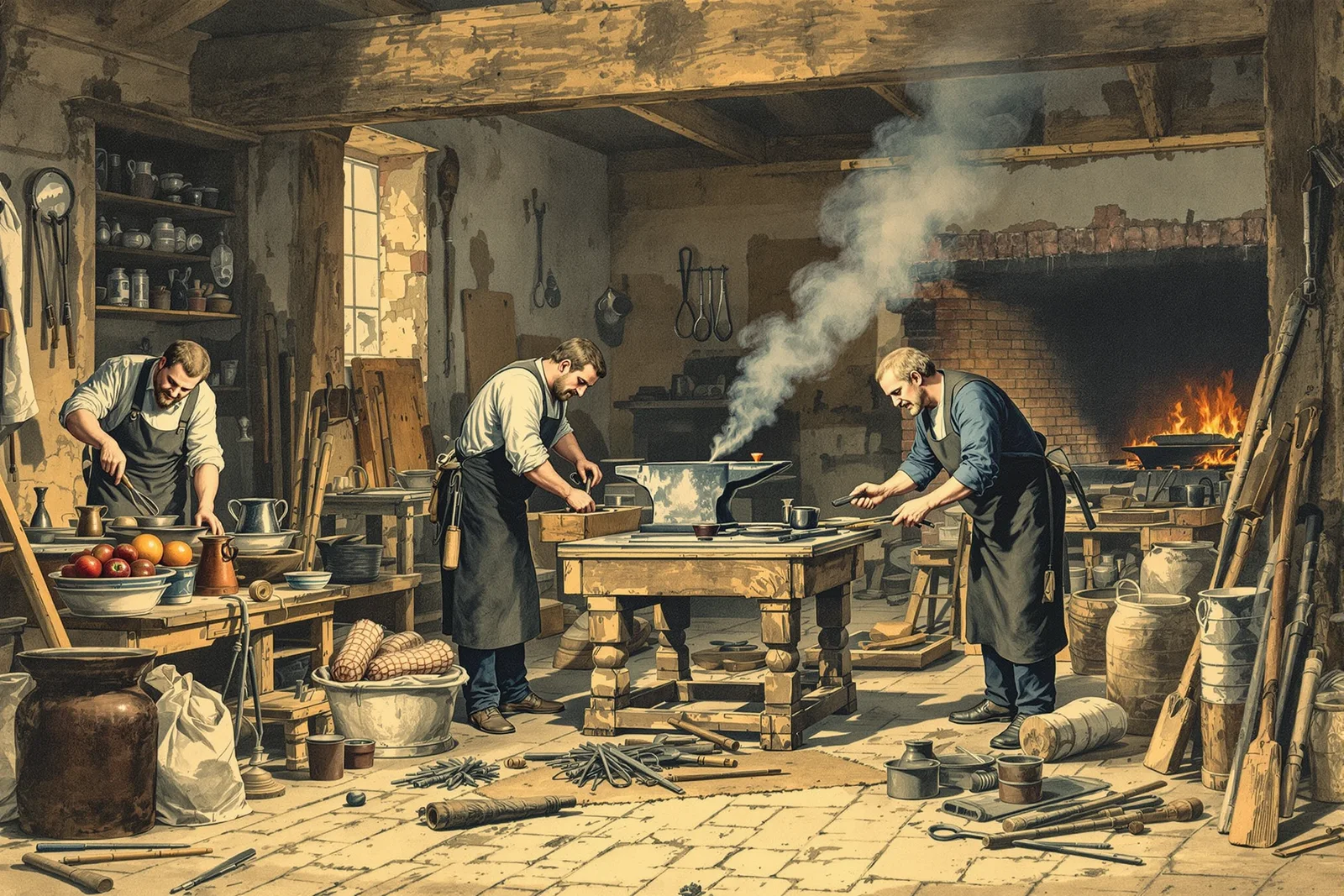
Complete Trammel Hook and Fireplace Cooking Hardware: From Bar to Hearth Kitchen
Trammel hooks allow adjustable pot suspension over a fire, essential for hearth cooking. This campaign covers trammel types, ratchet mechanisms, pot hooks, and cooking crane accessories.
Chapter 1: Hearth Cooking Hardware
| Item | Function | Adjustment | Material |
|---|---|---|---|
| Trammel hook | Adjustable pot height | Ratchet or sawtooth | 1/4-3/8 inch flat bar |
| Pot hook (S-hook) | Hang pot from crane | Fixed | 3/8 inch round bar |
| Cooking crane | Swing pot over/away from fire | Pivot | 3/4-1 inch bar |
| Trivet | Support pot over coals | Fixed height | 3/8-1/2 inch bar |
| Toasting fork | Hold bread near fire | Fixed | 1/4 inch round bar |
| Spit (rotisserie) | Rotate meat over fire | Rotating | 1/2-5/8 inch bar |
Chapter 2: Trammel Hook Forging
Sawtooth trammel: 1) Start with 1/4 x 1 inch flat bar, 24-36 inches long. 2) Forge sawtooth notches along one edge (every 1-1.5 inches). 3) Each notch: 1/4 inch deep, angled downward. 4) Forge hook at bottom (pot hanging hook). 5) Forge eye or hook at top (attaches to crane). 6) Forge adjusting arm: separate piece with hook that engages sawtooth. 7) Adjusting arm pivots on pin through trammel bar. 8) Lift adjusting arm to raise pot, lower to drop pot. 9) Sawtooth catches hold pot at desired height.
| Trammel Type | Mechanism | Adjustment Range | Complexity |
|---|---|---|---|
| Sawtooth | Notched bar + catch arm | Every 1-1.5 inches | Moderate |
| Ratchet | Toothed bar + pawl | Every 1 inch | High |
| Chain | Chain links + hook | Every link | Low |
| Sliding | Pin through holes | Every 2 inches | Low |
| Scissor | Crossed bars, pivot | Continuous | High |
Chapter 3: S-Hooks and Pot Hooks
S-hook: 1) Start with 3/8 inch round bar, 6-10 inches long. 2) Forge one end into hook (large hook for crane). 3) Forge other end into hook (small hook for pot bail). 4) Bend into S-shape. 5) Large hook: 1.5-2 inch opening (fits crane bar). 6) Small hook: 1-1.5 inch opening (fits pot bail handle). 7) Hooks should be smooth (no sharp edges to catch).
| Hook Size | Bar Diameter | Length | Large Hook Opening | Small Hook Opening |
|---|---|---|---|---|
| Small | 1/4 inch | 4-6 inches | 1 inch | 3/4 inch |
| Medium | 3/8 inch | 6-8 inches | 1.5 inches | 1 inch |
| Large | 1/2 inch | 8-10 inches | 2 inches | 1.5 inches |
Chapter 4: Cooking Crane
Cooking crane: 1) Vertical post: 3/4-1 inch round bar, 24-36 inches. 2) Horizontal arm: 3/4 inch bar, 24-36 inches. 3) Post mounts in wall or fireplace jamb. 4) Arm pivots on post (swings in and out of fireplace). 5) Forge pivot: eye on arm fits over post top. 6) Arm must swing freely (not bind). 7) Arm supports trammel, hooks, and pots. 8) Load capacity: 30-50 pounds.
Chapter 5: Trivet and Accessories
| Accessory | Design | Height | Use |
|---|---|---|---|
| Trivet (3-legged) | Ring with 3 legs | 3-6 inches | Support pot over coals |
| Trivet (4-legged) | Ring with 4 legs | 3-6 inches | Support pot over coals |
| Gridiron | Parallel bars on legs | 4-6 inches | Grilling meat, fish |
| Toasting fork | Long handle, 2-3 tines | N/A (handheld) | Toasting bread |
| Flesh fork | Long handle, 2 tines | N/A (handheld) | Turning meat |
| Skimmer | Long handle, perforated disc | N/A (handheld) | Skimming broth |
Trivet forging: 1) Forge ring from 3/8-1/2 inch round bar. 2) Ring diameter: 6-8 inches (fits pot bottom). 3) Forge 3 legs from 3/8 inch bar, 4-6 inches long. 4) Forge weld or rivet legs to ring (evenly spaced). 5) Legs must be same length (pot sits level). 6) Feet: small pad or scroll (stability on uneven hearth).
Reference Card
- The trammel controls cooking temperature (raising the pot away from the fire reduces heat; lowering it increases heat; the trammel is the hearth cook's temperature control). 2. Sawtooth trammels are the most practical (the sawtooth mechanism is simple, reliable, and provides fine height adjustment; it is the traditional choice for hearth cooking). 3. The cooking crane must swing freely (the crane pivots to swing pots over the fire for cooking and away from the fire for serving; a binding pivot makes the crane dangerous to operate with heavy, hot pots). 4. S-hooks must be smooth (rough or sharp edges on S-hooks catch on pot bails and crane bars; smooth hooks allow pots to be hung and removed quickly and safely). 5. Trivets must sit level (a trivet with uneven legs causes pots to tilt, spilling hot contents; all legs must be exactly the same length). 6. The hearth kitchen requires a complete set (crane, trammel, hooks, trivets, and utensils work together as a system; each piece is designed to work with the others). 7. Hearth cooking is the original kitchen (before stoves existed, all cooking was done at the hearth; the hardware described in this campaign equipped every kitchen for thousands of years). 8. These tools make the blacksmith essential to the community (a community without a blacksmith cannot equip a kitchen; hearth cooking hardware is one of the most practical and appreciated products of the forge).