Sovereignty Module: Hold the Hearth
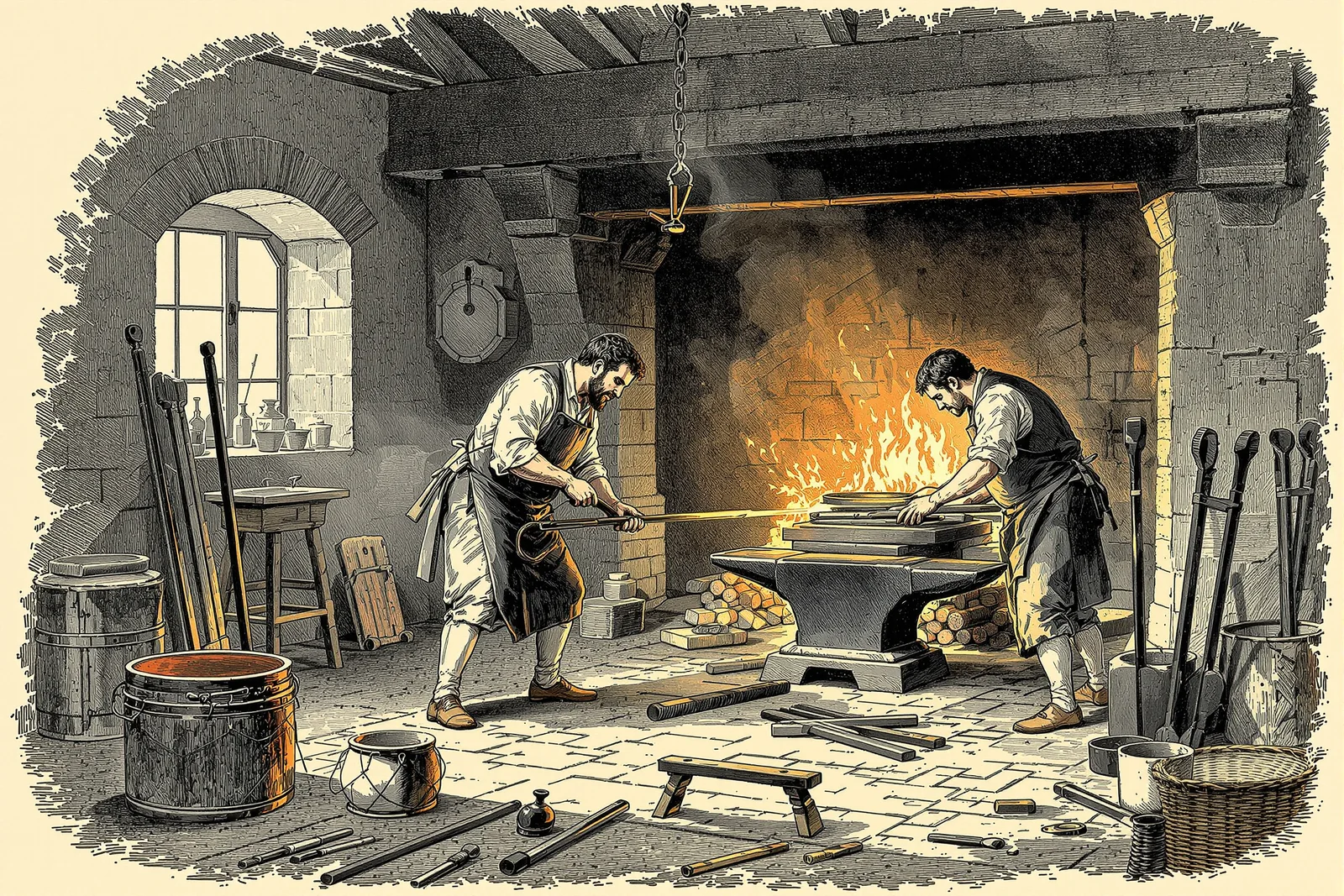
Complete Fireplace Grate and Andiron Making: From Bar to Hearth Furniture
Fireplace grates and andirons support burning logs and improve combustion. This campaign covers grate design, andiron forging, joinery methods, and decorative elements.
Chapter 1: Hearth Furniture Types
| Item | Function | Material | Size Range |
|---|---|---|---|
| Fireplace grate | Hold logs above hearth floor | 1/2-3/4 inch bar | 18-30 inches wide |
| Andirons (firedogs) | Support logs at ends | 3/4-1 inch bar | 18-24 inches tall |
| Fire basket | Contain fire in open hearth | 1/2 inch bar | 18-24 inches wide |
| Log cradle | Hold logs in stack | 1/2 inch bar | 24-36 inches wide |
| Spark screen | Block sparks from room | Wire mesh + frame | Fits fireplace opening |
Chapter 2: Fireplace Grate Forging
Grate construction: 1) Frame: 3/4 inch square bar, bent to rectangular shape. 2) Frame dimensions: width to fit fireplace, 14-18 inches deep. 3) Cross bars: 1/2 inch round bar, spaced 1.5-2 inches apart. 4) Cross bars run front to back (logs rest across them). 5) Front rail: 3/4 inch bar, raised 2-3 inches above cross bars. 6) Front rail prevents logs from rolling forward. 7) Legs: 3-4 inches tall (air circulation under grate). 8) Join cross bars to frame by forge welding, riveting, or collaring.
| Dimension | Small Grate | Medium Grate | Large Grate |
|---|---|---|---|
| Width | 18-20 inches | 22-26 inches | 28-32 inches |
| Depth | 12-14 inches | 14-16 inches | 16-18 inches |
| Height (legs) | 3 inches | 4 inches | 4-5 inches |
| Cross bars | 6-8 bars | 8-10 bars | 10-14 bars |
| Bar spacing | 1.5 inches | 1.5-2 inches | 2 inches |
| Front rail height | 2 inches | 2-3 inches | 3 inches |
Chapter 3: Andiron Forging
Andiron components: 1) Upright (front post): decorative, 18-24 inches tall. 2) Horizontal bar (log support): extends into fireplace, 14-18 inches. 3) Feet: support the andiron, prevent tipping. 4) Decorative finial: top of upright (ball, acorn, flame, etc.).
Forging sequence: 1) Start with 3/4-1 inch square bar for upright. 2) Forge decorative elements on upright (twists, scrolls). 3) Forge finial at top (ball: upset and round; flame: draw out and shape). 4) Forge horizontal bar from separate piece. 5) Join horizontal bar to upright base (forge weld or collar). 6) Forge feet: scroll or pad feet for stability. 7) Andirons must be made in pairs (mirror images).
Chapter 4: Joinery Methods
| Joint Type | Method | Strength | Appearance |
|---|---|---|---|
| Forge weld | Heat and hammer together | Excellent | Seamless |
| Collar joint | Wrap with hot band, tighten | Very good | Decorative band |
| Rivet | Drill and rivet | Good | Visible rivets |
| Tenon and mortise | Forge tenon, punch mortise | Excellent | Clean joint |
| Wrap and weld | Wrap around, forge weld | Very good | Organic look |
Collar joint: 1) Cut strip of thin flat bar (1/8 x 3/4 inch). 2) Heat strip to orange. 3) Wrap around joint (overlapping bars). 4) Tighten with tongs while hot. 5) As collar cools, it shrinks and grips tightly. 6) Rivet or weld collar ends for permanent joint.
Chapter 5: Finishing and Heat Resistance
| Finish | Method | Heat Resistance | Appearance |
|---|---|---|---|
| Beeswax | Apply to warm steel | Good (chars near flame) | Dark, natural |
| Linseed oil | Brush on, heat cure | Good | Dark brown-black |
| High-temp paint | Spray or brush | Excellent (to 1200°F) | Flat black |
| Forge scale | Leave as-forged | Excellent | Blue-black, textured |
| Wire brush | Clean with wire brush | N/A (base for other finishes) | Clean steel |
Reference Card
- Air circulation is the key to good combustion (a grate raises logs above the hearth floor, allowing air to flow underneath; this dramatically improves combustion efficiency and reduces smoke). 2. The front rail prevents log roll-out (a raised front rail keeps burning logs from rolling out of the fireplace into the room; this is a critical safety feature). 3. Andirons must be stable (andirons support heavy burning logs; they must not tip forward or sideways; wide feet and low center of gravity ensure stability). 4. Forge scale is the best finish for hearth furniture (the blue-black oxide scale that forms during forging is naturally heat-resistant; additional finishes near the flame zone will burn off). 5. Cross bar spacing matters (bars too close together restrict airflow; too far apart and small logs fall through; 1.5-2 inch spacing is optimal for most firewood sizes). 6. Make andirons in pairs (andirons are always used in pairs; they must be mirror images of each other in height, width, and decoration; mismatched andirons look unprofessional). 7. Collar joints are ideal for hearth furniture (collar joints are strong, decorative, and can be disassembled for repair; they are the traditional joinery method for fireplace ironwork). 8. Hearth furniture is the blacksmith's showpiece (fireplace grates and andirons are displayed prominently in the home; they showcase the blacksmith's skill in both function and decoration).