Sovereignty Module: Strike the Rock
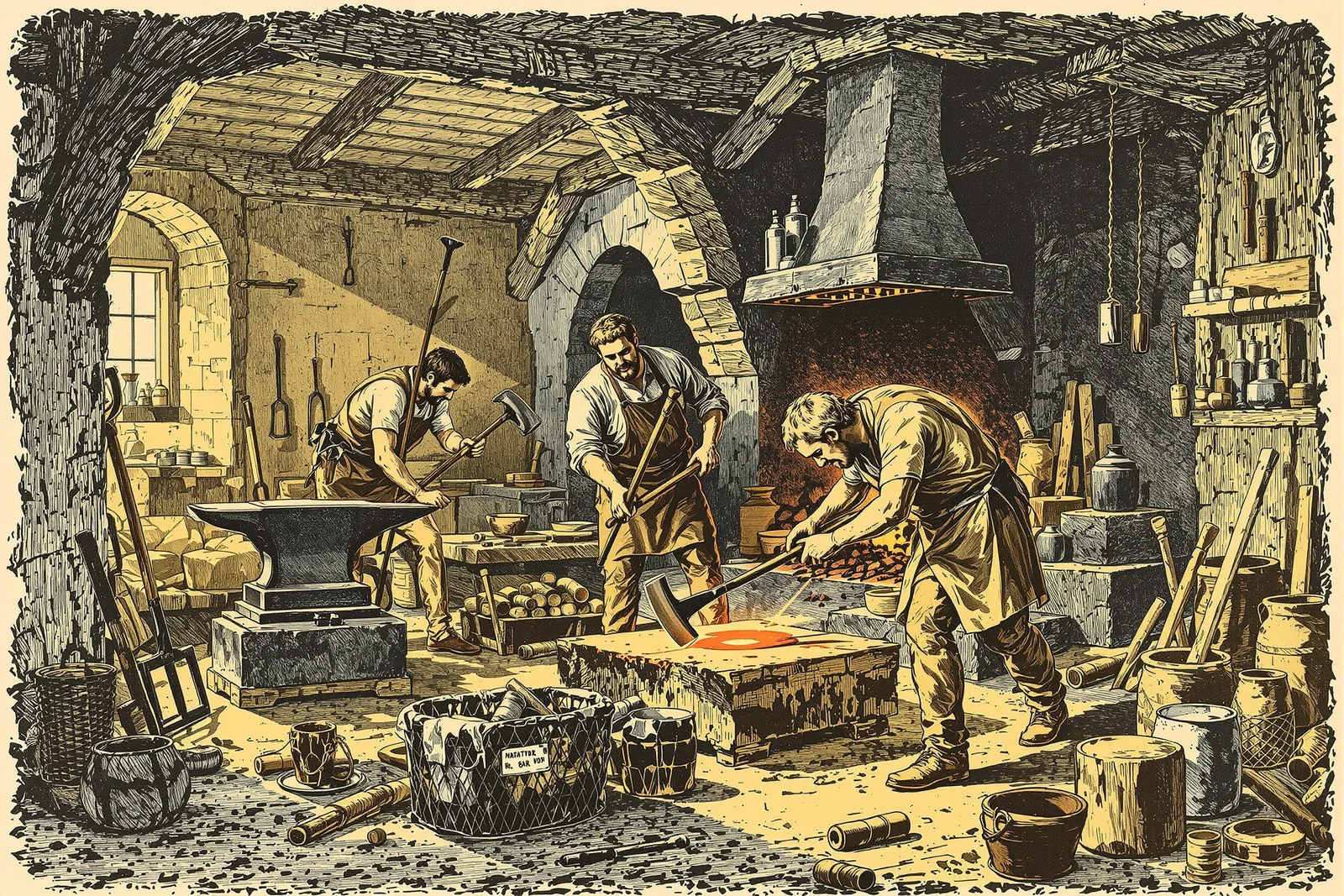
Complete Pickaxe and Mattock Making: From Bar to Breaking Tool
Pickaxes and mattocks are essential for breaking rock, digging in hard ground, and root removal. This campaign covers head forging, eye punching, edge geometry, and handle fitting.
Chapter 1: Breaking Tool Types
| Tool | Head Configuration | Weight | Primary Use |
|---|---|---|---|
| Pickaxe | Point + chisel (both ends) | 5-8 lbs | Breaking rock, hard ground |
| Mattock | Adze blade + pick point | 5-7 lbs | Digging, root cutting |
| Cutter mattock | Axe blade + adze blade | 5-7 lbs | Root cutting, digging |
| Railroad pick | Point + chisel | 8-12 lbs | Heavy rock breaking |
| Grub hoe | Wide adze blade only | 4-6 lbs | Grubbing roots, digging |
Chapter 2: Pickaxe Head Forging
Pickaxe head: 1) Start with medium-carbon steel (1045 or 4140). 2) Bar: 2 x 1.5 inch, 14-18 inches long. 3) Mark center for eye. 4) Hot-punch eye at center (1.25 x 0.75 inch oval). 5) Drift eye to final size (handle taper). 6) Forge one end to point: draw out to 6-8 inches, taper to pencil point. 7) Forge other end to chisel: draw out to 4-6 inches, flatten to 2 inches wide. 8) Grind chisel edge: 30-degree bevel. 9) Harden tips only: heat to non-magnetic, quench in oil. 10) Temper tips: 475-500°F (bronze-purple).
| Dimension | Pickaxe | Mattock | Grub Hoe |
|---|---|---|---|
| Overall head length | 16-20 inches | 14-18 inches | 8-12 inches |
| Eye size | 1.25 x 0.75 inch | 1.25 x 0.75 inch | 1.25 x 0.75 inch |
| Point length | 6-8 inches | 6-8 inches | None |
| Chisel/blade width | 2 inches | 3-4 inches | 4-6 inches |
| Head weight | 5-8 lbs | 5-7 lbs | 4-6 lbs |
| Handle length | 36 inches | 36 inches | 36 inches |
Chapter 3: Eye Punching
Eye punching for heavy tools: 1) Heat center section to bright orange-yellow. 2) Place on bolster plate. 3) Drive oval punch halfway through from one side. 4) Flip and drive from other side. 5) Slug drops through bolster plate. 6) Insert oval drift (tapered to final eye size). 7) Drive drift through to final dimension. 8) Eye must be tapered: wider at top for handle wedge. 9) Eye walls must be thick (3/8-1/2 inch minimum). 10) Thin eye walls crack under impact.
Chapter 4: Heat Treatment
| Steel | Hardening | Temper | Target HRC | Notes |
|---|---|---|---|---|
| 1045 | 1500°F, oil quench | 475-500°F | 42-48 | Good general purpose |
| 4140 | 1525°F, oil quench | 475-500°F | 44-50 | Better toughness |
| 5160 | 1525°F, oil quench | 475-500°F | 44-50 | Excellent spring-back |
Differential hardening: 1) Heat only the working tips (point and chisel). 2) Quench tips in oil (2-3 inches). 3) Allow body heat to temper tips. 4) Watch colors: when purple reaches tips, quench fully. 5) Eye area remains soft (tough, absorbs impact). 6) Tips are hard (resist wear and deformation).
Chapter 5: Handle Fitting
Handle fitting: 1) Select straight-grained hickory (36-inch handle). 2) Shape handle end to fit eye (slightly oversized). 3) Handle should be oval cross-section (matches eye). 4) Drive handle through eye from bottom. 5) Handle protrudes above eye. 6) Cut slot in protruding end. 7) Drive hardwood or steel wedge into slot. 8) Wedge expands handle, locking in eye. 9) Some smiths add cross-wedge (perpendicular to first). 10) Handle must be tight (loose head is dangerous).
| Handle Wood | Shock Absorption | Durability | Weight |
|---|---|---|---|
| Hickory | Excellent | Excellent | Medium |
| Ash | Very good | Very good | Light |
| Oak | Good | Good | Heavy |
Reference Card
- The eye must be thick-walled (a pickaxe eye absorbs tremendous impact force; thin eye walls crack and the head flies off the handle; minimum 3/8 inch wall thickness). 2. Taper the eye for wedging (an eye that is wider at the top than the bottom allows a wedge to lock the handle permanently; this is the traditional and safest method of securing a heavy tool head). 3. Harden only the working tips (the point and chisel tips need hardness to penetrate rock; the eye and body need toughness to absorb impact; differential hardening provides both). 4. Temper to bronze-purple for impact tools (pickaxes and mattocks strike rock with tremendous force; tempering to 475-500°F provides the toughness needed to prevent chipping and shattering). 5. Hickory is the only acceptable handle wood (for heavy impact tools, hickory's combination of strength, flexibility, and shock absorption is unmatched; other woods break or transmit painful vibration). 6. Check the handle before every use (a loose head can fly off during a swing with lethal force; always check that the head is tight on the handle before swinging). 7. The pickaxe is humanity's oldest mining tool (pickaxes have been used to break rock for mining, construction, and agriculture for thousands of years; the basic design has not changed because it cannot be improved). 8. A well-forged pickaxe lasts a lifetime (quality steel, proper heat treatment, and a good handle produce a tool that will serve for decades of hard use).