Sovereignty Module: Birth the Iron
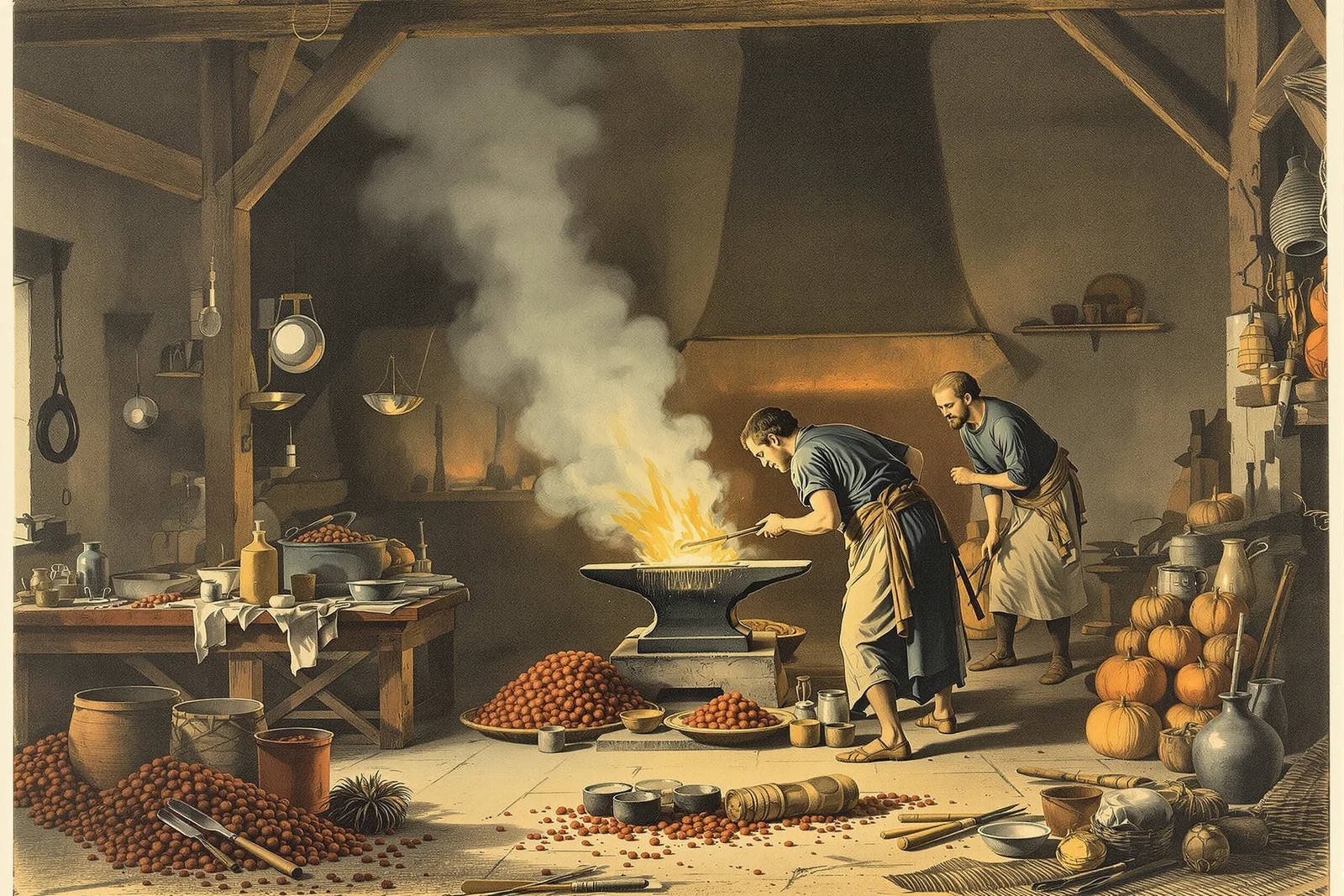
Complete Bloomery Iron Smelting: From Bog Ore to Wrought Iron
Iron changed everything — tools that hold an edge, plows that break sod, weapons that defeat bronze. This campaign covers finding ore, building a bloomery furnace, and producing usable iron.
Chapter 1: Iron Ore Sources
| Ore Type | Iron Content | Identification | Location | Processing |
|---|---|---|---|---|
| Bog iron (limonite) | 30-60% | Rust-colored, heavy, in swamps | Wetlands, stream beds | Easiest to smelt (low melting point) |
| Magnetite (lodestone) | 60-72% | Black, magnetic, very heavy | Igneous rock areas, black sand beaches | Highest iron content, harder to smelt |
| Hematite | 50-70% | Red-brown, heavy, red streak | Sedimentary formations | Common, good ore |
| Siderite | 30-48% | Brown/gray, heavy | Sedimentary layers | Needs roasting first |
| Iron sand (ironsand) | 50-60% | Black sand, magnetic | Volcanic beaches, river bends | Collect with magnet, direct smelt |
| Laterite | 20-40% | Red tropical soil | Tropical regions | Low grade, needs concentration |
Finding bog iron: Look in swamps, bogs, and slow streams. Rust-colored water = iron dissolved. Where it surfaces and oxidizes, bog iron accumulates. Dig 6-18 inches below rust-stained ground. Heavy, rust-colored nodules = bog iron ore.
Chapter 2: Bloomery Furnace Construction
| Component | Material | Dimensions | Function |
|---|---|---|---|
| Shaft (chimney) | Clay + sand + straw (cob) or stone | 3-4 feet tall, 10-14 inch interior diameter | Combustion chamber |
| Tuyere (air pipe) | Clay pipe or steel pipe | 1-2 inch diameter, angled slightly downward | Air injection point |
| Bellows | Wood frame + leather | Large enough to supply continuous air | Provides forced air (critical) |
| Base/hearth | Firebrick or packed clay | Flat, slightly bowl-shaped | Collects bloom (iron mass) |
| Tap hole (optional) | Hole at base, plugged with clay | 2-3 inch diameter | Drain slag during smelt |
| Charging hole | Top of shaft (open) | Full diameter | Add ore and charcoal from top |
Construction steps: 1. Build base (firebrick or clay pad, 24 inches diameter). 2. Form shaft walls (4-6 inches thick cob, built in layers, dry between). 3. Install tuyere 4-6 inches above base (angled down 10-15°). 4. Let dry completely (1-2 weeks, or fire-dry carefully). 5. Pre-heat before first smelt (small fire inside, hours).
Chapter 3: Charcoal Production (Fuel)
| Method | Yield | Time | Scale | Quality |
|---|---|---|---|---|
| Pit method (earth-covered) | 15-25% by weight | 2-5 days | Medium-large | Good |
| Mound method (earth-covered) | 15-25% by weight | 3-7 days | Large | Good |
| Retort (sealed container) | 25-35% by weight | 4-8 hours | Small-medium | Excellent |
| TLUD (top-lit updraft) | 20-30% by weight | 2-4 hours | Small | Good |
You need approximately 8-12 kg of charcoal per 1 kg of iron produced. A single smelt uses 20-50 kg of charcoal. Plan charcoal production WEEKS before smelting.
Chapter 4: The Smelt (Step-by-Step)
| Step | Action | Duration | Details |
|---|---|---|---|
| 1 | Pre-heat furnace (fire inside, bring to red heat) | 1-2 hours | Walls must be hot before charging ore |
| 2 | Fill with charcoal to tuyere level | - | Base layer of fuel |
| 3 | Begin bellows operation (continuous air) | Continuous | 2-3 people rotating on bellows |
| 4 | Add first charge: 1 part ore + 2 parts charcoal (by volume) | - | Crushed ore (walnut-size or smaller) |
| 5 | Wait for charge to descend (15-20 minutes) | 15-20 min | Ore melts/reduces as it descends through hot zone |
| 6 | Add next charge (same ratio) | - | Repeat every 15-20 minutes |
| 7 | Continue charging for 4-8 hours | 4-8 hours | Total ore: 10-30 kg depending on furnace size |
| 8 | Tap slag periodically (if tap hole present) | Every 30-60 min | Liquid glass-like slag flows out |
| 9 | Final charge consumed, stop bellows | - | Let cool slightly (30 minutes) |
| 10 | Break open furnace base, extract bloom | - | Hot, spongy mass of iron + slag |
| 11 | Hammer bloom while hot (consolidate) | Immediately | Drives out slag, welds iron together |
| 12 | Reheat and hammer repeatedly | Multiple heats | Each cycle removes more slag, improves iron |
Chapter 5: From Bloom to Usable Iron
| Step | Action | Result |
|---|---|---|
| 1 | Extract bloom (hot, spongy mass) | Raw bloom: 30-50% iron, rest is slag |
| 2 | Cut bloom in half (check quality) | See iron grains in slag matrix |
| 3 | Reheat to welding temperature (bright yellow) | Iron becomes plastic |
| 4 | Hammer vigorously (fold and weld) | Slag squeezes out as sparks |
| 5 | Repeat heat + hammer 10-20 times | Iron consolidates, slag expelled |
| 6 | Draw out into bar stock | Wrought iron bar (ready for forging) |
| 7 | Test: bend cold (should bend, not crack) | Good iron = ductile. Bad = brittle (too much slag) |
Yield expectations: From 10 kg of good bog iron ore, expect 1-3 kg of usable wrought iron after consolidation. This is normal. Ancient smiths achieved similar yields.
Chapter 6: Troubleshooting
| Problem | Cause | Solution |
|---|---|---|
| No bloom forms | Insufficient temperature | More air (bigger bellows, more operators) |
| Bloom is all slag | Ore too low-grade or not enough charcoal | Better ore, increase charcoal ratio |
| Furnace cracks/collapses | Walls too thin or not dry | Rebuild thicker (6+ inches), dry completely |
| Iron is brittle (cracks when hammered cold) | Too much carbon (accidentally made cast iron) | Decarburize: heat in air, hammer thin |
| Tuyere melts/blocks | Too close to bloom, wrong angle | Raise tuyere, angle downward more |
| Can't maintain temperature | Air supply insufficient | Larger bellows, continuous operation, seal leaks |
Reference Card
- Bog iron: easiest ore. Rust-colored nodules in swamps/streams. Heavy, magnetic when heated.
- Bloomery furnace: 3-4 foot clay shaft, 10-14 inch diameter, tuyere at 4-6 inches above base.
- Charcoal ratio: 8-12 kg charcoal per 1 kg iron produced. Make charcoal WEEKS before smelting.
- Charge: 1 part crushed ore + 2 parts charcoal by volume. Add every 15-20 minutes for 4-8 hours.
- Bellows: CONTINUOUS air supply is critical. 2-3 people rotating. No air = no iron.
- Bloom extraction: break open base while hot. Hammer immediately to consolidate. Fold and weld 10-20 times.
- Expected yield: 10-30% of ore weight becomes usable iron. 10 kg ore → 1-3 kg wrought iron. Normal.
- Test iron: bend cold bar. Good iron bends without cracking. Brittle = too much carbon or slag.