Sovereignty Module: Keep the Bees
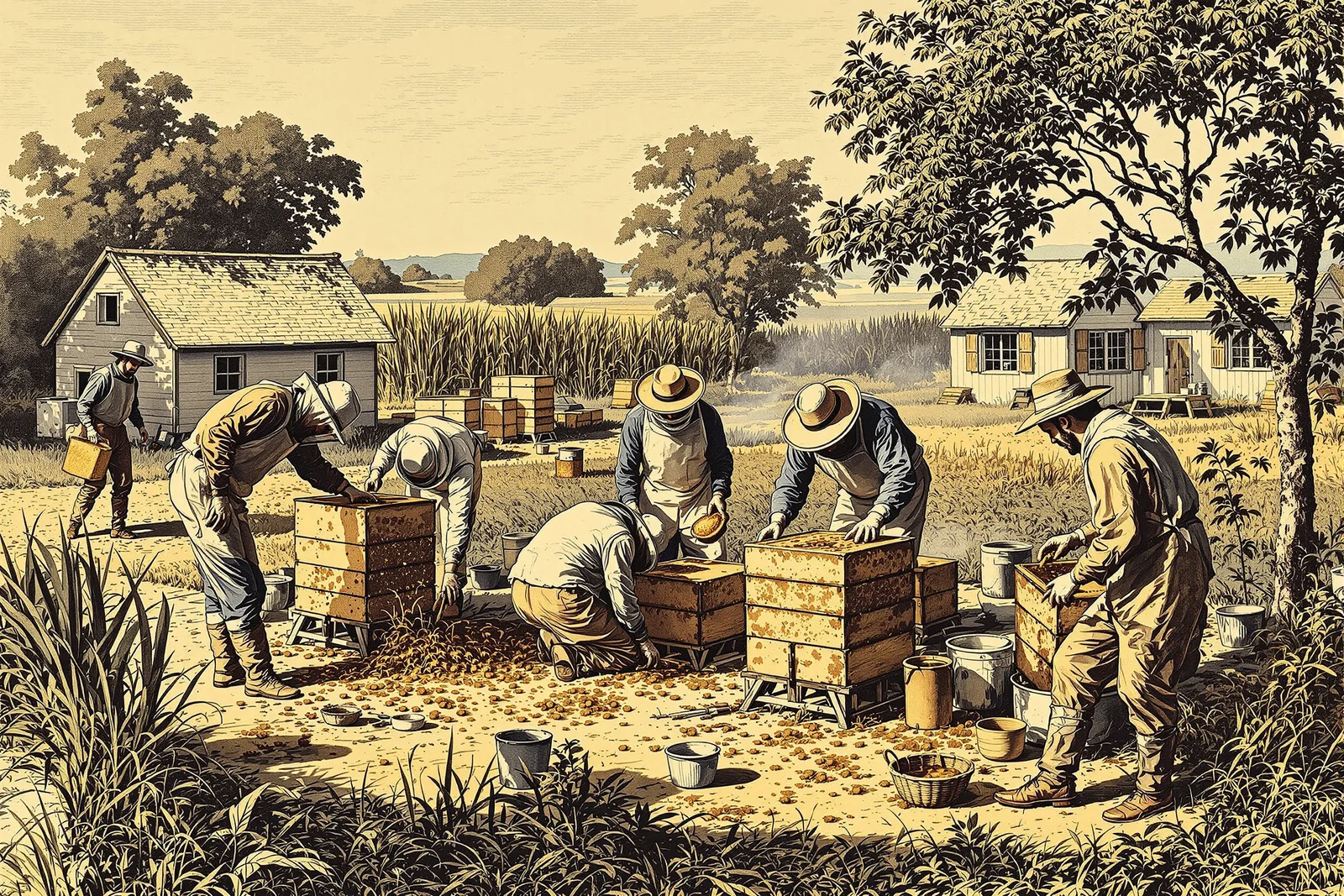
Complete Beekeeping and Honey Production: From Hive to Harvest
Bees provide honey (food, medicine, preservative), beeswax (candles, waterproofing, polish), and pollination (increases crop yields 30-80%). This campaign covers hive construction, colony management, honey harvest, and beeswax processing.
Chapter 1: Hive Types
| Hive Type | Complexity | Cost | Honey Yield | Management | Best For |
|---|---|---|---|---|---|
| Skep (straw dome) | Very low | Very low | Low (destructive harvest) | Minimal | Beginners, temporary |
| Top-bar hive | Low | Low | Moderate | Moderate | Developing areas, natural beekeeping |
| Langstroth (movable frame) | Moderate | Moderate | High | Active | Maximum production |
| Warre hive | Low-moderate | Low | Moderate | Minimal | Low-intervention beekeeping |
| Log hive (traditional) | Very low | Very low | Low | Minimal | Wild colonies, forest beekeeping |
Top-bar hive construction: 1) Build box: 3-4 ft long, 12 inches wide at top, tapered sides (120 degree angle). 2) Top bars: 1-3/8 inch wide strips spanning the top (this width matches natural comb spacing). 3) Starter strip: thin line of beeswax on bottom of each bar (guides comb building). 4) Entrance: 1/2 inch holes at one end (3-5 holes). 5) Legs: raise hive to waist height (comfortable working). 6) Roof: simple cover, sloped for rain. 7) Follower board: movable divider to adjust hive volume. 8) No foundation needed — bees build natural comb hanging from bars.
Chapter 2: Colony Management
| Season | Activity | Purpose | Frequency | Priority |
|---|---|---|---|---|
| Spring | Inspect for queen, brood, food | Verify colony survival | Every 2 weeks | Critical |
| Spring | Add space (bars/frames) | Prevent swarming | As needed | High |
| Spring | Split strong colonies | Increase colony count | Once (if strong) | Moderate |
| Summer | Monitor honey stores | Track production | Every 2 weeks | Moderate |
| Summer | Watch for disease/pests | Early intervention | Every inspection | High |
| Fall | Harvest excess honey | Leave 60+ lbs for winter | Once (late summer) | High |
| Fall | Reduce entrance | Prevent robbing | September | Moderate |
| Winter | Leave alone (mostly) | Don't disturb cluster | Monthly exterior check | Low |
| Winter | Ensure adequate food | Prevent starvation | Check heft (weight) | Critical |
Inspection procedure: 1) Smoke entrance lightly (calms bees, triggers feeding response). 2) Wait 1-2 minutes. 3) Open hive gently (pry with hive tool). 4) Work from side away from brood. 5) Look for: eggs (queen present within 3 days), larvae (healthy brood), capped brood (normal pattern), honey stores, pests. 6) Minimize time open (15-20 minutes maximum). 7) Replace bars/frames in same order. 8) Close up gently. 9) Record observations (date, queen seen, brood pattern, stores, concerns).
Chapter 3: Honey Harvest
| Method | Equipment | Yield | Quality | Difficulty | Best For |
|---|---|---|---|---|---|
| Crush and strain | Bucket, strainer, cheesecloth | Moderate | Good (raw) | Low | Top-bar, small scale |
| Cut comb | Knife | Low-moderate | Excellent (comb honey) | Very low | Premium product |
| Extractor (centrifugal) | Extractor, uncapping knife | High (comb reused) | Good | Moderate | Langstroth, large scale |
Crush and strain method: 1) Remove honey-filled bars/frames (no brood!). 2) Cut comb from bar into bucket. 3) Crush comb thoroughly (potato masher, hands). 4) Pour crushed comb into strainer over clean bucket. 5) Let gravity drain (12-24 hours at warm room temperature). 6) Honey collects below, wax stays in strainer. 7) Bottle honey in clean, dry jars. 8) Save wax for processing. 9) Raw honey never spoils if kept dry and sealed.
Chapter 4: Beeswax Processing
| Product | Wax Needed | Additional Materials | Difficulty | Use |
|---|---|---|---|---|
| Candles (dipped) | 1 lb per 2-3 candles | Wick (cotton string) | Low | Lighting |
| Candles (molded) | Variable | Wick + mold | Low | Lighting |
| Wood polish | 1 part wax | 3 parts oil (mineral/linseed) | Very low | Furniture care |
| Waterproofing | Variable | None (or mix with oil) | Very low | Leather, fabric, wood |
| Salve base | 1 oz per 8 oz oil | Infused herbal oil | Low | Medicine |
| Grafting wax | Equal parts | Resin + tallow | Low | Fruit tree grafting |
| Comb foundation | Variable | Mold/press | Moderate | Beekeeping |
Wax rendering: 1) Collect all wax scraps (cappings, old comb, crush-and-strain residue). 2) Melt in double boiler (NEVER direct heat — wax is flammable). 3) Strain through cheesecloth while liquid. 4) Pour into mold (any container). 5) Let cool slowly. 6) Scrape debris from bottom of solidified block. 7) Re-melt and re-strain for cleaner wax. 8) Store blocks indefinitely (wax doesn't spoil).
Dipped candle making: 1) Melt wax in tall container (deep enough for candle length). 2) Cut wick 2x desired candle length + 4 inches. 3) Drape wick over stick (two candles per dip). 4) Dip into wax (2-3 seconds). 5) Lift out, let cool 30 seconds. 6) Repeat (each dip adds thin layer). 7) 20-30 dips = standard candle. 8) Straighten while warm if crooked. 9) Trim wick to 1/4 inch. 10) Beeswax candles burn cleaner and longer than tallow.
Chapter 5: Pollination and Garden Integration
| Crop | Pollination Benefit | Bee Preference | Yield Increase | Hive Proximity |
|---|---|---|---|---|
| Apple/pear | Essential (cross-pollination) | High | 50-80% | Within 1/4 mile |
| Blueberry | Essential | Moderate | 40-60% | Within 300 ft |
| Squash/cucumber | Essential | High | 60-80% | Within 1/4 mile |
| Tomato | Helpful (buzz pollination) | Low (bumblebees better) | 10-20% | Nearby |
| Clover/alfalfa | Essential for seed | Very high | 80-100% | Within 1/2 mile |
| Sunflower | Helpful | Very high | 20-40% | Within 1/4 mile |
Reference Card
- Leave enough honey (60+ lbs for winter — a starved colony is a dead colony). 2. Smoke calms bees (triggers gorging response — they fill up on honey and become docile). 3. Queen is everything (no queen = no eggs = colony dies in 6 weeks — verify her presence). 4. Bees need water (provide clean water source near hive — they'll find your neighbors' pool otherwise). 5. Never heat wax directly (beeswax ignites easily — always use double boiler). 6. Raw honey never spoils (sealed, dry honey found in Egyptian tombs was still edible — 3,000+ years). 7. Pollination is the real value (honey is bonus — crop yield increase from pollination is worth 10x the honey). 8. One hive per garden minimum (even a single colony dramatically improves fruit and vegetable production).