Sovereignty Module: Feed the Soil
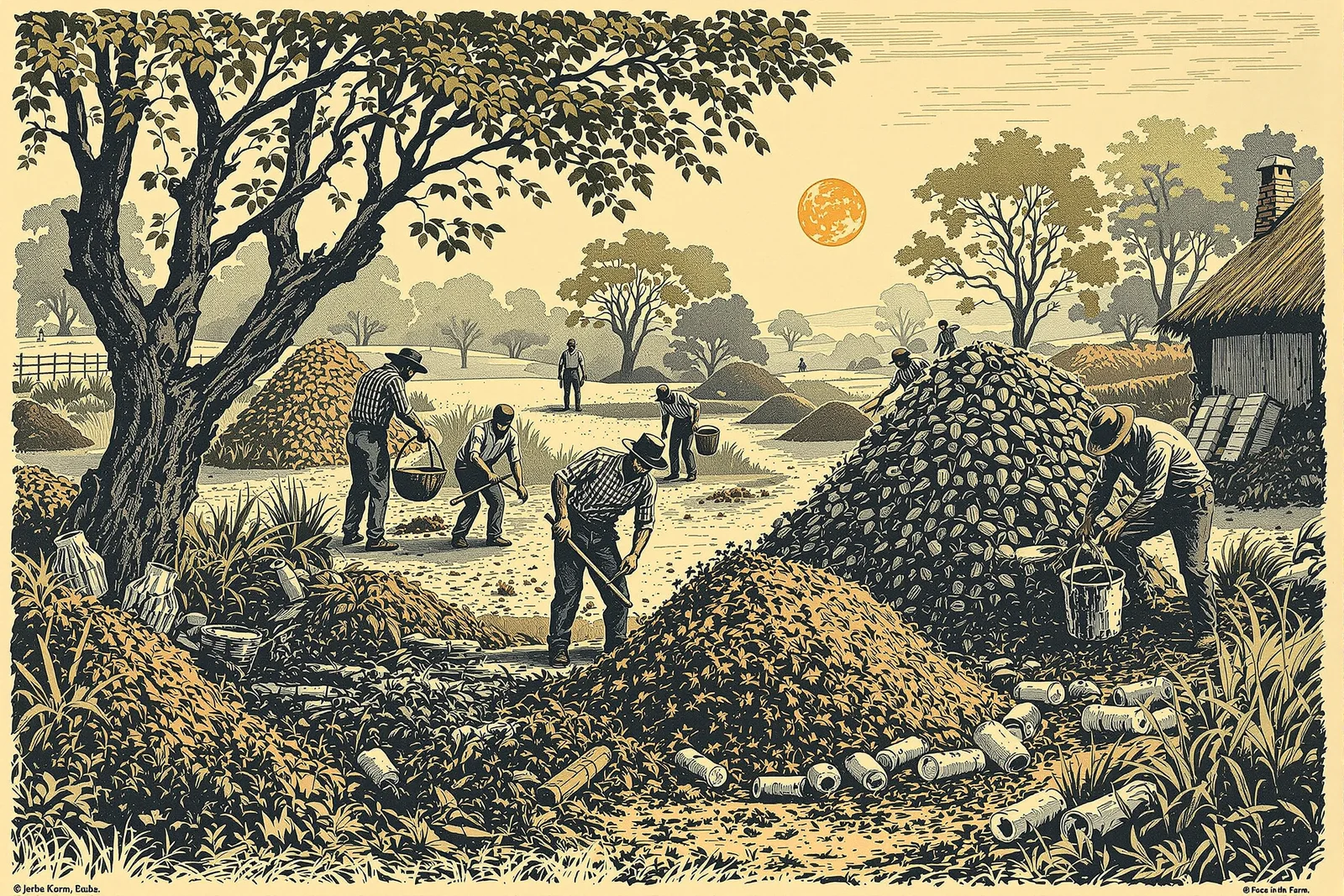
Complete Composting and Soil Building: From Waste to Fertility
Healthy soil is the foundation of all agriculture. This campaign covers composting methods, soil analysis, amendment strategies, cover cropping, and the biology that transforms dead matter into living earth.
Chapter 1: Composting Fundamentals
| Factor | Ideal Range | Too Low | Too High | How to Adjust |
|---|---|---|---|---|
| Carbon:Nitrogen ratio | 25-30:1 | Slimy, smelly (too much N) | Slow decomposition | Add browns (C) or greens (N) |
| Moisture | 40-60% (wrung sponge) | Decomposition stops | Anaerobic, smelly | Add water or dry materials |
| Oxygen | Aerobic (with air) | Anaerobic (smelly) | Dries out | Turn pile or add structure |
| Temperature | 130-160°F (hot phase) | Slow decomposition | Kills beneficial organisms | Adjust C:N, moisture, size |
| Particle size | 1-3 inches | Too large = slow | Too fine = compacts | Chop or shred materials |
| Pile size | 3×3×3 ft minimum | Won't heat up | Hard to manage | Build to minimum size |
| Material | C:N Ratio | Category | Notes |
|---|---|---|---|
| Food scraps (fruit/veg) | 15-20:1 | Green (nitrogen) | Chop small, bury in pile |
| Fresh grass clippings | 15-25:1 | Green | Mix with browns (mats if alone) |
| Coffee grounds | 20:1 | Green | Excellent activator |
| Fresh manure (herbivore) | 15-25:1 | Green | Hot — compost before garden use |
| Dry leaves | 40-80:1 | Brown (carbon) | Shred for faster breakdown |
| Straw | 75-100:1 | Brown | Excellent structure |
| Cardboard | 300-500:1 | Brown | Shred, wet thoroughly |
| Wood chips | 400-700:1 | Brown | Slow — best for paths/mulch |
| Sawdust | 300-500:1 | Brown | Use sparingly (very high C) |
| Newspaper | 150-200:1 | Brown | Shred, avoid glossy |
Chapter 2: Composting Methods
| Method | Time | Effort | Temperature | Volume | Best For |
|---|---|---|---|---|---|
| Hot composting (turned) | 3-8 weeks | High (turn every 3-5 days) | 130-160°F | Large batches | Fast results, weed seed kill |
| Cold composting (static) | 6-24 months | Very low (pile and wait) | Ambient | Any | Low effort, patient gardener |
| Vermicomposting (worms) | 2-4 months | Low (feed and harvest) | 55-77°F | Small-medium | Kitchen scraps, indoor |
| Bokashi (fermentation) | 2-4 weeks + burial | Low | Ambient (anaerobic) | Small | All food waste including meat |
| Sheet composting (lasagna) | 6-12 months | Low (layer and wait) | Low-moderate | Garden beds | Building new beds |
| Trench composting | 3-6 months | Very low (bury and forget) | Ambient | Small batches | Simple, no pile needed |
Hot composting procedure: 1) Gather materials (aim for equal volumes of greens and browns). 2) Chop/shred to 1-3 inch pieces. 3) Layer: 4-6 inches browns, 2-3 inches greens, repeat. 4) Moisten each layer (wrung sponge consistency). 5) Build to minimum 3×3×3 feet. 6) Temperature rises within 24-48 hours (should reach 130°F+). 7) Turn when temperature drops (every 3-7 days). 8) Re-moisten if dry when turning. 9) Finished when: dark, crumbly, earthy smell, no recognizable materials. 10) Cure 2-4 weeks before use (let biology stabilize).
Chapter 3: Soil Analysis
| Test | Method | What It Tells You | Frequency | Cost |
|---|---|---|---|---|
| Texture (jar test) | Soil + water in jar, settle | Sand/silt/clay proportions | Once per area | Free |
| pH (indicator test) | Soil + indicator solution | Acidity/alkalinity | Annually | Very low |
| Drainage (perc test) | Dig hole, fill with water, time | Drainage rate | Once per area | Free |
| Organic matter (visual) | Color, smell, structure | Biological health | Annually | Free |
| Earthworm count | Dig 1 cu ft, count worms | Biological activity | Annually | Free |
| Nutrient test (lab) | Send sample to lab | N, P, K, micronutrients | Every 2-3 years | Moderate |
Jar test (soil texture): 1) Collect soil sample (1 cup from 6 inches deep). 2) Remove rocks, roots, debris. 3) Fill quart jar 1/3 with soil. 4) Add water to near top. 5) Add 1 tsp dish soap (dispersant). 6) Shake vigorously for 2 minutes. 7) Let settle: sand settles in 1 minute, silt in 2-4 hours, clay in 24-48 hours. 8) Measure layers. 9) Calculate percentages. 10) Ideal garden soil: 40% sand, 40% silt, 20% clay (loam).
Chapter 4: Soil Amendments
| Amendment | Provides | Application Rate | Speed | Duration | pH Effect |
|---|---|---|---|---|---|
| Compost | All nutrients + biology | 1-3 inches/year | Moderate | Season | Neutral |
| Aged manure | N, P, K + organic matter | 1-2 inches/year | Moderate | Season | Slightly alkaline |
| Wood ash | Potassium, calcium | 5-10 lbs/100 sq ft | Fast | Months | Raises pH (alkaline) |
| Lime (calcium carbonate) | Calcium | Per soil test | Slow (months) | 1-3 years | Raises pH |
| Sulfur | Acidifier | Per soil test | Slow (months) | 1-2 years | Lowers pH |
| Bone meal | Phosphorus, calcium | 5-10 lbs/100 sq ft | Slow | Season | Slightly raises |
| Blood meal | Nitrogen | 3-5 lbs/100 sq ft | Fast | Weeks | Slightly lowers |
| Green sand | Potassium, iron, trace minerals | 5-10 lbs/100 sq ft | Very slow | Years | Neutral |
| Kelp/seaweed | Trace minerals, growth hormones | 1-2 lbs/100 sq ft | Moderate | Season | Neutral |
| Biochar | Carbon, water retention, biology | 5-10% by volume | Permanent | Decades-centuries | Slightly raises |
Chapter 5: Cover Cropping
| Cover Crop | Type | Season | Benefits | Biomass | N-Fixation |
|---|---|---|---|---|---|
| Crimson clover | Legume | Fall/winter | Nitrogen fixation, pollinator | Moderate | 75-150 lbs N/acre |
| Winter rye | Grass | Fall/winter | Erosion control, weed suppression | Very high | None |
| Buckwheat | Broadleaf | Summer | Fast cover, pollinator, P mining | Moderate | None |
| Field peas | Legume | Spring/fall | Nitrogen fixation, fast growth | Moderate | 50-100 lbs N/acre |
| Daikon radish | Brassica | Fall | Deep tillage (bio-drill), compaction | Low (above) | None |
| Oats | Grass | Spring/fall | Fast cover, easy to kill | Moderate | None |
| Hairy vetch | Legume | Fall/winter | Heavy N fixation, weed suppression | High | 100-200 lbs N/acre |
Reference Card
- Feed the soil, not the plant (healthy soil grows healthy plants — compost is food for soil biology). 2. C:N ratio 25-30:1 (equal volumes of browns and greens approximates this — the sweet spot for decomposition). 3. Moisture like a wrung sponge (too wet = anaerobic stink; too dry = nothing happens). 4. Turn for speed (turning adds oxygen, reactivates decomposition — every 3-5 days for fastest results). 5. Hot kills weeds and pathogens (130-160°F for 3+ days destroys weed seeds and disease organisms). 6. Earthworms are indicators (10+ worms per cubic foot = healthy soil; fewer = needs organic matter). 7. Cover crops are free fertilizer (legumes fix nitrogen from air — 100+ lbs per acre for free). 8. Never leave soil bare (bare soil erodes, compacts, and loses biology — always cover with mulch or plants).