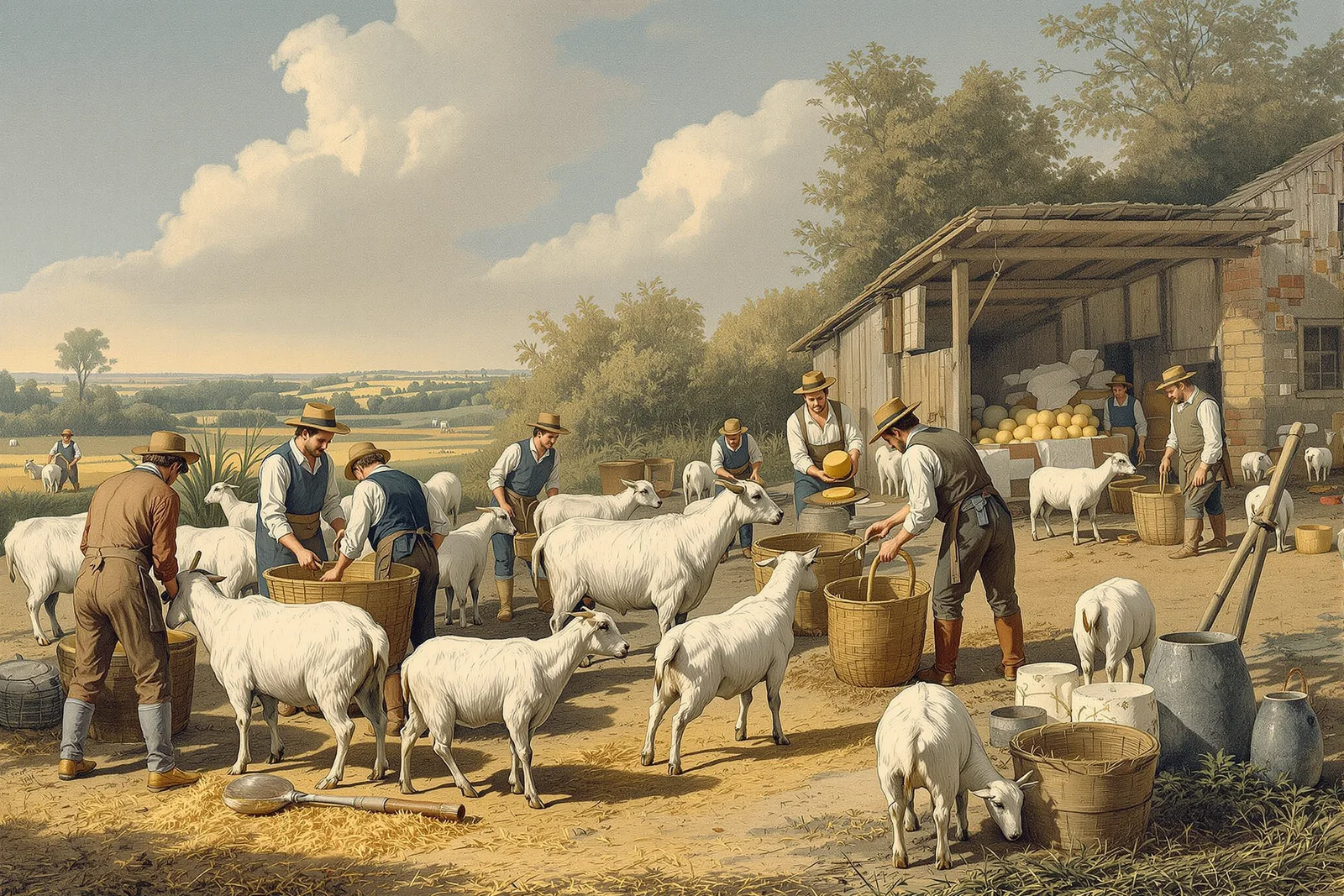
⟁ cover painted for this edition — the source module carried no illustrations
Complete Goat Keeping: From Kid to Milk to Cheese
Goats are the most versatile small livestock, providing milk, meat, fiber, and land clearing. This campaign covers breeds, housing, feeding, milking, breeding, and health management.
Chapter 1: Breed Selection
Breed
Purpose
Milk/Day
Temperament
Size
Climate
Special Traits
Nubian
Dairy
1-2 gallons
Vocal, friendly
Large
Hot climates
High butterfat (5%)
Alpine
Dairy
1-2 gallons
Active, curious
Large
Adaptable
Consistent production
Saanen
Dairy
1-3 gallons
Calm, gentle
Large
Cool climates
Highest volume
LaMancha
Dairy
1-2 gallons
Calm, friendly
Medium-large
Adaptable
Tiny ears, high butterfat
Nigerian Dwarf
Dairy
1-2 quarts
Friendly, playful
Small
Adaptable
Very high butterfat (6-10%)
Boer
Meat
Low
Docile
Large
Hot climates
Fast growth, muscular
Kiko
Meat
Low
Hardy, independent
Large
Adaptable
Parasite resistant
Angora
Fiber (mohair)
Low
Gentle
Medium
Moderate
Mohair fiber
Spanish
Meat/brush clearing
Low
Hardy
Medium
Hot, arid
Excellent foragers
Chapter 2: Housing and Fencing
Component
Minimum
Ideal
Purpose
Notes
Shelter (per goat)
15 sq ft
20-25 sq ft
Protection from rain, wind
Three-sided is adequate in mild climates
Pasture (per goat)
200 sq ft
500+ sq ft
Grazing and exercise
Rotate pastures for parasite control
Fence height
4 feet
5 feet
Containment
Goats are excellent climbers and jumpers
Fence type
Woven wire
Electric + woven wire
Predator protection
Electric wire at top and bottom
Fencing principles: 1) Goats test every fence constantly (they are escape artists). 2) Woven wire (not welded wire) is strongest. 3) No climb horse fence (2x4 inch mesh) is ideal. 4) Electric fence: hot wire at nose height (inside) deters pushing. 5) Hot wire at bottom prevents digging/crawling under. 6) Posts every 8-10 feet (closer on corners). 7) Corner posts must be very strong (braced). 8) Check fence daily (goats find weaknesses immediately).
Chapter 3: Feeding
Feed
When
Amount
Purpose
Notes
Pasture/browse
Daily (primary)
Free choice
Main nutrition
Goats prefer browse (shrubs, weeds) over grass
Hay (grass or alfalfa)
When pasture is limited
3-5 lbs/day
Fiber, nutrition
Alfalfa for dairy does
Grain
Milking does, growing kids
1-2 lbs/day
Energy, protein
Do not overfeed (urinary calculi in bucks)
Minerals (loose)
Free choice always
Self-regulated
Essential minerals
Goat-specific (not sheep mineral; copper needed)
Baking soda
Free choice
Self-regulated
Rumen buffer
Prevents bloat
Fresh water
Always available
1-3 gallons/day
Hydration
Clean, fresh daily
Chapter 4: Milking
Aspect
Detail
Frequency
Notes
Milking schedule
Every 12 hours
Twice daily
Consistency is critical
Milk per session
1/2 to 1.5 gallons
Per milking
Varies by breed and stage
Lactation length
10 months
Per breeding
Dry off 2 months before kidding
Milk handling
Strain, chill immediately
Every milking
Cool to 40°F within 1 hour
Pasteurization
145°F for 30 min or 161°F for 15 sec
Optional
Raw milk legal in some areas
Milking procedure: 1) Wash udder with warm water and clean cloth. 2) Strip first few squirts into separate container (check for abnormalities). 3) Milk into clean, sanitized stainless steel pail. 4) Wrap thumb and forefinger around base of teat (trap milk). 5) Squeeze remaining fingers in sequence (push milk out). 6) Do not pull teat downward (causes injury). 7) Alternate teats rhythmically. 8) Milk until udder feels empty and soft. 9) Apply teat dip after milking (prevents mastitis). 10) Strain milk through filter into clean jar. 11) Chill immediately in ice water bath. 12) Goat milk is naturally homogenized (cream does not separate easily).
Chapter 5: Breeding and Kidding
Timeline
Event
Notes
Fall (Sep-Dec)
Breeding season
Does cycle every 18-21 days
Day 0
Breeding
Buck with doe for 2-3 cycles
Day 145-155
Kidding (birth)
Average gestation: 150 days
Birth
Kids born
1-4 kids typical
Day 1-3
Colostrum
Critical for kid immunity
Week 1-8
Nursing
Kids nurse from dam
Week 8-12
Weaning
Gradual separation
Month 2
Begin milking
After kids are weaned
Reference Card
Goats are browsers, not grazers (goats prefer shrubs, weeds, and tree leaves over grass; they are nature's brush clearers). 2. Never keep a single goat (goats are herd animals and become stressed, noisy, and destructive when kept alone; minimum two goats). 3. Goats need copper (unlike sheep, goats require copper in their mineral supplement; sheep mineral without copper will cause deficiency). 4. Fence for Houdini (goats are the greatest escape artists in the animal kingdom; build fences assuming they will test every weakness). 5. Consistency in milking (milk at the same times every day; irregular milking reduces production and increases mastitis risk). 6. Chill milk immediately (goat milk flavor depends on rapid cooling; milk that cools slowly develops a goaty taste). 7. Rotate pastures for parasites (internal parasites are the number one health problem in goats; rotating pastures breaks the parasite lifecycle). 8. Start with two does (two dairy does provide enough milk for a family plus cheese making; add a buck only when you are ready to breed).