Sovereignty Module: Haft the Axe
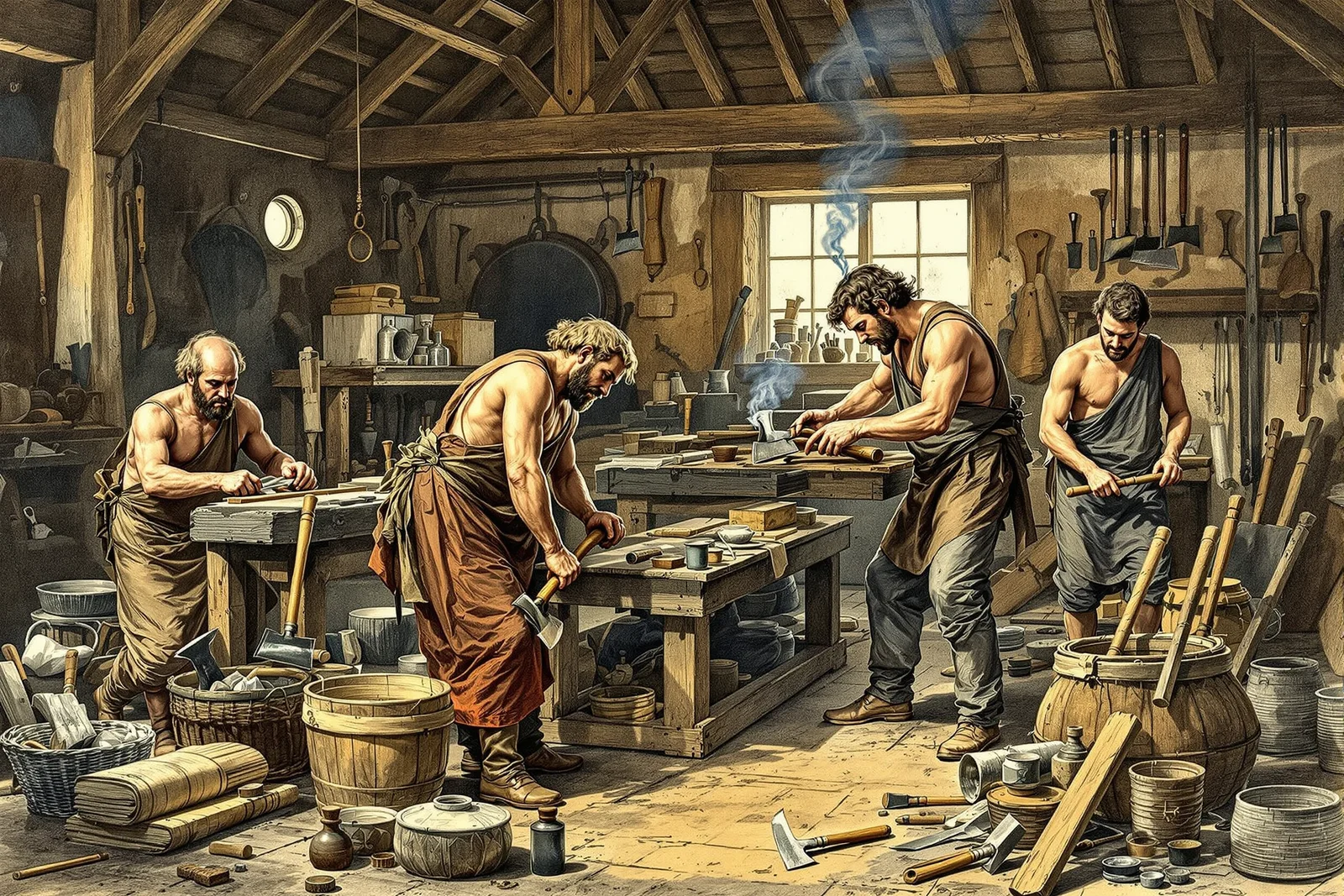
Complete Axe Making and Hafting: From Steel to Splitting Edge
The axe is the essential woodland tool. This campaign covers axe head forging, eye punching, heat treatment, handle shaping, and hafting techniques.
Chapter 1: Axe Head Types
| Type | Weight | Purpose | Edge Profile | Handle Length |
|---|---|---|---|---|
| Hatchet | 1-2 lbs | Light work, carving | Thin, sharp | 12-16 inches |
| Boy's axe | 2-2.5 lbs | General light work | Medium | 24-28 inches |
| Felling axe | 3-4 lbs | Cutting trees | Thin, sharp | 28-36 inches |
| Splitting axe | 4-6 lbs | Splitting firewood | Thick, wedge-shaped | 28-36 inches |
| Broad axe | 4-8 lbs | Hewing timber flat | Single bevel, wide | 18-24 inches (offset) |
| Tomahawk | 1-1.5 lbs | Camp tool, throwing | Thin, sharp | 16-20 inches |
Chapter 2: Forging theE Head
Wrap-and-weld method: 1) Start with flat bar (1.5 x 0.5 inch, 5160 or 1075 steel, 8-10 inches long). 2) Heat to bright orange. 3) Fold bar around a drift (mandrel the shape of the eye). 4) Forge weld the overlapping ends together. 5) The fold creates the eye (handle hole). 6) Draw out the bit (cutting edge) from the welded end. 7) Spread the bit to desired width (3-4 inches for felling axe). 8) Thin the bit toward the edge. 9) Shape the poll (back of head) by forging the folded end. 10) Refine eye shape with drift (oval, tapered). 11) Normalize three times. 12) Grind edge profile.
| Forging Step | Temperature | Tool | Critical Point |
|---|---|---|---|
| Flatten bar | Bright orange | Hammer, anvil | Even thickness |
| Fold around drift | Bright orange | Hammer, drift | Center the eye |
| Forge weld | White heat (2,100°F+) | Hammer, flux | Clean surfaces, borax flux |
| Draw out bit | Bright orange | Hammer, anvil | Even taper |
| Shape poll | Orange | Hammer, anvil | Balanced weight |
| Drift eye | Cherry red | Drift, hammer | Tapered oval |
Chapter 3: Heat Treatment
| Steel | Hardening Temp | Quench Medium | Temper Temp | Result |
|---|---|---|---|---|
| 1075 | 1,475°F (cherry red) | Oil | 400-450°F | Good edge, tough body |
| 5160 | 1,525°F (bright cherry) | Oil | 400-450°F | Excellent toughness |
| 1084 | 1,475°F (cherry red) | Oil | 400-450°F | Good all-around |
Differential heat treatment: 1) Heat only the bit (cutting edge) to critical temperature. 2) Keep the eye and poll cooler (they stay soft and tough). 3) Quench only the bit in oil (dip edge 1-2 inches deep). 4) The eye remains soft (absorbs handle shock without cracking). 5) Temper the bit to straw/brown color (400-450°F). 6) Result: hard cutting edge with tough, shock-absorbing body.
Chapter 4: Handle Making
| Wood | Shock Absorption | Durability | Availability | Rating |
|---|---|---|---|---|
| Hickory | Excellent | Excellent | Eastern N. America | Best |
| Ash | Very good | Good | Widespread | Very good |
| Oak | Moderate | Very good | Widespread | Good |
| Maple (hard) | Moderate | Good | Widespread | Acceptable |
Handle shaping: 1) Select straight-grained wood (no knots in handle area). 2) Split (do not saw) blank from log (follows grain for maximum strength). 3) Rough shape with drawknife or hatchet. 4) Final shape with spokeshave and rasp. 5) Handle cross-section: oval (not round; oval prevents rotation in hand). 6) Slight swell at end (prevents slipping from grip). 7) Throat (near head): slightly thinner than grip area. 8) Sand smooth: 80, 120, 220 grit. 9) Finish: boiled linseed oil (multiple coats). 10) Do not varnish or lacquer (slippery when wet).
Chapter 5: Hafting (Mounting Head on Handle)
Hafting process: 1) Shape top of handle to fit axe eye (snug fit). 2) Handle should protrude 1/4 to 1/2 inch above head. 3) Seat head by striking bottom of handle on hard surface. 4) Head slides down handle onto tapered fit. 5) Cut kerf (slot) in top of handle for wedge. 6) Drive hardwood wedge into kerf (expands handle in eye). 7) Cut wedge flush with top of handle. 8) Drive steel cross-wedge perpendicular to wood wedge. 9) Soak head in linseed oil (swells wood, tightens fit). 10) Check tightness before every use. 11) If head loosens: soak in water overnight (temporary fix). 12) Re-wedge or re-haft if head is persistently loose.
Reference Card
- The eye makes the axe (the wrap-and-weld method creates a strong eye; the eye must be tapered so the handle wedges tighter with use). 2. Differential hardening is essential (harden only the cutting edge; a fully hardened axe head shatters on impact). 3. Hickory is the only proper axe handle wood (nothing else absorbs shock like hickory; ash is an acceptable second choice). 4. Split the handle blank, do not saw it (splitting follows the grain; sawn handles often have cross-grain that breaks under stress). 5. Oval cross-section prevents rotation (a round handle rotates in your hand; an oval handle stays aligned with the cutting edge). 6. Wedge from both directions (a wood wedge along the grain plus a steel cross-wedge perpendicular locks the head permanently). 7. Check the head before every swing (a loose axe head is the most dangerous tool failure; always verify tightness before use). 8. A sharp axe is safer than a dull one (a sharp axe bites into wood predictably; a dull axe bounces and glances unpredictably).