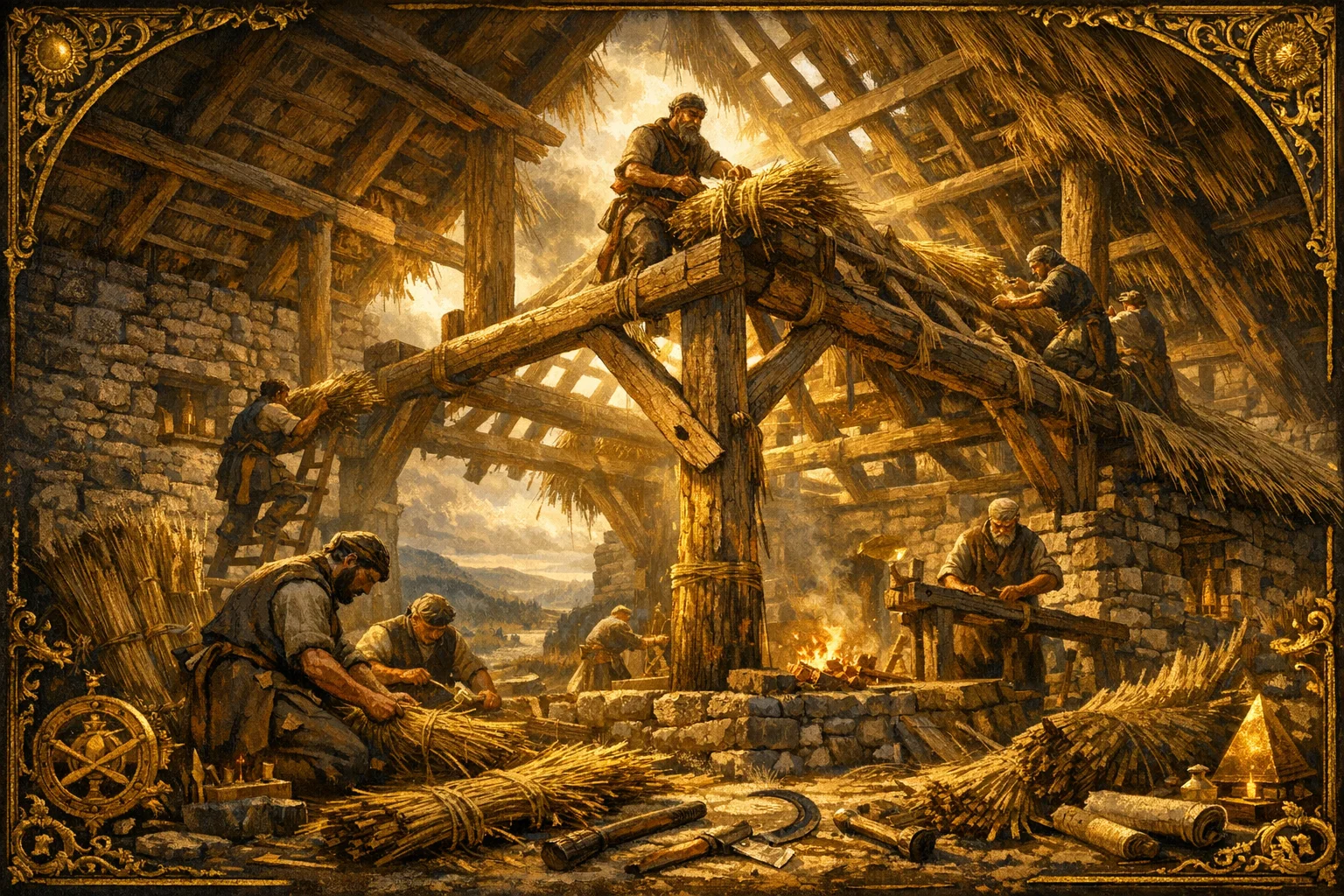
Complete Thatching and Roof Construction: From Reed to Rainproof
Thatching is one of the oldest roofing methods, using natural materials to create waterproof, insulating roofs. This campaign covers materials, techniques, ridge construction, and maintenance.
Chapter 1: Thatching Materials
Material
Durability
Insulation
Availability
Difficulty
Lifespan
Water reed (Phragmites)
Excellent
Very good
Wetlands
Moderate
25-60 years
Long straw (wheat/rye)
Good
Very good
Farmland
Moderate
15-25 years
Combed wheat reed
Very good
Very good
Farmland
Moderate
25-40 years
Palm fronds
Good
Moderate
Tropical
Low
5-15 years
Grass (various)
Moderate
Good
Widespread
Low
5-10 years
Heather
Good
Good
Moorland
Moderate
15-25 years
Sedge
Good
Good
Wetlands
Moderate
20-30 years
Material preparation: 1) Harvest at maturity (after seed set, before decay). 2) Water reed: cut in winter when dry. 3) Long straw: save from grain harvest (do not use combine-harvested straw). 4) Bundle into manageable sheaves (arm-sized bundles). 5) Store dry until needed (wet thatch rots). 6) Sort by length (longer material for main roof, shorter for ridges). 7) Remove leaves and debris (clean material lasts longer). 8) Soak briefly before use (flexible, easier to work).
Chapter 2: Roof Structure
Component
Function
Material
Sizing
Rafters
Main roof support
Timber (4-6 inch diameter)
Every 18-24 inches
Purlins
Horizontal supports across rafters
Timber (2-3 inch diameter)
Every 12-18 inches
Battens (laths)
Thatch attachment points
Split wood or sawn lath
Every 8-12 inches
Ridge pole
Top of roof
Timber (4-6 inch diameter)
Full length of roof
Wall plate
Top of wall, supports rafters
Timber (4-6 inch diameter)
Full length of wall
Roof pitch requirements: 1) Minimum pitch for thatch: 45 degrees (steeper is better). 2) Ideal pitch: 50-55 degrees. 3) Steep pitch sheds water quickly (water runs off before soaking in). 4) Shallow pitch allows water to penetrate (thatch fails). 5) Eaves should overhang walls by 12-18 inches (protects walls from rain). 6) Thatch thickness: 12-15 inches minimum (provides waterproofing and insulation).
Chapter 3: Thatching Technique
Basic thatching (long straw method): 1) Start at eaves (bottom of roof). 2) Lay first course of bundles with butt ends (thick ends) at eaves. 3) Butt ends should extend 6-8 inches beyond the wall. 4) Secure with hazel spars (bent staples of hazel wood) or wire. 5) Each spar is pushed through thatch into batten below. 6) Lay next course overlapping previous by 6-8 inches. 7) Work upward toward ridge. 8) Each course overlaps the one below (like shingles). 9) Dress (trim) each course with a leggett (flat paddle tool). 10) Compress thatch firmly (tight thatch sheds water better). 11) Continue to ridge. 12) Ridge requires special treatment (see Chapter 4).
Fixing Method
Material
Strength
Difficulty
Tradition
Hazel spars
Bent hazel rods
Good
Moderate
English traditional
Scallops and spars
Hazel rods and horizontal rods
Very good
Moderate
English traditional
Wire ties
Galvanized wire
Very good
Low
Modern
Bamboo pins
Bamboo stakes
Good
Low
Tropical
Rope lashing
Natural or synthetic rope
Good
Low
Various traditions
Chapter 4: Ridge Construction
Ridge Type
Durability
Appearance
Difficulty
Tradition
Wrap-over ridge
Good
Simple, rounded
Low
Basic
Block ridge
Very good
Decorative, patterned
Moderate
English
Flush ridge
Good
Clean, minimal
Moderate
Modern
Sedge ridge
Very good
Traditional, thick
Moderate
English (Norfolk)
Turf ridge
Moderate
Grass-covered
Low
Scandinavian
Chapter 5: Maintenance and Repair
Task
Frequency
Purpose
Method
Inspect
Annually (spring)
Identify damage, thin spots
Visual inspection from ground and ladder
Re-ridge
Every 10-15 years
Ridge wears fastest
Remove old ridge, apply new
Patch thin spots
As needed
Prevent leaks
Add new thatch over thin areas
Remove moss/algae
Every 2-3 years
Prevents moisture retention
Wire brush or copper strip at ridge
Trim eaves
As needed
Maintain neat appearance
Shears or knife
Fire prevention
Ongoing
Thatch is combustible
Spark arrestor on chimney, fire retardant treatment
Reference Card
Steep pitch is essential (thatch must be at minimum 45 degrees; steeper roofs shed water faster and last much longer). 2. Start at the bottom (always begin thatching at the eaves and work upward; each course overlaps the one below like shingles). 3. Tight thatch is waterproof thatch (compress each course firmly; loose thatch absorbs water instead of shedding it). 4. The ridge wears first (the ridge is exposed to the most weather; expect to re-ridge every 10-15 years even if the main roof is sound). 5. Water reed lasts longest (properly applied water reed thatch can last 60 years; it is the premium thatching material). 6. Thatch insulates brilliantly (a 12-inch thatch roof provides insulation equivalent to modern standards; warm in winter, cool in summer). 7. Fire is the main risk (thatch is combustible; install spark arrestors on chimneys and maintain clearance from heat sources). 8. Harvest at the right time (cut thatching material after it has dried naturally in the field; green material rots quickly on the roof).