Sovereignty Module: Mold the Brick
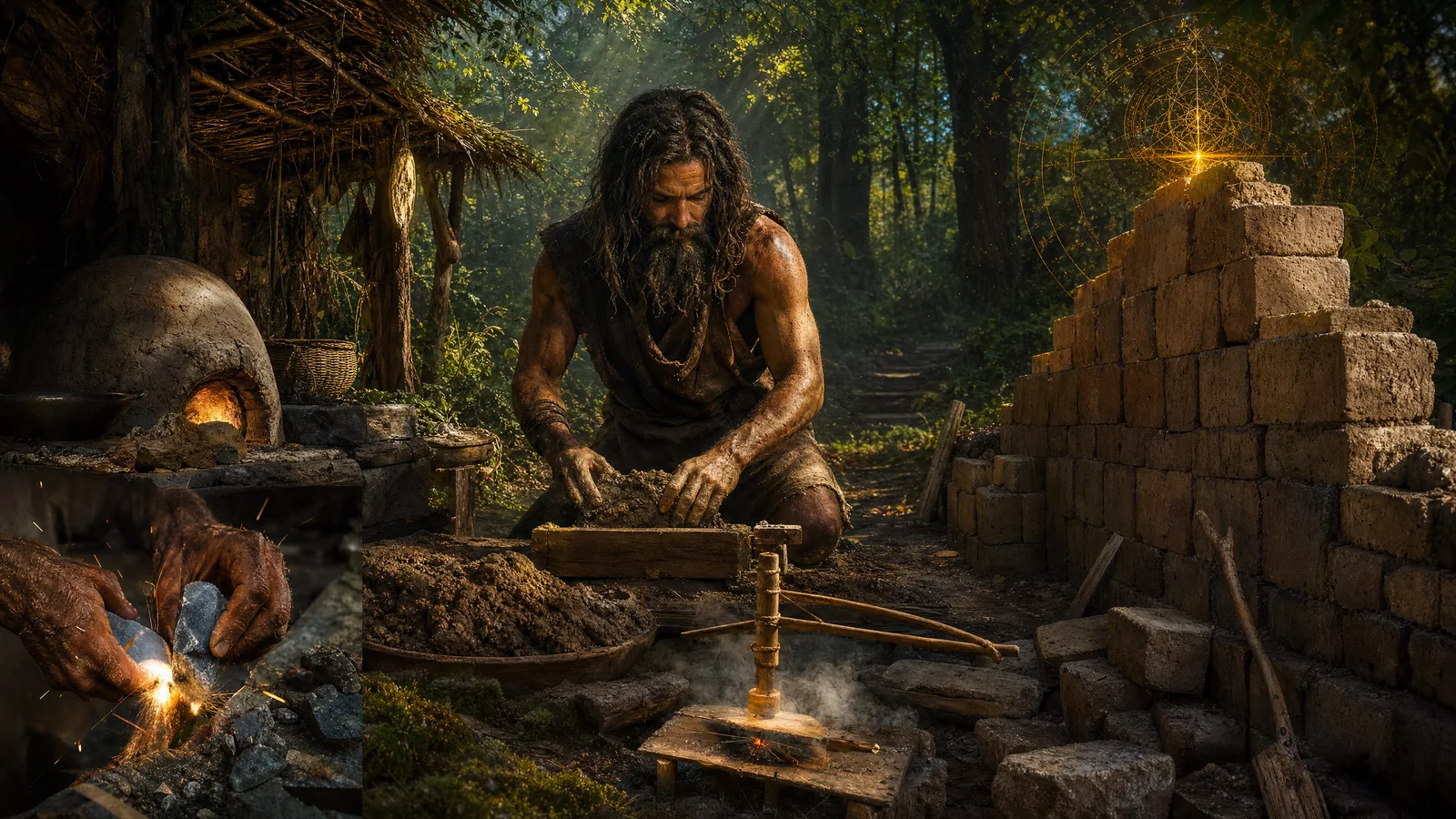
Complete Primitive Clay Brick Making: From Earth to Wall
Bricks are the building blocks of civilization. This campaign covers clay selection, brick molding, drying, firing, and construction with handmade bricks.
Chapter 1: Clay Selection and Preparation
| Clay Type | Shrinkage | Strength (fired) | Availability | Color (fired) | Best For |
|---|---|---|---|---|---|
| Red clay (iron-rich) | Moderate (5-8%) | Good | Very common | Red to brown | General construction |
| Fire clay | Low (3-5%) | Very good | Moderate | Buff to white | High-temperature applications |
| Kaolin (white clay) | Low (3-5%) | Good | Moderate | White | Fine ceramics, firebrick |
| Alluvial clay (river) | High (8-12%) | Moderate | Very common | Varies | Adobe, unfired bricks |
| Glacial clay | Moderate (5-8%) | Good | Northern regions | Gray to brown | General construction |
Clay preparation: 1) Dig clay from deposit (riverbank, hillside, road cut). 2) Break into small pieces. 3) Soak in water for 1-3 days (slaking). 4) Mix thoroughly (remove stones, roots, debris). 5) Screen through 1/4 inch mesh if needed. 6) Add temper: sand (10-30% by volume) to reduce shrinkage and cracking. 7) Mix temper thoroughly into clay. 8) Wedge (knead) until homogeneous. 9) Test: form a brick and dry; if it cracks excessively, add more sand. 10) Consistency should be like stiff modeling clay (holds shape, not sticky).
Chapter 2: Brick Molding
| Brick Type | Size (typical) | Weight | Mold | Difficulty |
|---|---|---|---|---|
| Standard brick | 8 x 4 x 2.5 inches | 4-5 lbs | Wooden mold | Low |
| Adobe brick | 10 x 14 x 4 inches | 25-35 lbs | Wooden mold | Low |
| Fire brick | 9 x 4.5 x 2.5 inches | 5-7 lbs | Wooden mold | Low |
| Paving brick | 8 x 4 x 1.5 inches | 3-4 lbs | Wooden mold | Low |
| Decorative brick | Various | Various | Carved mold | Moderate |
Brick molding process: 1) Build wooden mold (open top and bottom, handles on sides). 2) Wet mold and dust with sand (prevents sticking). 3) Pack clay firmly into mold (press into corners, no air pockets). 4) Strike off excess clay with straight edge (wire or board). 5) Lift mold straight up, leaving formed brick on flat surface. 6) Repeat (experienced worker: 500-1,000 bricks per day). 7) Let bricks dry slowly in shade (2-7 days depending on climate). 8) Turn bricks on edge after 1-2 days (even drying). 9) Fully dried bricks are called "green" bricks (unfired). 10) Green bricks are fragile; handle carefully.
Chapter 3: Brick Firing
| Firing Method | Max Temperature | Capacity | Fuel | Time | Quality |
|---|---|---|---|---|---|
| Open firing (clamp) | 1,500-1,800°F | 500-5,000 bricks | Wood | 2-5 days | Variable |
| Updraft kiln | 1,800-2,100°F | 1,000-10,000 bricks | Wood, coal | 3-7 days | Good |
| Downdraft kiln | 2,000-2,300°F | 1,000-50,000 bricks | Wood, coal, gas | 3-7 days | Very good |
| Pit firing | 1,200-1,500°F | 50-500 bricks | Wood | 1-2 days | Low-moderate |
Clamp firing (simplest method): 1) Stack dried green bricks in a rectangular pile. 2) Leave channels at bottom for fire (every 3-4 bricks wide). 3) Stack bricks with small gaps between (allows heat circulation). 4) Taper stack inward toward top (pyramid shape). 5) Plaster outside with wet clay/mud (seals heat in). 6) Leave vent holes at top. 7) Build fires in bottom channels. 8) Slowly increase temperature over 24-48 hours. 9) Maintain maximum heat for 24-48 hours. 10) Seal all openings and let cool slowly (2-3 days). 11) Break open clamp and sort bricks. 12) Center bricks (hottest) are best quality. 13) Outer bricks may be under-fired (use for interior walls).
Chapter 4: Adobe (Unfired) Bricks
| Component | Proportion | Function | Notes |
|---|---|---|---|
| Clay | 30-40% | Binder | Too much = cracking |
| Sand | 40-50% | Aggregate, reduces shrinkage | Coarse sand preferred |
| Straw/grass | 10-20% | Fiber reinforcement | Cut to 4-6 inch lengths |
| Water | As needed | Workability | Mix to stiff mud consistency |
Adobe advantages: 1) No firing needed (sun-dried only). 2) Excellent thermal mass (cool in summer, warm in winter). 3) Very low cost (materials are free). 4) Easy to make (no special skills or equipment). 5) Repairable (damaged areas can be patched with more adobe). 6) Recyclable (old adobe dissolves back into earth). 7) Limitation: not waterproof (must protect from rain with roof overhang and plaster). 8) Used for thousands of years in arid climates worldwide.
Chapter 5: Building with Bricks
| Bond Pattern | Strength | Difficulty | Appearance | Use |
|---|---|---|---|---|
| Running bond | Good | Very low | All stretchers (long face) | Walls, veneers |
| Common bond | Very good | Low | Stretchers with header course every 5-7 rows | Load-bearing walls |
| English bond | Excellent | Moderate | Alternating stretcher and header courses | Heavy load-bearing |
| Flemish bond | Excellent | Moderate | Alternating stretcher and header in each course | Decorative, strong |
| Stack bond | Low | Very low | All aligned (no offset) | Decorative only |
Reference Card
- Sand prevents cracking (pure clay shrinks and cracks as it dries; adding 10-30 percent sand as temper dramatically reduces cracking). 2. Dry slowly in shade (rapid drying causes uneven shrinkage and cracking; dry bricks slowly in shade for best results). 3. Fire slowly (rapid heating cracks bricks; increase temperature gradually over 24-48 hours before reaching maximum). 4. Center bricks are best (in a clamp firing, the center gets hottest; sort bricks by quality after firing). 5. Adobe works in dry climates (unfired adobe bricks are strong and durable in arid regions; they dissolve in prolonged rain without protection). 6. Straw reinforces adobe (chopped straw in adobe mix acts like rebar in concrete; it prevents cracking and adds tensile strength). 7. Mortar is just thin brick mix (the mortar between bricks is the same clay-sand mix used for the bricks, just wetter; consistency matters). 8. One person can make 500 bricks per day (brick making is labor-intensive but simple; a dedicated worker with molds can produce enough for a small building in a week).