Sovereignty Module: Raise the Walls
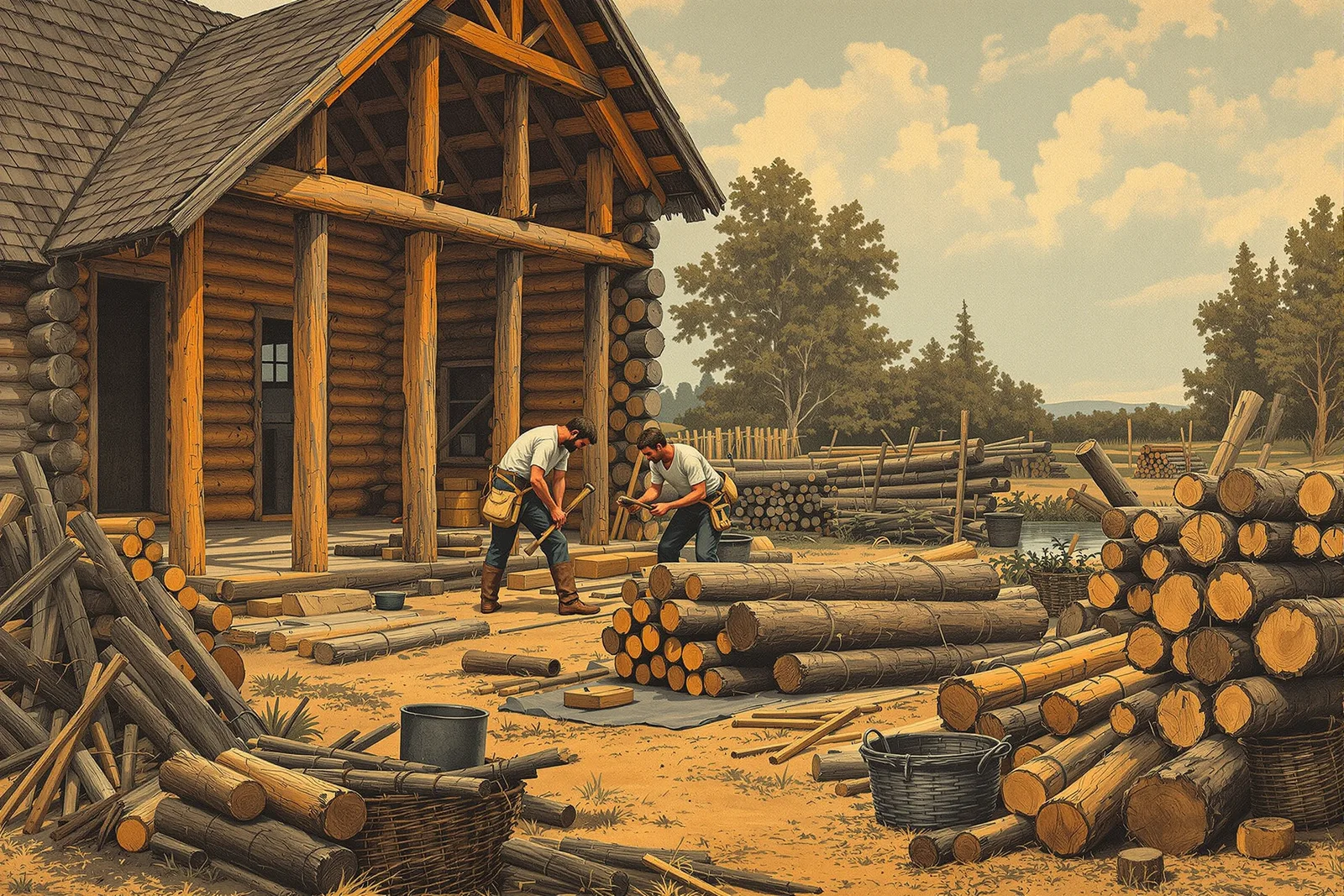
Complete Log Building, Timber Harvesting, and Cabin Construction Guide
Log construction is the fastest path from standing forest to weatherproof shelter. A single person with an axe can build a cabin in weeks. This campaign covers tree selection, felling, notching, and complete cabin construction.
Chapter 1: Wood Selection for Building
| Species | Strength | Rot Resistance | Workability | Weight (green) | Availability | Best Use |
|---|---|---|---|---|---|---|
| White cedar | Moderate | Excellent | Easy (soft) | Light | Northern forests | Walls, shingles, posts |
| Red cedar | Moderate | Excellent | Easy | Light | Pacific NW | Walls, shingles, siding |
| White pine | Moderate | Moderate | Easy | Light-moderate | Eastern forests | Walls, interior, framing |
| Douglas fir | High | Moderate | Moderate | Heavy | Pacific NW | Structural, beams |
| Oak (white) | Very high | Good | Hard | Very heavy | Eastern forests | Sills, structural, flooring |
| Spruce | Moderate | Poor | Easy | Light | Northern forests | Walls, rafters |
| Larch/tamarack | High | Excellent | Moderate | Heavy | Northern forests | Sills, foundation, posts |
| Poplar/aspen | Low | Poor | Very easy | Light | Widespread | Temporary, interior |
Best log cabin wood: Cedar (rot-proof, light, easy to work) or pine (straight, available, moderate rot resistance). Foundation logs (bottom course): MUST be rot-resistant species (cedar, larch, or treated).
Chapter 2: Tree Felling
| Step | Action | Safety | Details |
|---|---|---|---|
| 1 | Assess lean: which way does tree naturally lean? | Stand back, use plumb line | Fell in direction of lean when possible |
| 2 | Clear escape routes: 45° angles behind and to sides | Remove brush, plan two routes | NEVER stand directly behind falling tree |
| 3 | Face cut (notch): cut on falling side, 1/3 through trunk | - | Two cuts forming 45-70° wedge, horizontal + angled |
| 4 | Remove notch wedge | - | Creates hinge that guides fall direction |
| 5 | Back cut: horizontal cut from opposite side, 2 inches ABOVE notch bottom | LEAVE HINGE (2-3 inches uncut) | Hinge controls fall direction |
| 6 | Insert wedge in back cut if needed | Prevents saw/axe binding | Drive with hammer to start fall |
| 7 | Tree begins to fall: RETREAT along escape route | Move immediately when cracking starts | Watch for widow-makers (falling branches) |
| 8 | Limb fallen tree: cut branches flush with trunk | Work from base toward top | Stand uphill of log on slopes |
CRITICAL SAFETY: Felling kills more people than any other forestry activity. Never fell alone. Always have clear escape routes. Never turn your back on a falling tree. Watch for dead branches overhead (widow-makers).
Chapter 3: Log Notching Systems
| Notch Type | Complexity | Weather Seal | Strength | Settling | Best For |
|---|---|---|---|---|---|
| Saddle notch (round) | Low | Moderate (needs chinking) | Good | Moderate | Quick builds, round logs |
| V-notch | Low | Poor (channels water) | Moderate | High | Temporary structures |
| Full dovetail | High | Excellent (self-sealing) | Excellent | Low | Permanent cabins |
| Half dovetail | Moderate | Good | Good | Low | Permanent cabins |
| Scandinavian (cope & saddle) | Moderate-high | Excellent (no chinking needed) | Excellent | Low | Best permanent method |
| Square notch | Moderate | Good (with chinking) | Good | Low | Hewn (squared) logs |
| Butt-and-pass | Very low | Poor | Low | High | Quick shelters, temporary |
Chapter 4: Cabin Construction Sequence
| Step | Action | Time | Details |
|---|---|---|---|
| 1 | Foundation: stone piers or rot-resistant logs on gravel | 1-3 days | Keep wood off ground. Level surface. Drainage away from cabin. |
| 2 | Sill logs (first course): largest, straightest, most rot-resistant | 1 day | Flatten top and bottom. These carry all weight. |
| 3 | Wall logs: stack and notch, alternating butt/tip ends | 1-3 weeks | Each log scribed to fit the one below (Scandinavian) or chinked |
| 4 | Door/window openings: cut after walls are up OR frame as you build | 1-2 days | Leave 2 inches for settling above frames |
| 5 | Plate logs (top course): support rafters | 1 day | Flatten top for rafter seating |
| 6 | Gable ends: shorter logs stacked to roof peak | 2-3 days | Or frame gables with studs |
| 7 | Ridge pole + purlins: horizontal roof support | 1 day | Ridge at peak, purlins at intervals |
| 8 | Rafters: angled from plate to ridge | 1-2 days | 24-inch spacing, notched at plate |
| 9 | Roof boards/shakes: split cedar or sawn boards | 2-5 days | Overlap like shingles, 3-layer minimum |
| 10 | Chinking: fill gaps between logs | 2-5 days | Moss, oakum, mortar, or foam |
| 11 | Floor: puncheon (split logs flat side up) or boards | 2-3 days | On sleepers (floor joists) above ground |
| 12 | Door and windows: hang door, install glass or shutters | 1-2 days | Allow settling space above |
Chapter 5: Chinking and Sealing
| Material | Durability | Flexibility | Insulation | Application |
|---|---|---|---|---|
| Lime mortar (lime + sand + fiber) | Excellent (decades) | Low (may crack) | Moderate | Trowel into gaps, 2-3 layers |
| Moss + clay | Good (5-10 years) | Good | Excellent | Pack moss, cover with clay |
| Oakum (tarred hemp) | Excellent | Good | Good | Drive into gaps with caulking iron |
| Portland cement mortar | Excellent | Very low (cracks with settling) | Moderate | Not recommended (too rigid) |
| Daubing (clay + straw + lime) | Good | Moderate | Good | Traditional, reapply as needed |
| Modern chinking (synthetic) | Excellent | Excellent | Good | Caulk gun application |
Chapter 6: Cabin Sizing and Layout
| Cabin Size | Occupants | Build Time (1 person) | Logs Required | Floor Area |
|---|---|---|---|---|
| 10×12 feet | 1-2 | 3-6 weeks | 40-60 logs | 120 sq ft |
| 12×16 feet | 2-4 | 4-8 weeks | 60-80 logs | 192 sq ft |
| 16×20 feet | 4-6 | 6-12 weeks | 80-120 logs | 320 sq ft |
| 20×24 feet | 6-8 | 8-16 weeks | 100-150 logs | 480 sq ft |
Log diameter: 8-12 inches is ideal for walls. Larger = fewer courses needed but heavier to lift. A 12×16 cabin with 10-inch logs needs about 12-14 courses (10-12 feet wall height).
Reference Card
- Foundation: NEVER set logs on bare ground. Stone piers or gravel pad. Drainage away from cabin.
- Sill logs: most rot-resistant species available (cedar, larch). Largest diameter. Flatten top/bottom.
- Alternate butt and tip: each course alternates thick/thin ends to keep walls level.
- Scandinavian scribe-fit: no chinking needed. Each log scribed and grooved to fit the one below.
- Allow 2 inches settling space above doors/windows: green logs shrink as they dry.
- Roof pitch: minimum 4:12 (4 inches rise per 12 inches run) for water shedding.
- Chinking: pack gaps with moss/oakum first, then cover with lime mortar or clay daub.
- One person, one axe, one forest: a 12×16 cabin is achievable in 6-8 weeks solo.