Sovereignty Module: Build in Stone
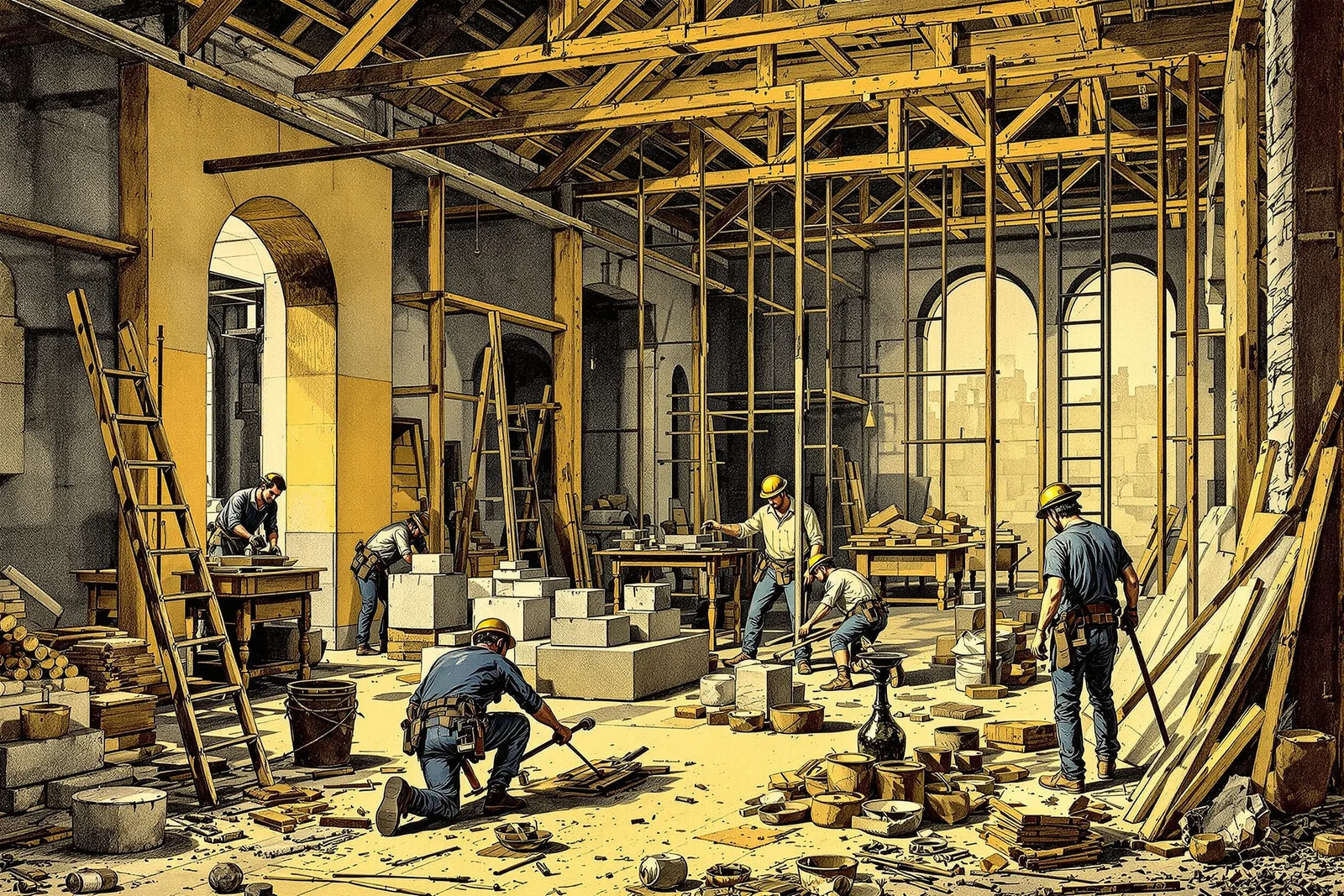
Complete Masonry: From Quarry to Cathedral
Stone outlasts all other building materials. This campaign covers stone selection, cutting, mortar, laying, and construction of permanent structures.
Chapter 1: Stone Types and Properties
| Stone | Hardness | Workability | Weight | Weather Resistance | Best Uses |
|---|---|---|---|---|---|
| Granite | Very hard | Difficult (split along grain) | Very heavy | Excellent | Foundations, monuments, paving |
| Limestone | Medium | Good (saws and carves) | Heavy | Good (some types dissolve slowly) | Walls, arches, carving, lime production |
| Sandstone | Soft-medium | Excellent (easy to shape) | Medium-heavy | Variable (some crumble) | Walls, carving, paving |
| Slate | Medium | Excellent (splits in sheets) | Medium | Excellent | Roofing, flooring, writing surfaces |
| Marble | Medium | Good (carves beautifully) | Heavy | Moderate (acid rain dissolves) | Sculpture, flooring, decoration |
| Basalt | Very hard | Difficult | Very heavy | Excellent | Foundations, paving, grinding stones |
| Fieldstone (mixed) | Variable | Use as found | Variable | Variable | Walls, foundations (dry-stack) |
| River stone (rounded) | Variable | Use as found | Variable | Good | Foundations, drainage, decorative |
| Flint/chert | Very hard | Knaps (fractures conchoidally) | Medium | Excellent | Tools, fire starting, aggregate |
Chapter 2: Stone Working Tools
| Tool | Function | Material | Priority | Notes |
|---|---|---|---|---|
| Point chisel | Rough shaping, removing bulk | Hardened steel | Critical | First tool used on raw stone |
| Flat chisel | Smoothing, creating flat surfaces | Hardened steel | Critical | Follow point chisel work |
| Tooth chisel (claw) | Intermediate texturing | Hardened steel | Important | Between point and flat work |
| Hand hammer (2-4 lb) | Drive chisels | Steel head, wood handle | Critical | Match weight to chisel size |
| Sledgehammer (8-12 lb) | Split large stones | Steel head, long handle | Important | Use with wedges and shims |
| Wedges and shims (feathers) | Split stone along line | Steel wedges, thin steel shims | Important | Drill holes, insert, hammer evenly |
| Bush hammer | Texture flat surfaces | Steel (multiple points) | Useful | Creates non-slip texture |
| Trowel | Apply and shape mortar | Steel blade, wood handle | Critical | Pointed for joints, flat for spreading |
| Level (spirit or water) | Ensure horizontal/vertical | Wood + vial, or water tube | Critical | Check every course |
| String line | Maintain straight courses | String + pins | Critical | Set for each course |
| Square | Check 90° corners | Steel or wood | Critical | Check frequently |
Chapter 3: Mortar Types
| Type | Ingredients | Ratio | Strength | Flexibility | Best For |
|---|---|---|---|---|---|
| Lime mortar (non-hydraulic) | Lime putty + sand | 1:3 (lime:sand) | Low-moderate | High (self-healing) | Historic buildings, soft stone |
| Hydraulic lime mortar | Hydraulic lime + sand | 1:3 | Moderate | Moderate | General construction, damp conditions |
| Portland cement mortar | Cement + lime + sand | 1:1:6 | High | Low (rigid) | Modern construction, hard stone |
| Mud mortar | Clay + sand + straw | Variable (test locally) | Low | High | Temporary, earthen buildings |
| Lime-pozzolan | Lime + volcanic ash/brick dust + sand | 1:1:3 | High (sets underwater) | Moderate | Underwater, foundations, Roman concrete |
Lime production: Burn limestone (CaCO3) at 900°C+ for hours → quickite (CaO). Slake quicklime with water → lime putty Ca(OH)2. Age putty 3+ months (improves workability). Mix with sand for mortar. Sets by absorbing CO2 from air (carbonation). Slow set = self-healing joints. Historic buildings lasted centuries with lime mortar.
Chapter 4: Wall Construction
| Type | Thickness | Mortar | Skill Level | Strength | Best For |
|---|---|---|---|---|---|
| Dry stone (no mortar) | 18-36" | None | High (stone selection) | Good (gravity + friction) | Field walls, retaining walls |
| Rubble (random) | 18-24" | Lime or cement | Moderate | Good | Foundations, utilitarian walls |
| Coursed rubble | 18-24" | Lime or cement | Moderate-high | Very good | General construction |
| Ashlar (cut stone) | 12-18" | Lime or cement | Very high | Excellent | Fine buildings, facades |
| Cavity wall (two skins) | 12-18" total | Lime or cement | High | Excellent (insulated) | Permanent buildings |
Dry stone wall principles: Two faces (outer skins) with rubble fill between. Through-stones (tie stones) every 3-4 feet span both faces. Batter (lean inward) 1:6 ratio. Hearting (fill) tightly packed. Cap stones on top. No two joints should align vertically. Largest stones at base. Each stone should rest on two below (bridging joints).
Chapter 5: Arches and Vaults
| Type | Span | Difficulty | Centering Required | Strength | Best For |
|---|---|---|---|---|---|
| Flat arch (jack arch) | 2-4 ft | Moderate | Yes (temporary support) | Low-moderate | Windows, small openings |
| Semicircular arch | 2-20+ ft | Moderate-high | Yes | Very high | Doors, windows, bridges |
| Pointed arch (Gothic) | 2-40+ ft | High | Yes | Excellent (less thrust) | Large spans, cathedrals |
| Barrel vault | Any length | High | Yes (full length) | Very high | Tunnels, cellars, roofs |
| Groin vault | Square bays | Very high | Yes | Very high | Large rooms, intersections |
| Corbelled arch | 2-6 ft | Moderate | No (self-supporting during build) | Moderate | Small openings, primitive |
Arch construction: Build temporary wooden centering (form) in exact shape of desired arch. Lay voussoirs (wedge-shaped stones) from both sides simultaneously toward center. Keystone (center top stone) locks arch. Remove centering only after mortar has fully set (weeks for lime mortar). Arch transfers weight to sides (abutments must resist lateral thrust).
Chapter 6: Foundations
| Type | Depth | Width | Material | Load Capacity | Best For |
|---|---|---|---|---|---|
| Strip foundation | Below frost line | 2× wall thickness | Stone, concrete | Moderate-high | Standard walls |
| Pad foundation | Below frost line | 3-4× column width | Stone, concrete | High (point loads) | Columns, posts |
| Raft foundation | 12-18" | Full building footprint | Concrete, stone | High (spreads load) | Weak soil, heavy buildings |
| Rubble trench | Below frost line | 18-24" | Gravel-filled trench | Moderate | Light buildings, good drainage |
| Pier foundation | Below frost line | 12-18" diameter | Stone, concrete, wood | Moderate | Raised buildings, slopes |
Foundation rules: Always below frost line (prevents heaving). Always on undisturbed soil (never fill). Always wider than wall above (spreads load). Always level (check with water level). Drainage away from foundation (slope grade). Damp-proof course between foundation and wall (slate, tar, or plastic).
Reference Card
- Dry stone: no mortar needed. Two faces + rubble fill + through-stones. Batter 1:6. Each stone on two below. Lasts centuries.
- Lime mortar: 1 part lime putty to 3 parts sharp sand. Self-healing (carbonation). Flexible. Historic buildings lasted 500+ years.
- Foundation: below frost line, on undisturbed soil, wider than wall, level, with drainage away from building.
- Arch: temporary centering (wooden form), lay from both sides to keystone. Remove centering only after mortar sets fully.
- Through-stones: every 3-4 feet in wall, spanning full thickness. These tie the two faces together. Essential for stability.
- Batter: walls should lean slightly inward (1:6 ratio). Gravity keeps wall stable. Vertical walls are less stable.
- Lime production: burn limestone at 900°C+ → quicklime. Add water → lime putty. Age 3+ months. Mix with sand for mortar.
- Stone selection: flat beds, no cracks, ring when struck (dull thud = internal crack). Largest at base, smallest at top.