Sovereignty Module: Master the Waters
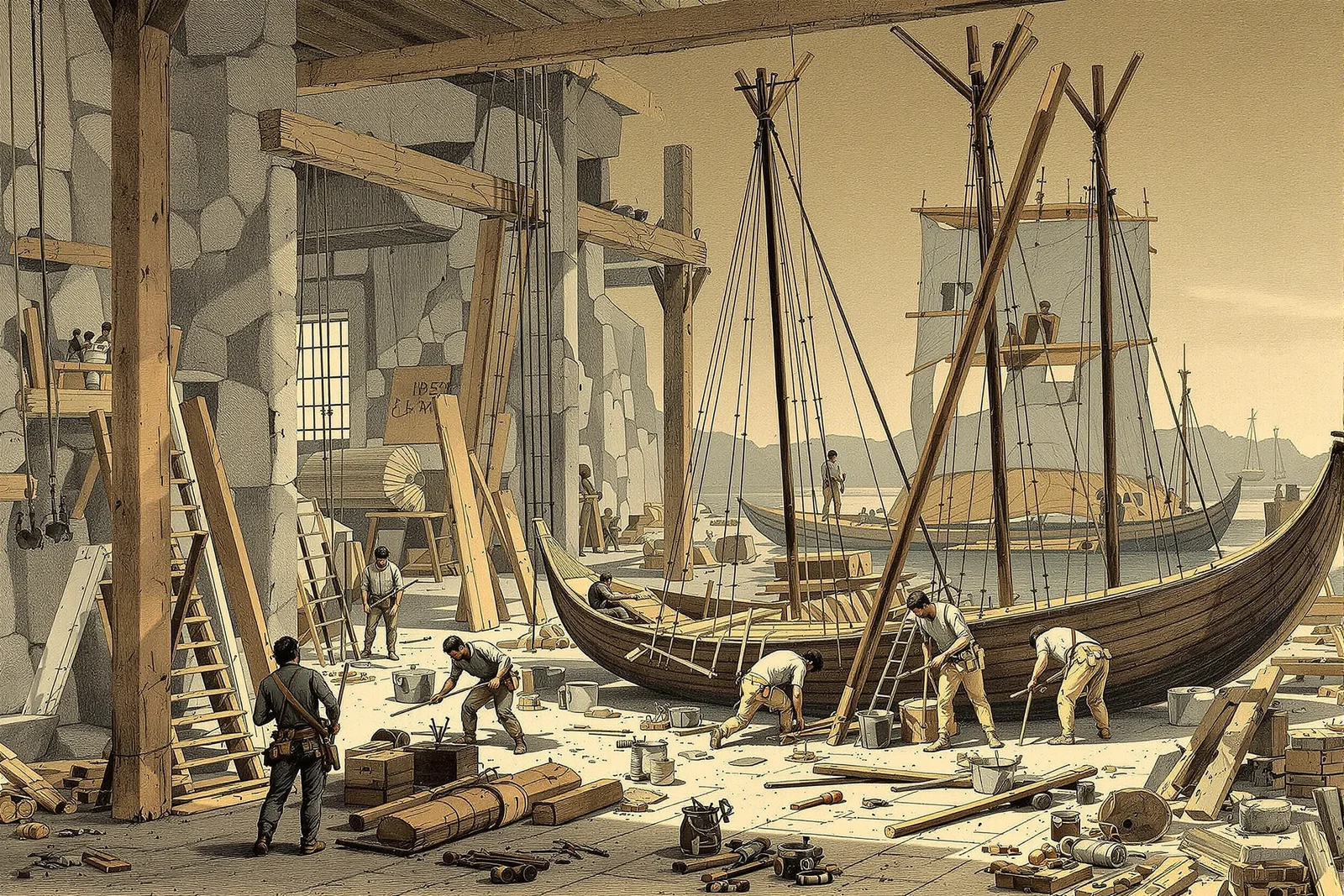
Complete Shipbuilding and Watercraft: From Raft to Sailing Vessel
Watercraft enable fishing, trade, exploration, and defense. This campaign covers hull design, construction methods, rigging, navigation, and the progression from simple rafts to capable sailing vessels.
Chapter 1: Watercraft Progression
| Vessel | Capacity | Build Time | Materials | Difficulty | Range |
|---|---|---|---|---|---|
| Log raft | 500-2,000 lbs | 1-2 days | Logs, rope | Very low | Rivers, calm water |
| Dugout canoe | 300-800 lbs | 1-4 weeks | Single large log | Moderate | Rivers, coastal |
| Skin-on-frame (coracle) | 200-500 lbs | 2-5 days | Saplings, hide/canvas | Low-moderate | Rivers, lakes |
| Skin-on-frame (kayak) | 300-600 lbs | 1-2 weeks | Saplings, hide/canvas | Moderate | Coastal, rivers |
| Plank canoe | 500-1,500 lbs | 2-4 weeks | Planks, ribs, fasteners | Moderate-high | Lakes, coastal |
| Flat-bottom skiff | 800-2,000 lbs | 1-3 weeks | Planks, frames | Moderate | Rivers, bays |
| Sailing dinghy | 500-1,000 lbs | 2-4 weeks | Planks, mast, sail | Moderate-high | Coastal |
| Clinker-built boat | 1,000-5,000 lbs | 1-3 months | Planks (overlapping), ribs | High | Open water |
| Carvel-built vessel | 2,000-50,000+ lbs | 3-12 months | Planks (flush), frames | Very high | Ocean-going |
Chapter 2: Simple Watercraft Construction
Dugout canoe: 1) Select straight tree (tulip poplar, cedar, cottonwood — 18-30 inch diameter). 2) Fell and cut to length (12-20 feet). 3) Split in half or flatten one side (stable base). 4) Hollow interior: controlled fire + adze/chisel. 5) Burn method: build small fires on top, scrape charred wood, repeat. 6) Leave 2-3 inch walls and bottom. 7) Shape exterior (adze, drawknife). 8) Thin walls can be spread with steam/hot water + cross-braces (widens beam). 9) Sand smooth inside and out. 10) Seal with oil, pine pitch, or paint.
Flat-bottom skiff (most practical small boat): 1) Bottom: two or three wide planks (3/4-1 inch thick, 12-16 ft long). 2) Join bottom planks with battens across underside. 3) Side planks: 10-12 inches wide, same length. 4) Attach sides to bottom at slight outward angle (flare for stability). 5) Bow transom: triangular piece closing the front. 6) Stern transom: rectangular piece closing the back. 7) Frames/ribs: every 18-24 inches for stiffness. 8) Seat thwarts: span gunwales, add rigidity. 9) Caulk seams: cotton oakum + pine pitch or marine sealant. 10) Paint or oil exterior. 11) Result: stable, shallow-draft boat for rivers and bays.
Chapter 3: Sailing Basics
| Sail Type | Shape | Rig | Difficulty | Performance | Best For |
|---|---|---|---|---|---|
| Square sail | Rectangular | Hung from yard (horizontal spar) | Low | Downwind excellent | Running before wind |
| Lateen sail | Triangular | Hung from diagonal yard | Moderate | Upwind good | All-around sailing |
| Spritsail | Four-sided | Diagonal sprit holds peak | Low-moderate | Moderate all-around | Small boats |
| Gaff sail | Four-sided (trapezoid) | Gaff + boom | Moderate | Good all-around | Larger boats |
| Bermuda/marconi | Triangular | Tall mast + boom | Moderate | Upwind excellent | Modern sailing |
| Junk sail | Rectangular (battened) | Multiple battens | Low | Good all-around | Easy handling |
Points of sail: 1) In irons (head to wind): NO forward motion — sails luff. 2) Close-hauled (45° to wind): sails pulled tight, boat heels, slow but makes progress upwind. 3) Beam reach (90° to wind): fastest point of sail, sails half out. 4) Broad reach (135° to wind): fast, comfortable, sails well out. 5) Running (180°, wind from behind): sails all the way out, risk of accidental jibe. 6) To go directly upwind: tack (zigzag) at 45° angles.
Chapter 4: Caulking and Waterproofing
| Method | Materials | Application | Lifespan | Difficulty | Best For |
|---|---|---|---|---|---|
| Oakum + pitch | Hemp fiber + pine tar | Drive into seams, seal with pitch | 2-5 years | Moderate | Traditional plank boats |
| Cotton + compound | Cotton wicking + caulking compound | Drive into seams, smooth | 3-7 years | Moderate | Plank boats |
| Pine pitch/tar | Pine resin (heated) | Brush on hull exterior | 1-2 years (recoat) | Low | All wooden boats |
| Linseed oil + paint | Boiled linseed oil + pigment | Brush on (multiple coats) | 2-3 years | Low | Above waterline |
| Copper sheathing | Thin copper sheets + tacks | Nail to hull below waterline | 10-20 years | High | Ocean-going vessels |
Chapter 5: Navigation
| Method | Equipment | Accuracy | Conditions | Difficulty |
|---|---|---|---|---|
| Dead reckoning | Compass, log, clock | +/- 5-10% | Any | Moderate |
| Celestial (latitude) | Sextant/cross-staff | +/- 1-5 miles | Clear sky | Moderate-high |
| Celestial (longitude) | Accurate clock + tables | +/- 10-50 miles | Clear sky + clock | High |
| Coastal piloting | Chart, compass, landmarks | Very good | Visible coast | Low-moderate |
| Soundings | Lead line | Depth accurate | Any | Low |
| Natural signs | Observation | Variable | Experienced only | High |
Dead reckoning: 1) Know starting position. 2) Record compass heading. 3) Measure speed (chip log: timed line with knots). 4) Track time on each heading. 5) Plot: distance = speed × time, in direction of heading. 6) Account for current and leeway (drift). 7) Errors accumulate — fix position with celestial observation when possible.
Reference Card
- Flat bottom is simplest (a flat-bottom skiff is the easiest useful boat to build — start here). 2. Caulk before launch (every seam must be sealed — water finds the smallest gap). 3. Beam reach is fastest (90 degrees to wind — sails fill perfectly, boat moves efficiently). 4. You cannot sail directly into wind (tack at 45-degree angles — zigzag toward your destination). 5. Stability comes from width (wider beam = more stable; narrow = faster but tippy). 6. Ballast low (weight at the bottom prevents capsizing — never load heavy cargo high). 7. Pine tar preserves wood (annual coating of pine tar extends hull life dramatically). 8. Dead reckoning drifts (errors accumulate — verify position with landmarks or stars whenever possible).