Sovereignty Module: Mend the Metal
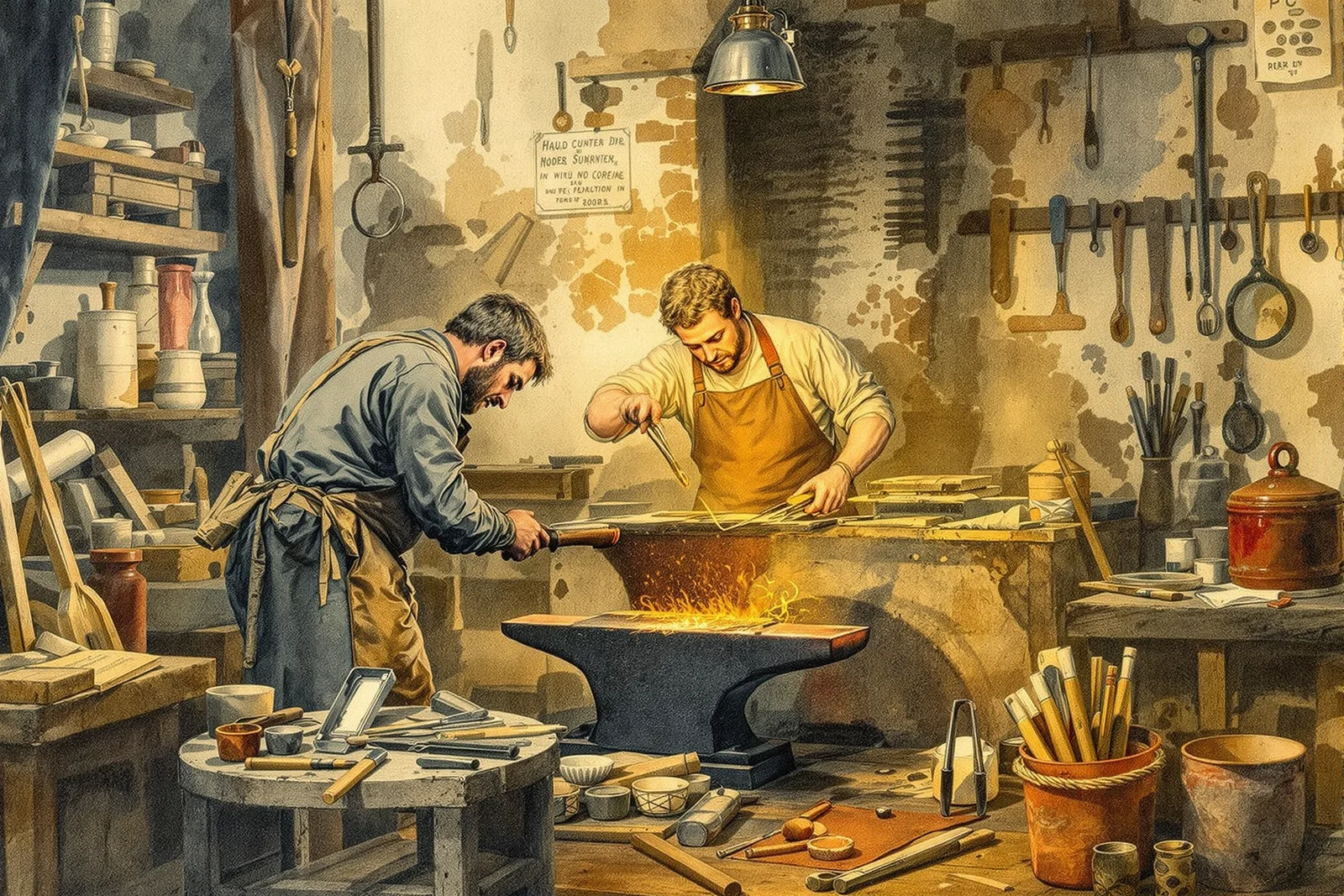
Mend the Metal
Complete Restoration and Repair: From Broken Tools to Renewed Service
Complete Restoration and Repair: From Broken Tools to Renewed Service
Repair work is the blacksmith's most practical service. This campaign covers tool repair, handle replacement, weld repair, and the restoration of antique ironwork.
Chapter 1: Common Repairs
| Item | Common Problem | Repair Method |
|---|---|---|
| Axe head | Loose handle | Re-hang with new handle and wedge |
| Hammer head | Mushroomed face | Grind face, re-harden |
| Knife blade | Broken tip | Forge new tip, re-harden |
| Chain link | Broken link | Forge new link, forge weld closed |
| Gate hinge | Worn pin | Forge new pin, ream hinge |
| Plow point | Worn edge | Forge weld new steel to edge |
| Shovel | Bent blade | Heat and straighten |
| Tongs | Loose rivet | Forge new rivet |
Chapter 2: Handle Replacement
Handle replacement: 1) Remove old handle (saw, burn, or drift out). 2) Select new handle wood (hickory, ash, or oak). 3) Shape handle to fit eye of tool. 4) Handle should fit tightly without forcing. 5) Drive handle into eye from bottom. 6) Cut handle flush with top of eye. 7) Drive steel wedge into handle top (expands handle in eye). 8) Drive cross wedge perpendicular to first. 9) Soak head in linseed oil (swells wood for tight fit).
| Tool | Handle Wood | Handle Length | Eye Shape |
|---|---|---|---|
| Axe | Hickory | 28-36 inches | Oval, tapered |
| Hammer | Hickory or ash | 12-16 inches | Oval, tapered |
| Sledge | Hickory | 30-36 inches | Oval, tapered |
| Pick | Hickory | 36 inches | Oval, tapered |
| File | Hardwood | 4-6 inches | Tang (pointed) |
Chapter 3: Weld Repair
| Repair Type | Method | When to Use |
|---|---|---|
| Forge weld | Heat and hammer | Traditional, strong, no filler |
| Arc weld | Electric arc | Quick, strong, modern |
| Brazing | Bronze filler | Lower heat, dissimilar metals |
| Scarf and weld | Overlap and forge weld | Broken bars, rods |
| Patch weld | Weld plate over hole | Thin material, holes |
| Build-up | Multiple weld passes | Worn surfaces |
Chapter 4: Antique Ironwork Restoration
| Step | Method | Purpose |
|---|---|---|
| Documentation | Photograph before work | Record original condition |
| Cleaning | Wire brush, vinegar soak | Remove loose rust |
| Assessment | Inspect for cracks, missing parts | Plan repair scope |
| Repair | Forge or weld as needed | Restore function |
| Missing parts | Forge replacements to match | Complete the piece |
| Finishing | Wax, oil, or paint | Protect from further rust |
| Documentation | Photograph after work | Record completed restoration |
Chapter 5: Sharpening and Edge Restoration
| Tool | Angle | Method | Finish |
|---|---|---|---|
| Axe | 25-30 degrees | File, then stone | Medium |
| Knife | 15-20 degrees | Stone, then strop | Fine |
| Chisel | 25-30 degrees | Stone | Medium-fine |
| Plane iron | 25-30 degrees | Stone, then strop | Very fine |
| Scissors | 60-70 degrees (included) | Stone | Fine |
| Scythe | 20-25 degrees | Peening, then stone | Medium |
Reference Card
- Repair is the blacksmith's most valued service (in a community, the ability to fix broken tools is more immediately useful than making new ones; the repair smith keeps the community working). 2. Diagnose before repairing (understand why the tool broke before fixing it; a tool that broke from misuse will break again unless the user changes their technique; a design flaw requires a design change). 3. Match the original when possible (when repairing or restoring, match the original material, technique, and finish; a repair that looks like the original honors the original maker's work). 4. A re-hung axe is safer than a loose one (a loose axe head is extremely dangerous; proper re-hanging with a tight fit and steel wedge prevents the head from flying off during use). 5. Sharpening is the most frequent repair (a dull tool is dangerous because it requires excessive force; regular sharpening maintains the edge and keeps the tool safe and efficient). 6. Document antique restoration (before and after photographs, notes on repairs made, and materials used create a record that future owners and restorers will value). 7. The repair smith extends the life of tools (a well-repaired tool can serve for another generation; repair is the ultimate form of sustainability, keeping useful objects in service rather than replacing them). 8. Every repair tells a story (a repaired tool carries the history of its use and its mending; the forge weld, the new handle, the sharpened edge all speak of the hands that kept the tool alive).
TransmissionCOMPLETE — unaltered & unabridged
Words838 — every one of them
SHA-256 of source textb623bcc28f4242873008988f4463bd2cc20adcde0d46f3603ee23ddba89abfc7
Canonical textdownload campaign-mend-metal.md — byte-identical to what this page renders