Sovereignty Module: Forge the Steel
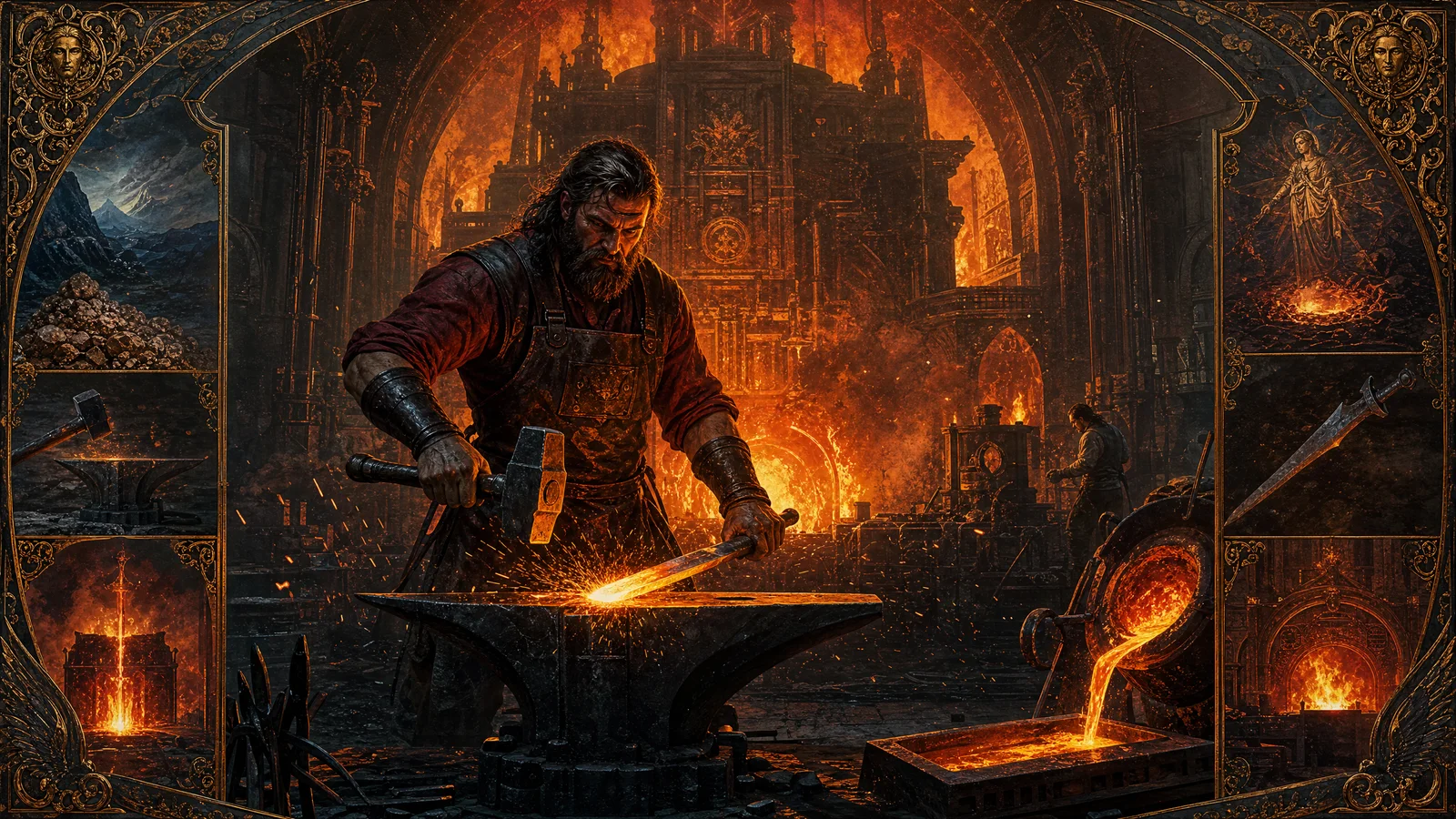
Complete Metalworking: From Ore to Finished Product
Metal tools and weapons define civilization's capability. This campaign covers prospecting, smelting, forging, casting, and finishing of all useful metals.
Chapter 1: Metal Properties
| Metal | Melting Point | Hardness | Corrosion Resistance | Workability | Primary Use |
|---|---|---|---|---|---|
| Copper | 1,085°C | Low | Good | Excellent (cold/hot work) | Wire, pipe, cookware, alloys |
| Tin | 232°C | Very low | Excellent | Excellent | Alloying (bronze), plating, solder |
| Bronze (Cu+Sn) | 950°C | Moderate | Excellent | Good (casting) | Tools, bearings, bells, art |
| Iron (wrought) | 1,538°C | Moderate | Poor | Good (hot forging) | Tools, hardware, structural |
| Steel (low carbon) | 1,425°C | High | Poor | Good (hot forging) | Blades, springs, tools |
| Steel (high carbon) | 1,400°C | Very high | Poor | Moderate (hot only) | Cutting edges, drill bits |
| Lead | 327°C | Very low | Excellent | Excellent (cold work) | Bullets, weights, solder, roofing |
| Zinc | 420°C | Low | Good | Moderate | Galvanizing, brass alloy |
| Brass (Cu+Zn) | 900°C | Moderate | Good | Excellent | Hardware, instruments, cartridges |
| Aluminum | 660°C | Low | Excellent | Good | Lightweight structures (hard to smelt) |
| Silver | 962°C | Low | Good | Excellent | Currency, electrical contacts, medicine |
| Gold | 1,064°C | Very low | Perfect | Excellent | Currency, electronics, dentistry |
Chapter 2: Forge Setup
| Component | Material | Function | Size (minimum) |
|---|---|---|---|
| Forge (fire pot) | Steel plate or cast iron | Contains fire, directs air | 12×12 inch fire pot minimum |
| Blower/bellows | Leather + wood (bellows) or electric blower | Supplies air to fire | Must reach welding heat |
| Anvil | Cast steel or large iron mass | Work surface | 100+ lbs (heavier = better) |
| Hammer (cross pein) | Tool steel head, hickory handle | Primary forming tool | 2-3 lbs |
| Tongs (various) | Mild steel (forge your own) | Hold hot metal | Flat jaw, wolf jaw, bolt jaw minimum |
| Vise (post/leg vise) | Cast/forged steel | Hold work for filing, bending | 4-6 inch jaws |
| Quench tank | Metal or stone container | Cooling for heat treatment | Large enough to submerge work |
| Slack tub | Barrel or tank of water | Cool tongs, quench | Always full, always nearby |
| Coal/charcoal supply | Bituminous coal or hardwood charcoal | Fuel | 50+ lbs on hand minimum |
Anvil substitutes: Railroad track section (turned on side), large steel block, sledgehammer head set in stump, any large flat steel mass. Weight matters — heavier anvil = more efficient forging (less energy lost to movement).
Chapter 3: Basic Forging Operations
| Operation | Temperature | Tool | Technique | Result |
|---|---|---|---|---|
| Drawing out | Yellow-orange heat | Hammer on anvil face | Hit at slight angle, rotate 90° | Lengthens and thins metal |
| Upsetting | Yellow heat | Hammer on end (or anvil) | Hit end straight on | Shortens and thickens metal |
| Bending | Orange-red heat | Hammer over anvil edge/horn | Support one side, hammer other | Creates angles and curves |
| Punching | Yellow heat | Punch + hammer | Drive punch through, flip, drive from other side | Creates holes |
| Splitting | Orange heat | Hot chisel + hammer | Cut partway through, open with drift | Divides metal |
| Welding (forge) | White/sparkling heat | Hammer (fast, firm blows) | Flux (borax), heat both pieces, join with hammer | Permanently joins pieces |
| Twisting | Orange-red heat | Tongs + wrench | Clamp one end, twist other | Decorative, strengthens |
| Scrolling | Orange heat | Hammer over horn/jig | Curl end around horn progressively | Decorative elements |
Heat colors: Black = too cold (below 400°F). Dark red = 1,000°F. Cherry red = 1,400°F. Bright orange = 1,800°F. Yellow = 2,000°F. Light yellow/white = 2,200°F+ (welding heat). Work between cherry red and yellow for most operations.
Chapter 4: Heat Treatment
| Process | Heating | Cooling | Result | Use |
|---|---|---|---|---|
| Hardening | Heat to critical (non-magnetic) | Quench in oil or water (fast) | Very hard but brittle | Cutting edges before tempering |
| Tempering | Reheat to specific color (after hardening) | Air cool | Reduces brittleness, retains hardness | All hardened tools (after hardening) |
| Annealing | Heat to critical | Cool very slowly (in ash/vermiculite) | Soft, workable | Before machining or cold working |
| Normalizing | Heat above critical | Air cool (still air) | Refines grain, relieves stress | After heavy forging |
| Case hardening | Pack in carbon (charcoal powder) + heat | Quench | Hard surface, soft core | Gears, pins, wear surfaces |
Temper colors (steel): Straw/pale yellow (400°F) = files, razors, engraving tools. Gold/dark straw (450°F) = drill bits, taps. Brown/purple (500°F) = axes, wood chisels, punches. Blue (550°F) = springs, screwdrivers, swords. Grey/blue-grey (600°F) = too soft for cutting.
Chapter 5: Casting
| Method | Metals | Detail Level | Production Volume | Equipment |
|---|---|---|---|---|
| Sand casting (green sand) | All (especially iron, bronze, aluminum) | Moderate | Low-medium | Flask, sand, pattern |
| Lost wax (investment) | Bronze, gold, silver | Very high | Low | Wax, plaster, kiln |
| Permanent mold (gravity) | Lead, zinc, aluminum, bronze | Moderate-high | Medium-high | Metal mold (machined) |
| Centrifugal | Any | Moderate | Low-medium | Spinning mold |
Sand casting process: 1. Make pattern (wood, exact shape of desired part + shrinkage allowance). 2. Pack green sand (sand + clay + water) around pattern in flask. 3. Remove pattern (leaves cavity). 4. Cut gates and risers (channels for metal flow). 5. Assemble mold halves. 6. Pour molten metal. 7. Cool, break out, clean, machine.
Chapter 6: Projects (Beginner to Advanced)
| Project | Skill Level | Time | Materials | Teaches |
|---|---|---|---|---|
| S-hook | Beginner | 15 minutes | 3/8" round stock | Drawing, bending, scrolling |
| Nail | Beginner | 10 minutes | 1/4" square stock | Drawing, heading |
| Knife (simple) | Intermediate | 2-4 hours | High carbon steel (file, spring) | Forging, grinding, heat treatment |
| Tongs | Intermediate | 3-5 hours | 1/2" round stock | Drawing, bending, riveting |
| Axe head | Advanced | 4-8 hours | Medium carbon steel | Punching, drifting, welding, heat treatment |
| Hammer head | Advanced | 3-6 hours | Medium-high carbon steel | Punching, drifting, heat treatment |
| Sword blade | Expert | 20-40 hours | High carbon or pattern-welded steel | All techniques combined |
| Plow point | Advanced | 4-8 hours | High carbon steel | Heavy forging, heat treatment |
Reference Card
- Anvil: heavier is better. Railroad track works. Secure firmly to stump or stand. Face must be flat and smooth.
- Heat colors: cherry red for bending, orange for drawing, yellow for upsetting, white for welding. Never forge below cherry red.
- Quenching: oil for most steels (slower, less cracking). Water for low-carbon only. Always quench edge-first (reduces warping).
- Tempering: ALWAYS temper after hardening. Heat slowly, watch colors. Straw for cutting edges, blue for springs.
- Forge welding: both pieces at white heat. Flux with borax. Fast, firm hammer blows. Clean surfaces essential.
- Steel sources: old files, leaf springs, coil springs, railroad spikes (low carbon), ball bearings (high carbon).
- Safety: leather apron, safety glasses, ear protection. Never look at white-hot metal without eye protection. Keep water nearby.
- Practice: make 100 nails before making a knife. Make 10 knives before making a sword. Mastery comes through repetition.