Sovereignty Module: Raise the Walls
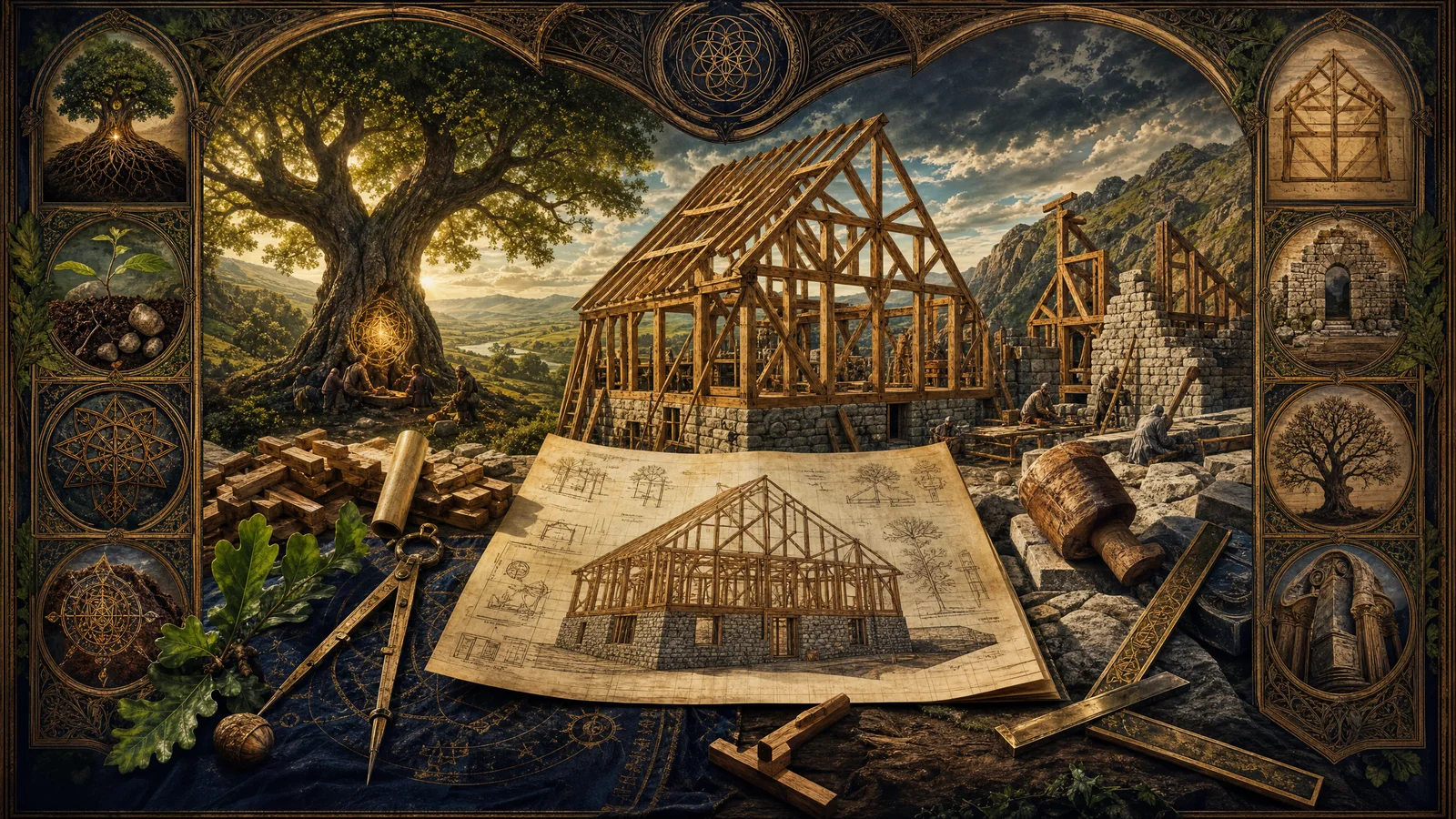
Complete Shelter and Construction Systems: From Emergency to Permanent
Shelter protects from weather, provides security, and enables all other activities. This campaign covers emergency, temporary, and permanent construction methods.
Chapter 1: Shelter Types by Timeline
| Type | Build Time | Lifespan | Capacity | Materials | Climate |
|---|---|---|---|---|---|
| Debris hut | 2-4 hours | Days-weeks | 1-2 people | Sticks, leaves, debris | Emergency (any) |
| Tarp/tent shelter | 30-60 minutes | Weeks-months | 1-4 people | Tarp/canvas, rope, poles | Temporary (any) |
| Wattle and daub | 1-2 weeks | 10-30 years | Family | Poles, woven sticks, clay/mud | Temperate |
| Log cabin | 2-6 weeks | 50-200+ years | Family | Logs, chinking material | Cold/temperate |
| Timber frame | 2-8 weeks | 100-500+ years | Family-large | Timber, infill material | Any |
| Cob/adobe | 2-6 months | 50-500+ years | Family-large | Clay, sand, straw, water | Dry/temperate |
| Rammed earth | 1-3 months | 100-1,000+ years | Family-large | Subsoil (clay + sand + gravel) | Dry/temperate |
| Stone | 3-12 months | 500-1,000+ years | Family-large | Stone, mortar (lime or cement) | Any |
| Earth-sheltered | 1-4 months | 100+ years | Family | Earth, timber/concrete roof | Any (excellent insulation) |
Chapter 2: Foundation Types
| Foundation | Soil Type | Load | Frost Depth | Materials | Complexity |
|---|---|---|---|---|---|
| Rubble trench | Most soils | Light-moderate | Below frost line | Gravel, drain pipe | Low |
| Stone pier | Stable soil | Moderate | Below frost line | Flat stones, mortar | Low-moderate |
| Concrete pier | Any | Heavy | Below frost line | Concrete, rebar | Moderate |
| Continuous stone | Any | Very heavy | Below frost line | Stone, lime mortar | High |
| Slab on grade | Stable, well-drained | Any | N/A (insulated edge) | Concrete, gravel, insulation | Moderate |
| Post in ground | Stable soil | Light-moderate | Below frost line | Treated/charred posts | Very low |
Rubble trench: Dig trench below frost line (width = wall width + 4 inches). Fill with compacted gravel. Lay drain pipe at bottom (daylight to downhill). Top with concrete grade beam or first course of wall. Excellent drainage, no concrete below grade.
Chapter 3: Wall Systems
| System | R-Value | Thickness | Materials | Labor | Skill Level |
|---|---|---|---|---|---|
| Log (8-inch) | R-8 to R-12 | 8-12 inches | Logs, chinking | High | Moderate |
| Timber frame + straw bale | R-30 to R-40 | 18-24 inches | Timber, straw bales, plaster | Moderate | Moderate |
| Cob (24-inch) | R-3 to R-6 | 18-24 inches | Clay, sand, straw | Very high | Low |
| Adobe brick | R-4 to R-8 | 12-18 inches | Clay, sand, straw (formed bricks) | High | Low |
| Rammed earth (18-inch) | R-4 to R-6 | 18-24 inches | Subsoil, forms | High | Moderate |
| Stone (18-inch) | R-2 to R-4 | 18-24 inches | Stone, mortar | Very high | High |
| Cordwood (16-inch) | R-15 to R-20 | 12-16 inches | Log ends, mortar, insulation | Moderate | Low |
| Earthbag | R-4 to R-8 | 15-18 inches | Polypropylene bags, earth fill | Moderate | Low |
| Wattle and daub | R-2 to R-4 | 4-6 inches | Woven sticks, clay/mud plaster | Moderate | Low |
Straw bale: Excellent insulation (R-30+). Stack bales like bricks (running bond). Pin with rebar or bamboo stakes. Plaster both sides with lime or earthen plaster (3 coats). Must keep dry — moisture = mold. Raised foundation, wide roof overhang essential.
Chapter 4: Roof Systems
| Type | Slope | Materials | Lifespan | Complexity | Climate |
|---|---|---|---|---|---|
| Thatch (reed/straw) | 45-55° | Reed, straw, or palm | 15-40 years | Moderate | Temperate (rainy OK if steep) |
| Wood shingle/shake | 30-45° | Cedar, oak, or cypress splits | 20-50 years | Moderate | Any |
| Metal (salvaged) | 15-45° | Corrugated metal sheets | 30-60+ years | Low | Any |
| Sod/living roof | 15-30° | Soil + vegetation on waterproof membrane | 30-50+ years | Moderate | Cool/temperate |
| Clay tile | 30-45° | Fired clay tiles | 50-100+ years | High | Any |
| Slate | 30-45° | Split stone (slate) | 100-200+ years | High | Any |
| Tar/pitch + fabric | 5-15° (low slope) | Canvas/fabric + pine tar or bitumen | 5-15 years | Low | Dry climates |
Roof structure: Rafters (common rafter or truss). Spacing: 16-24 inches on center. Size: depends on span and load (snow). Purlins run perpendicular to rafters. Roof boards or skip sheathing on purlins. Then roofing material. Always overhang walls 12-24 inches minimum (protects walls from rain).
Chapter 5: Heating Systems
| System | Efficiency | Fuel | Heat Output | Complexity | Safety |
|---|---|---|---|---|---|
| Open fireplace | 10-15% | Wood | Low (most heat up chimney) | Low | Moderate (sparks) |
| Enclosed stove (cast iron) | 40-60% | Wood | High | Moderate | Good (contained) |
| Masonry heater (Russian stove) | 80-90% | Wood (one firing/day) | Very high (sustained) | Very high | Excellent |
| Rocket mass heater | 80-90% | Small wood/sticks | High (sustained via thermal mass) | Moderate-high | Good |
| Hypocaust (underfloor) | 60-80% | Wood (external fire) | Moderate-high (radiant) | Very high | Excellent (fire outside) |
| Kang (heated bed platform) | 70-85% | Wood, straw, dung | Moderate (sleeping area) | Moderate | Good |
Rocket mass heater: Burns small sticks at very high temperature (clean combustion). Heat captured in thermal mass (cob bench or floor). One small fire heats mass for 12-24 hours. Uses 1/10 the wood of open fireplace. Exhaust exits cool (safe through wall). Build from: fire brick, cob, metal pipe (burn tunnel).
Chapter 6: Passive Design Principles
| Principle | Application | Effect | Cost |
|---|---|---|---|
| Solar orientation | Long axis east-west, windows face south (N. hemisphere) | Free heating in winter | None (design only) |
| Thermal mass | Thick walls, stone/concrete floors | Stabilizes temperature (warm nights, cool days) | Material cost |
| Insulation | Straw bale, cellulose, wool, cork | Retains heat/cool | Moderate |
| Cross ventilation | Windows on opposite walls | Free cooling in summer | None (design only) |
| Earth sheltering | Bermed or underground walls | Constant 50-55°F ground temperature | High (excavation) |
| Roof overhang | Sized for latitude | Blocks summer sun, admits winter sun | Minimal |
| Windbreak | Trees/walls on prevailing wind side | Reduces heat loss 10-30% | Low (plant trees) |
| Light colors (summer) | White/light exterior surfaces | Reflects solar heat | Minimal (paint/lime) |
Reference Card
- Orientation: long axis east-west. South-facing windows (N. hemisphere). Overhang blocks summer sun, admits winter sun.
- Thermal mass + insulation: mass inside insulation. Mass absorbs heat by day, releases at night. Stable temperature.
- Foundation below frost line: prevents heaving. Rubble trench = simple, effective, well-drained.
- Roof overhang: minimum 12-24 inches. Protects walls from rain. Wider = better (especially for earth/straw walls).
- Ventilation: every room needs air exchange. Cross-ventilation (opposite windows). Ridge vent for hot air escape.
- Rocket mass heater: 1/10 the wood of fireplace. Burns clean. Thermal mass stores heat 12-24 hours. Build from local materials.
- Straw bale walls: R-30+ insulation. Must stay dry. Raised foundation, wide overhang, lime plaster both sides.
- Build for your climate: cold = insulation + thermal mass + south glass. Hot = shade + ventilation + light colors + thermal mass.