Sovereignty Module: Command the Forge
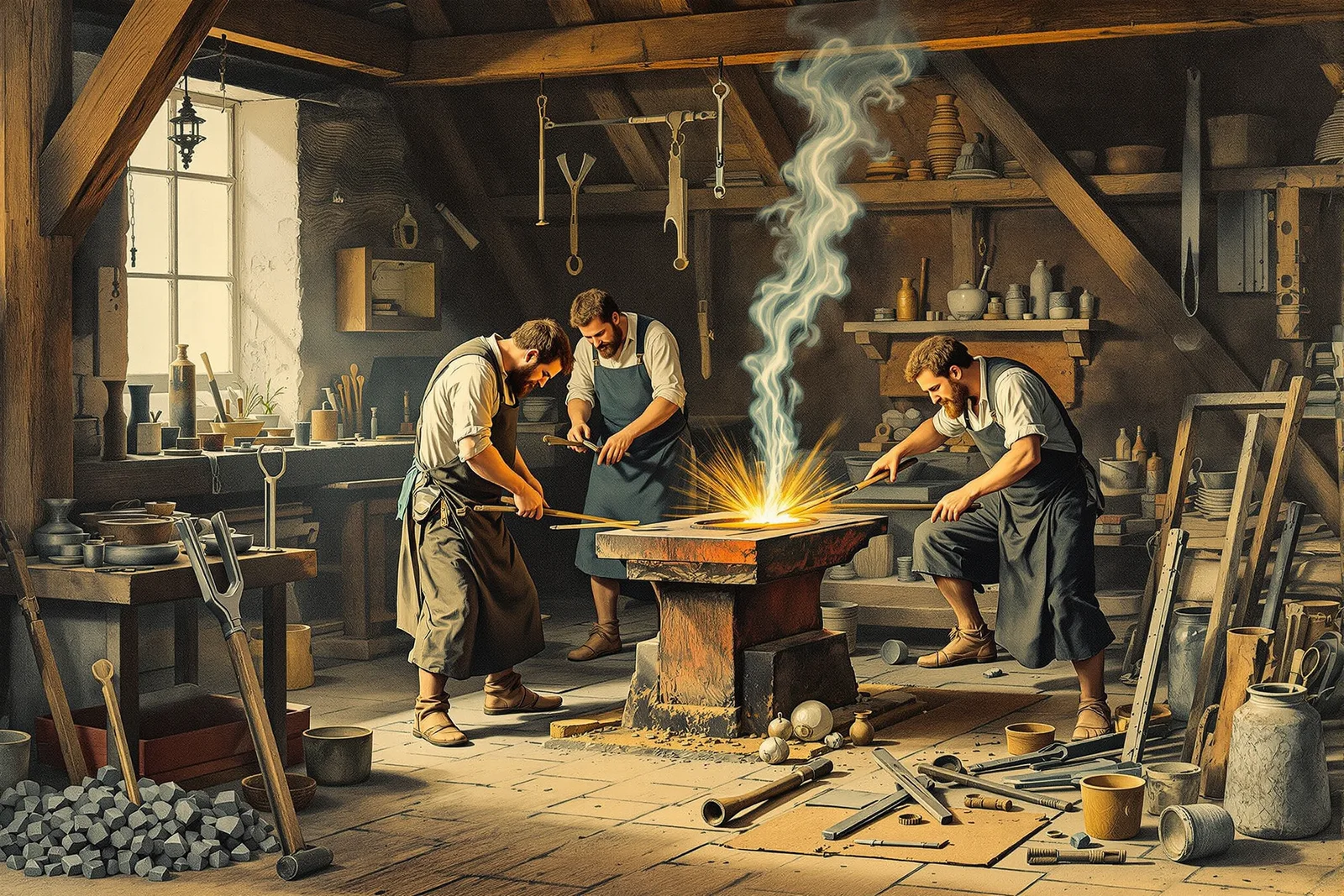
Complete Metalworking: From Ore to Finished Tool
Metal transforms civilization. This campaign covers prospecting, smelting, forging, casting, and finishing metals from raw ore to finished products.
Chapter 1: Metal Properties and Uses
| Metal | Melting Point | Hardness | Availability | Primary Uses | Difficulty |
|---|---|---|---|---|---|
| Copper | 1,984°F | Soft | Moderate (native, oxide ores) | Tools, wire, vessels, alloys | Low-moderate |
| Tin | 450°F | Very soft | Rare (cassiterite ore) | Alloying (bronze), plating | Low |
| Bronze (Cu+Sn) | 1,742°F | Moderate-hard | Made (copper + tin) | Tools, weapons, bearings, bells | Moderate |
| Iron (wrought) | 2,800°F | Moderate | Common (oxide ores) | Tools, hardware, structural | High |
| Steel (iron + carbon) | 2,500°F | Hard-very hard | Made (iron + charcoal) | Cutting tools, springs, weapons | Very high |
| Lead | 621°F | Very soft | Common (galena ore) | Plumbing, bullets, solder, weights | Very low |
| Zinc | 787°F | Moderate | Moderate (sphalerite) | Galvanizing, brass alloy | Moderate |
| Brass (Cu+Zn) | 1,700°F | Moderate | Made (copper + zinc) | Hardware, instruments, decorative | Moderate |
| Silver | 1,764°F | Soft | Rare (native, sulfide ores) | Currency, jewelry, antibacterial | Moderate |
| Gold | 1,948°F | Very soft | Very rare (native, placer) | Currency, jewelry, electronics | Low (if found) |
| Aluminum | 1,221°F | Soft-moderate | Common ore, hard to smelt | Lightweight structures (modern) | Extreme (electrolysis) |
Chapter 2: Prospecting and Ore Identification
| Ore | Metal | Color/Appearance | Streak | Specific Gravity | Location |
|---|---|---|---|---|---|
| Hematite | Iron | Red-black, metallic | Red-brown | 5.0-5.3 | Widespread, sedimentary |
| Magnetite | Iron | Black, magnetic | Black | 5.2 | Igneous rocks, sand |
| Bog iron | Iron | Brown, porous, rusty | Brown | 3.5-4.0 | Swamps, bogs, streams |
| Malachite | Copper | Green, banded | Green | 3.9-4.0 | Near copper deposits |
| Azurite | Copper | Blue, crystalline | Blue | 3.8 | Near copper deposits |
| Native copper | Copper | Copper-colored metal | Copper | 8.9 | Lake Superior, volcanic |
| Galena | Lead | Silver-gray, cubic crystals | Gray-black | 7.4-7.6 | Limestone regions |
| Cassiterite | Tin | Brown-black, heavy | White-brown | 6.8-7.1 | Granite regions, alluvial |
| Sphalerite | Zinc | Brown-yellow, resinous | White-yellow | 3.9-4.1 | With galena (limestone) |
Chapter 3: Smelting
| Metal | Ore | Furnace Type | Temperature | Flux | Charcoal Ratio | Yield |
|---|---|---|---|---|---|---|
| Copper | Malachite/azurite | Pit or shaft | 2,000°F+ | None (oxide ores) | 3:1 charcoal:ore | 60-80% |
| Iron (bloom) | Hematite/bog iron | Bloomery | 2,200-2,400°F | Limestone | 5:1 charcoal:ore | 20-50% |
| Lead | Galena | Open fire/hearth | 1,000°F+ | None | 2:1 | 70-90% |
| Tin | Cassiterite | Pit fire | 1,200°F+ | None | 2:1 | 60-80% |
| Bronze | Copper + tin | Crucible | 2,000°F | Charcoal cover | N/A (melt metals) | 90%+ |
Bloomery iron smelting: Build shaft furnace (clay/stone, 3-5 ft tall, 12" internal diameter). Tuyere (air pipe) at base. Preheat furnace with charcoal. Alternate layers: charcoal + crushed ore + limestone flux. Pump bellows continuously (4-8 hours). Iron particles weld together into "bloom" (spongy mass). Remove bloom. Hammer while hot to consolidate and expel slag. Result: wrought iron. Requires significant charcoal (100+ lbs per smelt).
Chapter 4: Forge Work
| Operation | Temperature (color) | Tools | Purpose | Difficulty |
|---|---|---|---|---|
| Drawing out | Yellow-white (2,000°F+) | Hammer, anvil | Lengthen/thin metal | Basic |
| Upsetting | Yellow (1,800°F+) | Hammer, anvil | Thicken/shorten metal | Basic |
| Bending | Orange-yellow (1,600-1,800°F) | Hammer, vise, forms | Create angles/curves | Basic |
| Punching | Orange (1,400-1,600°F) | Punch, anvil (hardy hole) | Create holes | Basic-moderate |
| Splitting | Orange (1,400-1,600°F) | Hot chisel, anvil | Divide metal | Basic-moderate |
| Welding (forge) | White (2,300°F+) | Hammer, flux (borax) | Join two pieces permanently | Advanced |
| Twisting | Orange-red (1,200-1,400°F) | Vise, wrench | Decorative, strengthen | Basic |
| Scrolling | Orange (1,400-1,600°F) | Scroll jig, hammer | Decorative curves | Moderate |
| Fullering | Yellow (1,800°F+) | Fuller tool, hammer | Create grooves/necks | Moderate |
| Swaging | Yellow (1,800°F+) | Swage block/die | Shape to form | Moderate |
Heat colors (critical reference): Black heat = below 900°F (no work). Dark red = 1,000°F. Cherry red = 1,400°F. Orange = 1,600°F. Yellow = 1,800-2,000°F. Light yellow = 2,100°F. White = 2,300°F+ (welding heat). Work metal at yellow-orange for most operations. Never hammer cold (cracks). Never overheat (burns/crumbles).
Chapter 5: Heat Treatment
| Process | Purpose | Procedure | Result |
|---|---|---|---|
| Hardening | Make steel hard | Heat to critical temp (cherry red), quench in oil/water | Very hard but brittle |
| Tempering | Reduce brittleness | After hardening: reheat to specific color, air cool | Tough + hard (balanced) |
| Annealing | Make soft (workable) | Heat to cherry red, cool very slowly (in ash/vermiculite) | Soft, easy to file/drill |
| Normalizing | Relieve stress | Heat to cherry red, air cool | Uniform grain, stress-free |
| Case hardening | Hard outside, soft inside | Pack in charcoal, heat 2-4 hours, quench | Wear-resistant surface, tough core |
Temper colors (steel): Pale straw (430°F) = razors, engraving tools. Straw (450°F) = knives, chisels. Dark straw (470°F) = axes, punches. Brown (490°F) = scissors, cold chisels. Purple (520°F) = swords, springs. Blue (570°F) = springs, screwdrivers. Light blue (600°F) = soft springs. Gray (640°F) = too soft for tools.
Chapter 6: Essential Projects
| Project | Steel/Iron | Skills Used | Time | Difficulty | Priority |
|---|---|---|---|---|---|
| Knife (from file) | High carbon steel | Drawing, grinding, heat treat | 4-8 hours | Moderate | Critical |
| Axe head | Medium carbon steel | Drawing, punching, welding | 8-16 hours | Advanced | Critical |
| Nails (hand forged) | Mild steel/iron | Drawing, heading | 2-5 min each | Basic | High |
| Hinges | Mild steel | Drawing, punching, bending | 1-2 hours | Basic-moderate | High |
| Tongs (blacksmith) | Mild steel | Drawing, bending, riveting | 4-8 hours | Moderate | Critical (make first) |
| Hooks and hardware | Mild steel | Drawing, bending, scrolling | 30 min-2 hours | Basic | High |
| Plow point | Medium-high carbon | Drawing, hardening | 4-8 hours | Moderate-advanced | Critical |
| Hammer head | Medium carbon | Drawing, punching, heat treat | 4-8 hours | Moderate | Critical |
Reference Card
- Heat colors: cherry red = 1,400°F (general work). Yellow = 1,800°F (heavy work). White = 2,300°F (forge welding only).
- Never hammer cold steel: it cracks. Return to forge when color drops below dark red. Patience prevents waste.
- Quench in oil for most tools (less shock than water). Water quench for maximum hardness but higher crack risk.
- Temper after hardening: ALWAYS. Un-tempered steel shatters. Straw color for knives, purple for springs, blue for screwdrivers.
- Charcoal for smelting: 5:1 ratio (charcoal to ore for iron). Make charcoal first. Enormous quantities needed. Plan ahead.
- Bog iron: free iron from swamps. Brown, porous, rusty lumite. Collect, dry, smelt in bloomery. Renewable (regrows in 20-30 years).
- Forge weld: surfaces must be clean (wire brush), fluxed (borax), and at white heat. Strike fast, firm, center first.
- First project: make tongs. You need tongs to hold everything else. Borrow or use pliers for the first pair.