Sovereignty Module: Mill the Grain
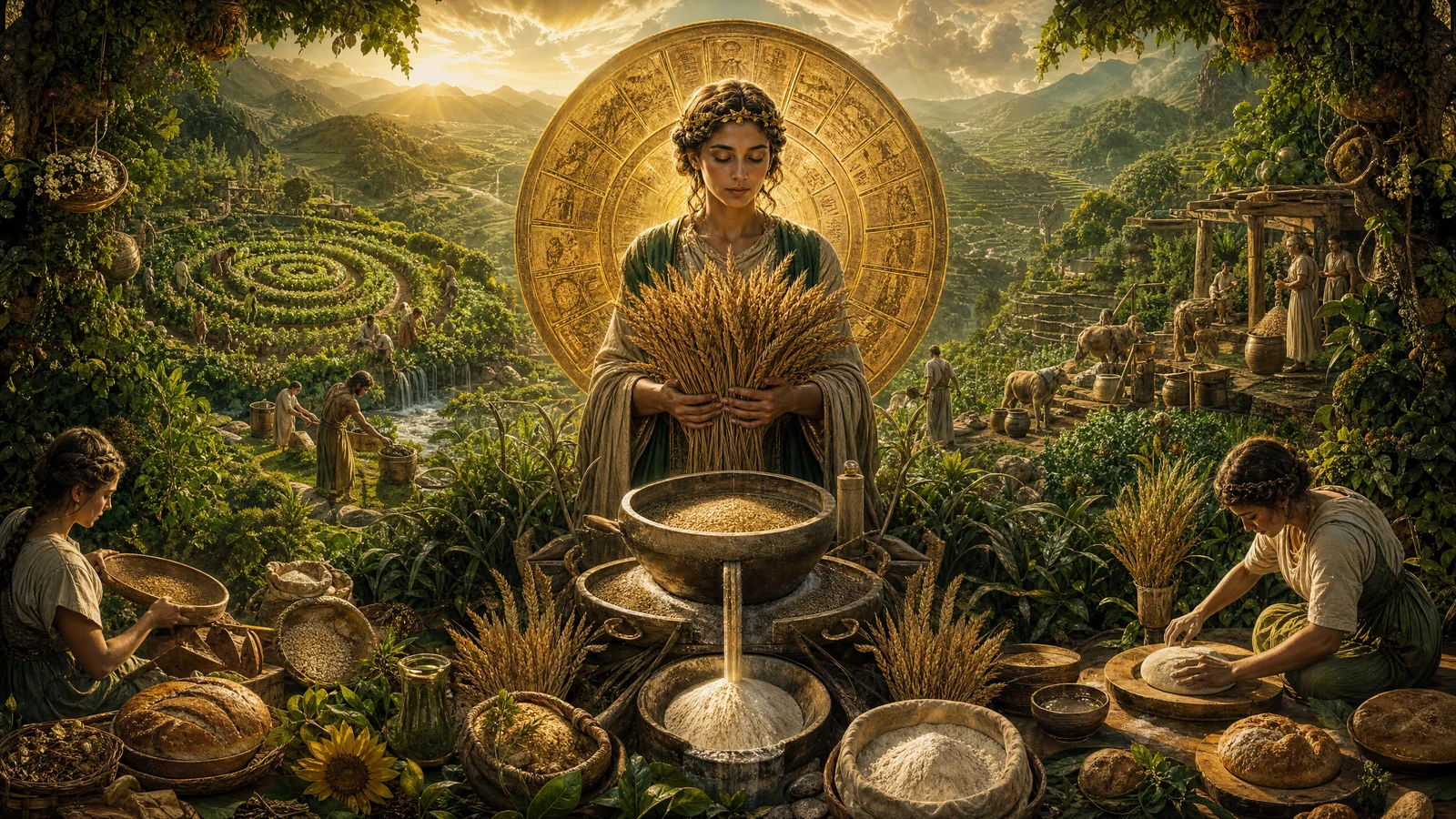
Complete Seed-to-Table Grain Processing: From Field to Flour
Grain is the foundation of civilization. This campaign covers grain varieties, harvesting, threshing, winnowing, milling, and flour storage.
Chapter 1: Grain Varieties
| Grain | Growing Season | Yield/Acre | Protein | Gluten | Climate | Difficulty |
|---|---|---|---|---|---|---|
| Hard red wheat | Spring or winter | 30-60 bu | 12-15% | Strong | Temperate | Moderate |
| Soft wheat | Winter | 40-70 bu | 8-11% | Weak | Temperate, humid | Moderate |
| Corn (maize) | Summer | 100-200 bu | 8-10% | None | Warm | Low |
| Rice (paddy) | Summer | 40-80 bu | 6-8% | None | Warm, wet | Moderate-high |
| Oats | Spring | 40-80 bu | 11-15% | None (avenin) | Cool, moist | Low |
| Barley | Spring or winter | 40-80 bu | 10-13% | None (hordein) | Temperate | Low |
| Rye | Winter | 20-40 bu | 8-12% | Weak | Cold, poor soil | Very low |
| Millet | Summer | 20-40 bu | 10-12% | None | Hot, dry | Very low |
| Sorghum | Summer | 40-80 bu | 8-12% | None | Hot | Low |
| Buckwheat | Summer (short) | 15-30 bu | 11-14% | None | Cool | Very low |
| Amaranth | Summer | 1,000-2,000 lbs | 13-18% | None | Warm | Low |
| Quinoa | Summer | 1,000-2,000 lbs | 14-18% | None | Cool highlands | Moderate |
Chapter 2: Harvesting and Threshing
| Method | Scale | Speed | Equipment | Labor | Grain Loss |
|---|---|---|---|---|---|
| Hand sickle | Small (garden) | Very slow | Sickle | High | Low |
| Scythe with cradle | Small-medium | Slow-moderate | Scythe + cradle | High | Low |
| Flail threshing | Small | Slow | Flail (hinged stick) | High | Low |
| Trampling (animal) | Medium | Moderate | Animals, threshing floor | Moderate | Moderate |
| Roller threshing | Medium | Moderate | Stone roller, animals | Moderate | Low |
Harvest timing: 1) Test kernel: bite it. Dough stage = too early. Hard, crunchy = ready. 2) Straw should be golden/dry (green straw = not ready). 3) Bend head: if kernels fall easily = overripe (harvest immediately). 4) Ideal: kernels hard, straw dry, heads intact. 5) Harvest in dry weather (wet grain molds). 6) Cut with sickle or scythe, bundle into sheaves. 7) Shock sheaves (stand upright in field to dry further, 1-2 weeks). 8) Store in dry barn until threshing.
Flail threshing: 1) Lay sheaves on hard, clean surface (threshing floor: packed earth, stone, or wood). 2) Beat with flail (two sticks joined by leather or rope hinge). 3) Rhythmic swinging: overhead strike, let flail head bounce. 4) Turn sheaves, beat again. 5) Continue until all kernels separated from heads. 6) Remove straw (rake off). 7) Remaining mix: grain + chaff + small debris. 8) Ready for winnowing.
Chapter 3: Winnowing and Cleaning
| Method | Equipment | Speed | Effectiveness | Scale |
|---|---|---|---|---|
| Toss winnowing | Basket or sheet | Slow | Good | Small |
| Wind winnowing | Tarp, natural breeze | Moderate | Good | Small-medium |
| Winnowing fan | Hand-cranked fan | Moderate-fast | Very good | Medium |
| Screen cleaning | Graduated screens | Slow | Excellent | Any |
Winnowing: 1) Wait for steady breeze (or use fan). 2) Pour grain/chaff mix from height (3-4 feet) into container below. 3) Heavy grain falls straight down into container. 4) Light chaff blows away in wind. 5) Repeat 2-3 times for clean grain. 6) Final cleaning: pass through screens (removes remaining debris). 7) Grain should be clean, dry, and free of chaff. 8) Test moisture: bite kernel; should crack, not dent (below 14% moisture for storage).
Chapter 4: Milling
| Mill Type | Power | Output | Flour Quality | Difficulty | Cost |
|---|---|---|---|---|---|
| Mortar and pestle | Human (hand) | Very low (1-2 lbs/hr) | Coarse | Very low | Very low |
| Saddle quern | Human (hand) | Low (2-5 lbs/hr) | Moderate | Low | Low |
| Rotary quern | Human (hand) | Moderate (5-15 lbs/hr) | Good | Moderate | Moderate |
| Water mill | Water power | High (50-200 lbs/hr) | Very good | High | High |
| Windmill | Wind power | High (50-200 lbs/hr) | Very good | Very high | Very high |
| Impact mill (hand) | Human (crank) | Moderate (5-20 lbs/hr) | Good | Moderate | Moderate |
Rotary quern construction: 1) Find two flat, hard stones (granite, basalt, or hard sandstone). 2) Shape into discs (12-18 inches diameter, 3-4 inches thick). 3) Bottom stone (bedstone): flat top surface, slightly concave center. 4) Top stone (runner): flat bottom, hole in center (grain entry), handle socket. 5) Dress both grinding faces: carve shallow furrows radiating from center (channels move flour outward). 6) Grain enters through center hole, is ground between stones, exits at edges as flour. 7) Adjust gap between stones for flour fineness (closer = finer). 8) Redress (re-carve furrows) periodically as they wear smooth.
Chapter 5: Flour Storage and Use
| Storage Method | Duration | Conditions | Container | Pest Prevention |
|---|---|---|---|---|
| Whole grain (intact) | 1-3 years | Cool, dry, dark | Sealed bin, jar | Airtight seal, diatomaceous earth |
| Whole grain flour | 1-3 months | Cool, dry, dark | Sealed jar, bag | Use quickly (oils go rancid) |
| White flour (sifted) | 6-12 months | Cool, dry | Sealed container | Airtight, cool storage |
| Parched grain | 1-2 years | Dry | Sealed container | Pre-cooked, very stable |
Nixtamalization (corn processing): 1) Boil dried corn kernels in water with wood ash or lime (calcium hydroxide). 2) Ratio: 1 part corn : 2 parts water : 2 tablespoons wood ash per quart. 3) Boil 30-60 minutes (kernels should be soft, skins loosening). 4) Soak overnight (12-24 hours). 5) Wash thoroughly (remove skins and excess alkali). 6) Grind wet into masa (dough) for tortillas, tamales. 7) Why: nixtamalization releases niacin (prevents pellagra), improves protein quality, improves flavor and texture. 8) Every corn-dependent culture discovered this process independently.
Reference Card
- Hard kernel = ready to harvest (bite test: doughy = too early; crunchy = ready; falling off = overripe). 2. Dry grain stores longest (below 14% moisture for storage; above that = mold and spoilage). 3. Whole grain outlasts flour (intact kernels store 1-3 years; flour goes rancid in months; grind as needed). 4. Winnowing needs wind (toss grain from height in a breeze; heavy grain falls, light chaff blows away). 5. Dress your stones (milling stones need carved furrows to cut grain; smooth stones just crush). 6. Nixtamalize corn (cooking corn with alkali releases niacin and improves nutrition; essential for corn-based diets). 7. Rye grows where wheat won't (poor soil, cold climate, short season; rye is the survivor's grain). 8. Grain built civilization (stored grain = food security = permanent settlements = everything that followed).