Sovereignty Module: Grind the Grain
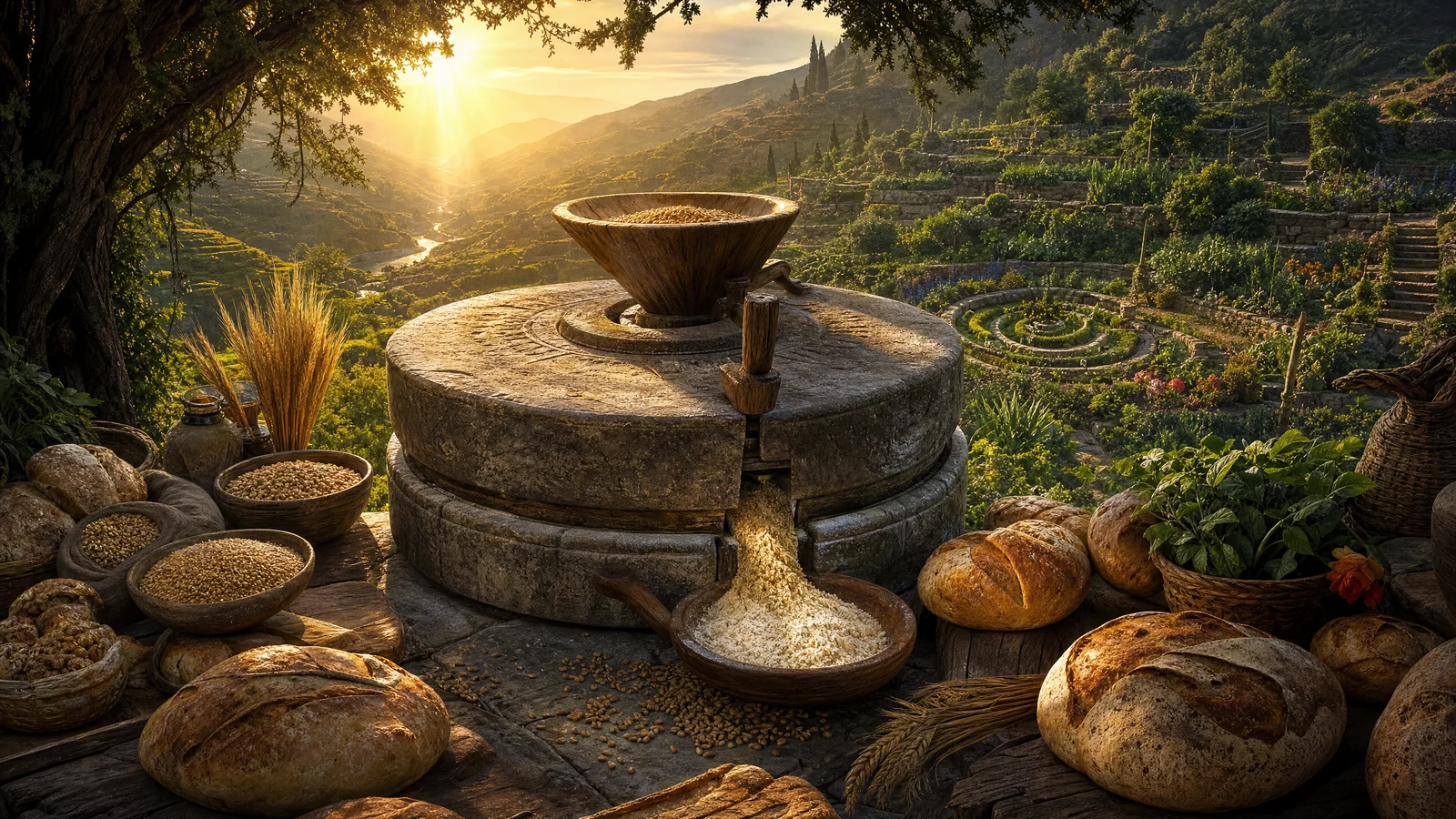
Complete Grain Milling, Flour Production, and Bread Making Guide
The Philosophy of Bread
Bread is the foundation of civilization. The ability to transform raw grain into flour and flour into bread is the single most important food processing skill in human history. Grain stores for years, travels well, and provides the caloric base for entire populations. But raw grain is nearly indigestible by humans without milling and cooking. This campaign covers every step from harvested grain to finished bread, including millstone construction, flour grading, fermentation, and baking.
Chapter 1: Grain Types and Properties
| Grain | Protein (%) | Gluten | Best Use | Storage Life | Yield (lbs/acre) |
|---|---|---|---|---|---|
| Hard red wheat | 12-15% | Strong | Bread, pasta | 10-30 years (dry) | 1,500-3,000 |
| Soft white wheat | 8-10% | Weak | Pastry, cake, biscuits | 10-30 years | 1,500-2,500 |
| Rye | 8-12% | Weak (different type) | Dark bread, pumpernickel | 10-30 years | 1,000-2,000 |
| Corn (maize) | 8-10% | None | Cornbread, tortillas, porridge | 5-10 years | 3,000-8,000 |
| Oats | 11-15% | None (different protein) | Porridge, flatbread | 5-10 years | 1,000-2,500 |
| Barley | 8-13% | Very weak | Flatbread, beer, porridge | 10-30 years | 1,500-3,000 |
| Rice | 6-8% | None | Steamed, rice flour | 10-30 years (white) | 2,000-5,000 |
| Millet | 10-12% | None | Flatbread, porridge | 5-10 years | 500-1,500 |
| Buckwheat | 10-12% | None | Pancakes, noodles (soba) | 5-10 years | 500-1,000 |
Gluten and Bread Rising:
Only wheat (and to a lesser extent, rye) contains gluten proteins that form an elastic network when mixed with water and kneaded. This network traps gas bubbles from yeast fermentation, causing bread to rise. Grains without gluten (corn, oats, rice, millet) can only make flatbreads or must be mixed with wheat flour for leavened bread.
Chapter 2: Milling Methods
Hand Milling (saddle quern):
The oldest method. A flat or slightly concave base stone and a smaller hand stone. Grain is placed on the base and ground by rubbing the hand stone back and forth. Output: 2-5 lbs flour per hour. Extremely labor-intensive.
Rotary Quern (hand mill):
Two circular stones (12-20 inches diameter). The bottom stone is fixed; the top stone rotates via a handle. Grain is fed through a hole in the top stone and ground between the faces. Output: 5-15 lbs flour per hour. The standard household mill for thousands of years.
Millstone Construction:
| Component | Material | Specifications |
|---|---|---|
| Bedstone (bottom, fixed) | Hard granite, gneiss, or buhrstone | Flat, slightly concave center, furrows (grooves) cut in face |
| Runner stone (top, rotates) | Same as bedstone | Slightly convex center, matching furrows |
| Rynd (iron cross) | Iron/steel | Fits into runner stone, connects to spindle |
| Spindle | Iron/steel | Vertical shaft through bedstone, drives runner |
| Hopper | Wood | Feeds grain into center hole (eye) of runner |
| Shoe (feed mechanism) | Wood | Vibrates to control grain flow rate |
Millstone Furrows (dress):
The grinding surfaces are not smooth. They have a pattern of grooves (furrows) cut into them that act as cutting edges and channels to move flour outward.
Pattern: Furrows radiate from center to edge in a spiral pattern. The leading edge of each furrow is the cutting edge. The flat area between furrows (the land) does the fine grinding.
Redressing (resharpening): Every 100-200 hours of use, the furrows must be recut with a mill pick (a specialized hammer). This is a skilled trade (millwright).
Power Sources for Mills:
| Source | Output | Grain Processed | Notes |
|---|---|---|---|
| Human (hand quern) | 50-75 watts | 5-15 lbs/hour | Minimum viable, exhausting |
| Animal (horse/ox mill) | 300-500 watts | 50-100 lbs/hour | Requires draft animal |
| Water wheel | 1,000-5,000 watts | 200-1,000 lbs/hour | Best option where water available |
| Windmill | 2,000-8,000 watts | 200-500 lbs/hour | Intermittent (wind dependent) |
Chapter 3: Flour Types and Extraction
Extraction Rate (how much of the grain becomes flour):
| Flour Type | Extraction Rate | Contains | Color | Use |
|---|---|---|---|---|
| Wholemeal (100%) | 100% | All bran, germ, endosperm | Brown | Dense bread, nutrition |
| Brown (85%) | 85% | Most bran removed, germ retained | Tan | General bread |
| White (72-75%) | 72-75% | Endosperm only (bran and germ removed) | White | Light bread, pastry |
| Patent (60%) | 60% | Finest endosperm only | Very white | Cake, fine pastry |
Sifting (bolting):
After milling, flour is sifted through progressively finer screens to separate grades:
| Screen | Mesh Size | Passes Through | Retained |
|---|---|---|---|
| Coarse | 20 mesh | Fine flour + middlings | Bran (large flakes) |
| Medium | 40 mesh | Fine flour | Middlings (coarse flour particles) |
| Fine | 60-80 mesh | Patent flour | Standard flour |
Bran and Germ Uses:
| Byproduct | Use | Notes |
|---|---|---|
| Bran | Animal feed, fiber supplement, compost | High in B vitamins and fiber |
| Germ | Eaten fresh (nutritious), oil extraction | Goes rancid quickly (use within days) |
| Middlings | Re-ground for more flour, animal feed | Contains some bran fragments |
Chapter 4: Leavening (Making Bread Rise)
Types of Leavening:
| Type | Source | Rise Time | Flavor | Shelf Life |
|---|---|---|---|---|
| Wild yeast (sourdough starter) | Captured from air/flour | 4-12 hours | Tangy, complex | Indefinite (if fed) |
| Commercial yeast (Saccharomyces) | Purchased | 1-2 hours | Mild | Months (dry); days (fresh) |
| Baking soda + acid | Chemical reaction | Immediate | Neutral | Years (dry) |
| Baking powder | Chemical reaction | Immediate | Neutral | 6-12 months |
| None (unleavened) | N/A | N/A | Dense, flat | N/A |
Creating a Sourdough Starter (from scratch):
| Day | Action | What Happens |
|---|---|---|
| 1 | Mix 1/2 cup flour + 1/3 cup water in jar. Cover loosely. | Wild yeast and bacteria begin colonizing |
| 2 | Stir. Observe for bubbles. | Early fermentation (may smell bad initially) |
| 3 | Discard half. Add 1/2 cup flour + 1/3 cup water. | Feeding the growing colony |
| 4 | Repeat: discard half, feed. | Colony strengthening |
| 5-7 | Repeat daily. Should be bubbly, smell pleasantly sour. | Stable culture establishing |
| 7-14 | Continue feeding until it reliably doubles in 4-8 hours after feeding. | Ready to use |
Maintaining Starter:
- Room temperature: feed daily (discard half, add equal weight flour and water)
- Cool storage (50-60F): feed every 2-3 days
- Refrigerator: feed weekly
- Dried (backup): spread thin on parchment, dry, crumble, store indefinitely. Rehydrate to revive.
Chapter 5: Bread Making (Complete Process)
Basic Sourdough Bread Recipe:
| Ingredient | Amount | Baker's Percentage |
|---|---|---|
| Flour (bread/strong) | 500g (3.5 cups) | 100% |
| Water | 350g (1.5 cups) | 70% |
| Active starter | 100g (1/2 cup) | 20% |
| Salt | 10g (2 tsp) | 2% |
Process:
| Step | Time | Action | Purpose |
|---|---|---|---|
| Autolyse | 30-60 min | Mix flour and water only. Rest. | Hydrates flour, begins gluten development |
| Mix | 5 min | Add starter and salt. Mix until combined. | Incorporates leavening and seasoning |
| Bulk fermentation | 4-8 hours | Let dough sit at room temp. Fold every 30-60 min (first 2 hours). | Yeast produces CO2; gluten develops |
| Shape | 10 min | Turn out, pre-shape (round), rest 20 min, final shape (tight round or batard). | Creates surface tension for oven spring |
| Proof | 1-3 hours (or overnight in cold) | Place in floured basket or bowl, seam-side up. | Final rise before baking |
| Score | 1 min | Slash top with razor or sharp knife. | Controls where bread expands in oven |
| Bake | 45-50 min | 450F covered (Dutch oven or with steam) 20 min, then uncovered 25-30 min. | Steam = crisp crust; high heat = oven spring |
| Cool | 1-2 hours | Rest on rack. Do not cut until fully cooled. | Internal structure sets; moisture equalizes |
Chapter 6: Bread Variations
| Bread Type | Flour | Leavening | Special Technique | Region |
|---|---|---|---|---|
| Sourdough boule | Wheat | Wild yeast starter | Long fermentation, Dutch oven | Universal |
| Flatbread (naan, pita) | Wheat | Yeast or starter | High heat, puffs from steam | Middle East/India |
| Tortilla | Corn (nixtamalized) or wheat | None | Pressed thin, cooked on griddle | Mexico |
| Pumpernickel | Rye (100%) | Sourdough | Very long bake (12-24 hours, low heat) | Germany |
| Injera | Teff | Wild fermentation | Poured like crepe, fermented 2-3 days | Ethiopia |
| Bannock/damper | Wheat or oat | Baking soda or none | Cooked in pan or on coals | Scotland/Australia |
| Hardtack | Wheat | None | Baked twice until bone dry | Military/ship rations |
| Chapati/roti | Wheat (whole) | None | Rolled thin, cooked on dry griddle | India |
Hardtack (indefinite storage bread):
Mix flour, water, and a pinch of salt into a very stiff dough. Roll to 1/2 inch thick. Cut into squares. Poke holes with a nail (prevents puffing). Bake at 350F for 30 minutes per side until completely dry and hard. Store in airtight container. Lasts years to decades. Soak in water or broth before eating.
Chapter 7: Nixtamalization (Corn Processing)
Raw corn is nutritionally incomplete. The niacin (vitamin B3) is chemically bound and unavailable. Populations that eat corn without nixtamalization develop pellagra (niacin deficiency: dermatitis, diarrhea, dementia, death).
Nixtamalization Process:
- Add 1 tablespoon of calcium hydroxide (slaked lime, cal) or 2 tablespoons of wood ash to 1 quart of water
- Add 1 lb of dried corn kernels
- Bring to a boil, then simmer for 30-60 minutes
- Remove from heat, let soak 8-14 hours (overnight)
- Drain and rinse thoroughly (remove loose hulls)
- Result: nixtamal (hominy). Grind wet for masa (tortilla dough) or dry for corn flour.
Why This Works:
The alkaline solution (lime water) dissolves the hull, releases bound niacin, improves protein quality (amino acid availability), adds calcium, and develops the distinctive flavor of tortillas and tamales.
Chapter 8: Grain Storage
Enemies of Stored Grain:
| Enemy | Damage | Prevention |
|---|---|---|
| Moisture | Mold, mycotoxins, sprouting | Dry to below 12% moisture before storage |
| Insects (weevils, moths) | Consumption, contamination | Airtight containers; diatomaceous earth; freeze before storage |
| Rodents | Consumption, contamination | Metal or stone containers; elevated storage; cats |
| Heat | Accelerates all degradation | Cool, dark storage (below 70F ideal) |
| Oxygen | Oxidation (rancidity of oils in germ) | Airtight storage; nitrogen or CO2 flush |
Storage Methods:
| Method | Container | Lifespan | Capacity |
|---|---|---|---|
| Metal bins (sealed) | Galvanized steel with tight lid | 10-30 years | 5-55 gallons |
| Mylar bags in buckets | Mylar + oxygen absorbers in food-grade bucket | 20-30+ years | 5-6 gallons |
| Clay pots (sealed) | Fired pottery with wax-sealed lid | 5-10 years | Variable |
| Underground pit (lined) | Stone or clay-lined pit | 2-5 years | Large (tons) |
| Elevated granary | Wood or woven structure on posts | 1-2 years | Large |
Grain Requirement per Person per Year:
| Activity Level | Grain (lbs/year) | Flour (lbs/year) | Bread (loaves/year) |
|---|---|---|---|
| Sedentary | 200-300 | 150-225 | 200-300 |
| Moderate labor | 300-400 | 225-300 | 300-400 |
| Heavy labor | 400-600 | 300-450 | 400-600 |
For a community of 50 at moderate labor: 15,000-20,000 lbs of grain per year (7.5-10 tons). At 2,000 lbs/acre yield, this requires 8-10 acres of grain crops.
Chapter 9: Building a Water Mill
Components:
| Part | Function | Construction |
|---|---|---|
| Dam/weir | Creates head (height difference) | Stone, earth, timber |
| Mill race (channel) | Directs water to wheel | Dug channel, lined with stone or clay |
| Water wheel | Converts water energy to rotation | Wood (overshot, undershot, or breastshot) |
| Main shaft | Transfers rotation inside building | Large timber or iron |
| Pit wheel (large gear) | First gear reduction | Wood with iron teeth |
| Wallower (small gear) | Meshes with pit wheel, drives spindle | Wood/iron |
| Spindle | Vertical shaft driving runner stone | Iron |
| Millstones | Grind grain | Granite, buhrstone, or composite |
| Hopper and shoe | Feed grain at controlled rate | Wood |
| Meal spout | Collects ground flour | Wood chute to bin |
Gear Ratio:
Water wheel turns slowly (5-15 RPM). Millstones need 100-150 RPM. Gear ratio of 8:1 to 15:1 achieved through pit wheel (large) driving wallower (small).
Site Requirements:
| Requirement | Minimum | Ideal |
|---|---|---|
| Head (height of water fall) | 3 feet | 8-15 feet |
| Flow rate | 5 cubic feet/second | 15-30 cubic feet/second |
| Year-round water | Essential | Consistent flow all seasons |
| Access road | For grain delivery | Close to community |
Chapter 10: Community Milling Operation
Daily Operations (for a community of 50):
| Task | Frequency | Time | Output |
|---|---|---|---|
| Milling grain | Daily (2-4 hours) | Morning | 200-400 lbs flour |
| Stone dressing | Monthly | Half day | Resharpened furrows |
| Bread baking (communal oven) | Daily | 4-6 hours | 20-40 loaves |
| Starter maintenance | Daily | 5 minutes | Fed and active culture |
| Grain inventory | Weekly | 1 hour | Track consumption vs. stores |
Communal Bread Oven:
A large masonry oven (retained heat design) serves the entire community:
- Build fire inside oven for 2-3 hours (heat soaks into masonry)
- Rake out coals and ash
- Mop floor with wet cloth
- Load bread (oven holds 20-40 loaves depending on size)
- Seal door
- Bread bakes from retained heat (no additional fuel needed)
- After bread: use declining heat for pastries, then drying herbs/fruit
Reference Card
GRAIN MILLING ESSENTIALS:
- Grain must be dry (below 12% moisture) for storage and milling
- Millstones need furrows (grooves) to cut grain; redress monthly
- Sourdough starter is immortal if fed regularly (wild yeast captured from air)
- Bread needs strong gluten (wheat) to rise; other grains make flatbread
- Nixtamalize corn with lime water or wood ash (prevents pellagra)
- A community of 50 needs 8-10 acres of grain and a mill
- Water mills produce 200-1,000 lbs flour per hour (vs. 5-15 lbs by hand)
- Hardtack (flour + water + salt, baked dry) stores indefinitely
This campaign provides the complete knowledge to transform raw grain into bread using hand mills, water mills, or wind mills. A community with milling capability converts stored grain into the daily bread that sustains all labor, all growth, and all life. Bread is not merely food; it is the caloric engine of civilization.