Campaign 6: Clear the Signal

The Complete Mental Sovereignty Guide
A Sovereignty Module of the Practitioner Community
Preamble
The mind is the final frontier of sovereignty. You can purify your water, grow your food, eliminate your debt, generate your energy, and heal your body, but if your mind is not your own, none of it matters. You will be steered back into the system by invisible hands operating through psychological techniques developed over a century of research into human manipulation.
This campaign gives any individual the complete knowledge to identify, resist, and immunize themselves against the 12 primary propaganda techniques used daily by media, governments, corporations, and social engineers. Once you see the techniques, you cannot unsee them. Once you cannot unsee them, you cannot be controlled by them.
Part I: The Architecture of Control (How Minds Are Captured)
Chapter 1: The Science of Propaganda
Propaganda is not crude. It is the most sophisticated applied psychology on Earth, developed by the brightest minds with unlimited budgets over 100+ years. Understanding its history is understanding its power.
The Propaganda Timeline
| Year | Figure | Contribution | Impact |
|---|---|---|---|
| 1895 | Gustave Le Bon | "The Crowd: A Study of the Popular Mind" | First systematic study of mass psychology; how individuals lose rationality in groups |
| 1917 | Committee on Public Information (Creel Committee) | US government propaganda bureau for WWI | Turned pacifist America into war supporters in 18 months using systematic media manipulation |
| 1928 | Edward Bernays | "Propaganda" (book) | Nephew of Sigmund Freud; applied psychoanalysis to mass manipulation; coined "public relations" to replace the word "propaganda" |
| 1933-1945 | Joseph Goebbels | Nazi Ministry of Propaganda | Industrialized Bernays' techniques; proved entire nations can be programmed |
| 1950s | CIA Operation Mockingbird | CIA infiltration of major US media outlets | Documented (Church Committee, 1975): CIA had assets in every major news organization |
| 1953 | CIA MKUltra | Mind control research program | Documented (declassified 1977): LSD experiments, trauma-based programming, hypnosis research on unwitting subjects |
| 1960s | Marshall McLuhan | "The medium is the message" | Television as hypnotic medium; content matters less than the medium's effect on consciousness |
| 1995 | Overton Window concept (Joseph Overton) | Framework for shifting public opinion gradually | Ideas move from "unthinkable" to "policy" through systematic normalization |
| 2000s | Social media algorithms | Attention harvesting, engagement optimization | Behavioral modification at scale; former Facebook VP Sean Parker: "We exploit a vulnerability in human psychology" |
| 2010s | Cambridge Analytica | Psychographic profiling for political manipulation | Demonstrated individual-level propaganda targeting using personal data |
| 2020s | AI-generated content | Synthetic media, deepfakes, bot networks | Impossible to distinguish real from manufactured at scale |
Chapter 2: The 12 Propaganda Techniques (The Complete Taxonomy)
Every piece of propaganda you encounter uses one or more of these 12 techniques. Learn them. Identify them in real-time. Once identified, they lose their power.
Technique 1: Appeal to Authority
| Definition | How It Works | Example | Defense |
|---|---|---|---|
| Citing an authority figure to bypass critical thinking | "Experts say..." or "Scientists agree..." creates social pressure to comply without examining evidence | "9 out of 10 doctors recommend..." (Who funded the study? Which doctors? What were the other options?) | Ask: Who is the authority? Who funds them? What do dissenting experts say? Is the claim verifiable independently? |
Technique 2: Appeal to Fear
| Definition | How It Works | Example | Defense |
|---|---|---|---|
| Creating fear to bypass rational analysis | Fear activates amygdala (survival brain), suppresses prefrontal cortex (rational brain). Decisions made in fear are reactive, not reasoned. | "If we don't act now, millions will die." "You're putting others at risk." Terror alerts, pandemic modeling, climate catastrophism. | Ask: What is the actual statistical risk to me? Who benefits from my fear? What am I being asked to do/accept while afraid? Is there a calmer analysis available? |
Technique 3: Bandwagon (Social Proof)
| Definition | How It Works | Example | Defense |
|---|---|---|---|
| "Everyone is doing it" pressure | Humans are social animals; conformity is a survival instinct. Isolation feels dangerous. | "The majority of Americans support..." "Join millions who already..." Polls showing consensus (often manufactured). | Ask: Is this actually true? How was it measured? Would I believe this if I were alone? Am I being pressured by numbers or by evidence? |
Technique 4: False Dichotomy (Binary Framing)
| Definition | How It Works | Example | Defense |
|---|---|---|---|
| Presenting only two options when many exist | Eliminates nuance, forces choice between controlled alternatives | "You're either with us or against us." "Left vs. Right." "Science vs. Denial." Two-party political systems. | Ask: What options are being excluded? Who benefits from limiting my choices to these two? What is the third (or fourth, or fifth) option? |
Technique 5: Repetition (The Big Lie)
| Definition | How It Works | Example | Defense |
|---|---|---|---|
| Repeating a claim until it feels true | The "illusory truth effect" (Hasher et al., 1977): repeated statements are rated as more true regardless of actual truth value | Slogans, talking points repeated across all media simultaneously, "safe and effective," "weapons of mass destruction" | Ask: Am I believing this because I've heard it many times, or because I've verified it? How many independent sources confirm this vs. how many are repeating the same original claim? |
Technique 6: Emotional Manipulation (Pathos Over Logos)
| Definition | How It Works | Example | Defense |
|---|---|---|---|
| Using emotional stories to bypass logical analysis | Individual stories trigger empathy; statistics trigger analysis. Propagandists use stories to prevent statistical thinking. | One crying child on camera overrides data showing a policy harms millions. Emotional music in documentaries. Outrage-inducing headlines. | Ask: Am I being shown data or a story? What does the full data say? Am I being made to feel something to prevent me from thinking something? |
Technique 7: Ad Hominem (Attack the Messenger)
| Definition | How It Works | Example | Defense |
|---|---|---|---|
| Discrediting the person instead of addressing the argument | If the argument cannot be defeated, destroy the arguer's credibility | "Conspiracy theorist," "anti-science," "far-right," "grifter." Character assassination. Guilt by association. | Ask: Is the argument being addressed or the person? Would this argument be valid regardless of who said it? Is the label being used to prevent me from evaluating the claim? |
Technique 8: Gatekeeping (Information Control)
| Definition | How It Works | Example | Defense |
|---|---|---|---|
| Controlling what information is accessible | If you never encounter an idea, you cannot evaluate it | Search engine manipulation, social media censorship, "fact-checking" that labels inconvenient truths as "misinformation," deplatforming, library curation | Ask: What am I NOT being shown? Why was this removed/censored? What are the censored people actually saying (go to primary source)? Who decides what is "misinformation"? |
Technique 9: Anchoring (First Impression Framing)
| Definition | How It Works | Example | Defense |
|---|---|---|---|
| The first piece of information received becomes the reference point for all subsequent information | Initial framing determines how all future data is interpreted | "Deadly virus" as first framing makes all subsequent data interpreted through lens of danger. "Insurrection" as first label makes all subsequent footage interpreted as violence. | Ask: What was the first framing I received? Who provided it? What if I encountered this information without that initial frame? What would a neutral first frame look like? |
Technique 10: Manufactured Consensus
| Definition | How It Works | Example | Defense |
|---|---|---|---|
| Creating the appearance of agreement where none exists | Multiple outlets repeating the same talking points simultaneously creates illusion of independent agreement | "All major news outlets agree..." (because they all receive the same wire service copy or talking points memo). "97% of scientists agree..." (based on a deeply flawed methodology by Cook et al., 2013) | Ask: Are these sources actually independent? Do they share ownership, funding, or wire services? What do the dissenting voices say? How was the "consensus" measured? |
Technique 11: Normalization (Overton Window Shift)
| Definition | How It Works | Example | Defense |
|---|---|---|---|
| Gradually making the unacceptable seem acceptable through incremental exposure | Ideas move from Unthinkable to Radical to Acceptable to Sensible to Popular to Policy over time | Mass surveillance (unthinkable in 1990, policy by 2001). Digital ID (unthinkable in 2010, "sensible" by 2025). Each step is small enough to not trigger resistance. | Ask: Would I have accepted this 10 years ago? What is the trajectory? Where does this lead if continued? Am I accepting this because it is right, or because I have been gradually acclimated? |
Technique 12: Divide and Conquer
| Definition | How It Works | Example | Defense |
|---|---|---|---|
| Keeping the population fighting each other instead of examining the system | Artificial divisions prevent unified resistance to systemic exploitation | Left vs. Right, Black vs. White, Vaxxed vs. Unvaxxed, Boomer vs. Millennial, Men vs. Women. Every division is amplified by media. | Ask: Who benefits from this division? What would happen if these groups united? What do we have in common that is being obscured? Is my anger directed at another citizen or at the system that exploits us both? |
Part II: The Defense Protocols (Immunizing Your Mind)
Chapter 3: The Information Hygiene Protocol
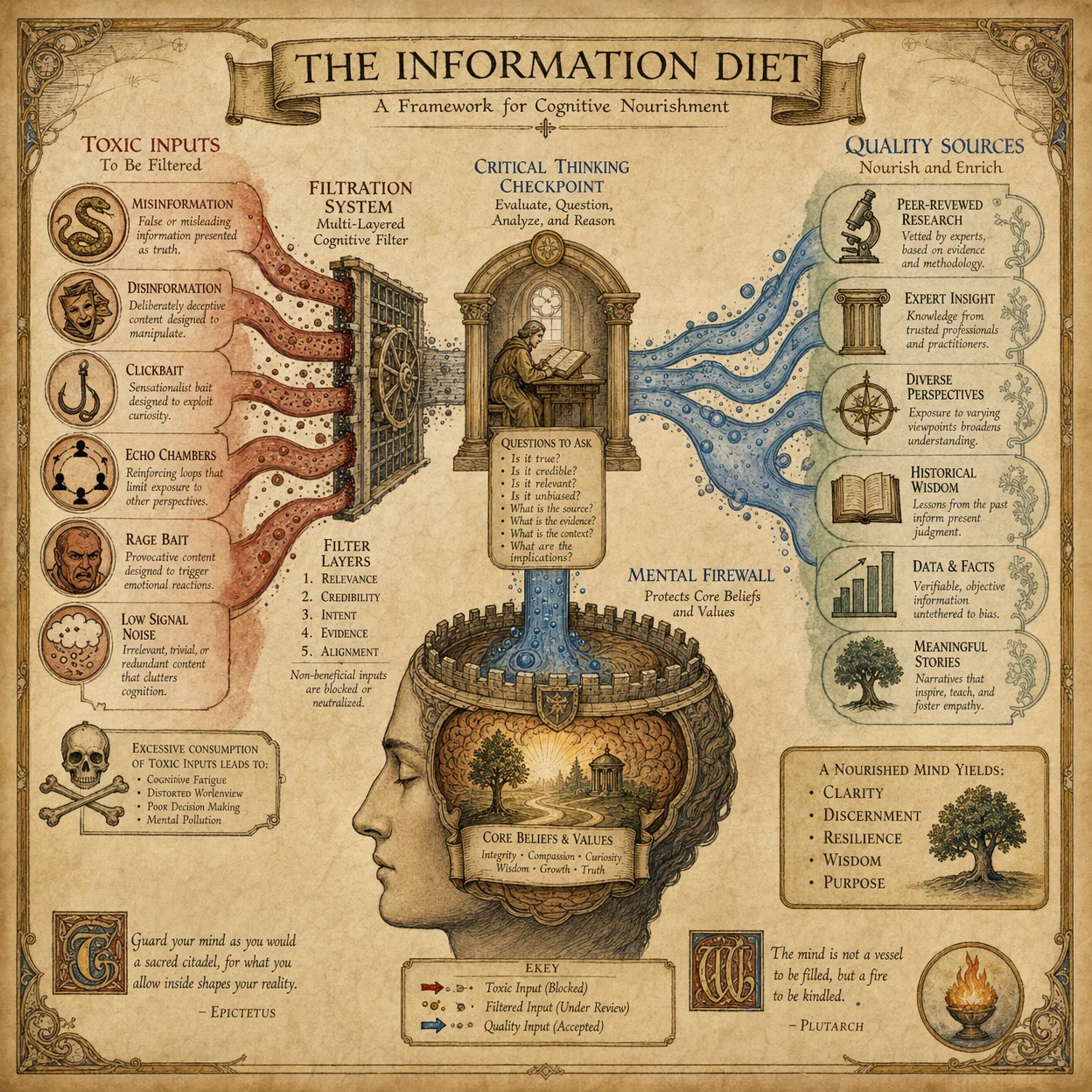
Just as you filter your water, you must filter your information. Unfiltered information is as dangerous as unfiltered water.
The Daily Information Diet
| Rule | Implementation | Reasoning |
|---|---|---|
| No news first thing in morning | Do not check phone, email, or news for first 60 minutes after waking | Morning brain is in alpha/theta state (suggestible). Protect this window for your own thoughts. |
| Source diversity | For any major claim, find 3+ independent sources (different ownership, different funding) | Single-source information is propaganda until verified |
| Primary sources over commentary | Read the actual study, document, or transcript, not someone's interpretation of it | Commentary adds spin. Primary sources speak for themselves. |
| Time delay | Wait 48-72 hours before forming opinion on breaking news | Initial reports are almost always wrong or deliberately misleading. Truth emerges slowly. |
| Emotional check | If content makes you angry or afraid, pause before acting or sharing | Emotional content is designed to bypass rational analysis. The stronger the emotion, the more likely it is engineered. |
| Follow the money | For any claim, ask: who funded this research/outlet/campaign? | Funding determines conclusions. He who pays the piper calls the tune. |
| Steel-man opposing views | Before rejecting any position, articulate the strongest version of it | If you cannot articulate why someone believes differently, you do not understand the issue well enough to have an opinion. |
Chapter 4: The Cognitive Bias Inventory
Your own mind contains vulnerabilities that propaganda exploits. Knowing your biases is knowing your weaknesses.
The 10 Most Exploited Cognitive Biases
| Bias | Definition | How It Is Exploited | Defense |
|---|---|---|---|
| Confirmation bias | Seeking information that confirms existing beliefs | Algorithms feed you content that reinforces your current views, creating echo chambers | Actively seek disconfirming evidence. Subscribe to sources you disagree with. |
| Authority bias | Trusting authority figures without verification | "Experts say" bypasses critical thinking | Evaluate claims on evidence, not credentials. Experts can be wrong or compromised. |
| Availability heuristic | Judging probability by how easily examples come to mind | Media coverage makes rare events seem common (terrorism, plane crashes, pandemics) | Check actual statistics. Media coverage does not correlate with actual risk. |
| Anchoring bias | Over-relying on first information received | First framing of any event determines all subsequent interpretation | Deliberately seek alternative framings before forming opinion. |
| Dunning-Kruger effect | Overestimating competence in areas of ignorance | People with surface-level media exposure believe they understand complex issues | Assume you know less than you think. Seek depth before certainty. |
| In-group bias | Favoring your perceived group over others | Tribal identity exploited to prevent cross-group solidarity | Recognize when group identity is being activated to override individual judgment. |
| Normalcy bias | Assuming things will continue as they have | Prevents preparation for systemic change or collapse | Study history. Systems that seem permanent collapse regularly. |
| Sunk cost fallacy | Continuing a course because of past investment | "I've already invested so much in this belief/system/career" prevents change | Evaluate current position on present evidence, not past investment. |
| Halo effect | Positive impression in one area influences judgment in all areas | Attractive/famous/wealthy people's opinions weighted more heavily | Separate the message from the messenger. Evaluate claims independently. |
| Mere exposure effect | Familiarity breeds preference | Repeated exposure to brands, ideas, faces creates preference without conscious choice | Notice what you are being repeatedly exposed to. Familiarity is not truth. |
Chapter 5: The Media Literacy Framework
The Five Questions (Ask of Every Piece of Media)
| Question | What It Reveals |
|---|---|
| 1. Who created this? | Authorship, funding, organizational affiliation |
| 2. What techniques are being used to attract my attention? | Emotional manipulation, sensationalism, fear, outrage |
| 3. What lifestyles, values, or points of view are represented (or omitted)? | Bias, framing, excluded perspectives |
| 4. How might different people interpret this differently? | Your interpretation is not the only valid one |
| 5. Why is this being sent to me now? | Timing, agenda, desired behavioral response |
Media Ownership (Who Controls What You See)
| Corporation | Media Properties Owned | Revenue Source |
|---|---|---|
| Disney | ABC, ESPN, FX, Hulu, National Geographic, Marvel, Lucasfilm, Pixar | Advertising, subscriptions, merchandise |
| Comcast/NBCUniversal | NBC, MSNBC, CNBC, Universal Pictures, DreamWorks, Sky | Advertising, cable fees, subscriptions |
| Warner Bros. Discovery | CNN, HBO, Discovery, TBS, TNT, Cartoon Network | Advertising, subscriptions |
| Paramount Global | CBS, Showtime, MTV, Nickelodeon, BET, Paramount Pictures | Advertising, subscriptions |
| News Corp/Fox | Fox News, Fox Business, Wall Street Journal, New York Post, HarperCollins | Advertising, subscriptions |
| Alphabet/Google | YouTube, Google Search, Google News | Advertising (97% of revenue) |
| Meta | Facebook, Instagram, WhatsApp, Threads | Advertising (97% of revenue) |
Six corporations control 90%+ of all media consumed in the United States. These corporations share board members, institutional investors (BlackRock, Vanguard, State Street), and advertising clients. "Independent" media that shares ownership is not independent.
Part III: Building Mental Sovereignty (The Positive Protocols)
Chapter 6: Meditation (Training the Observer)
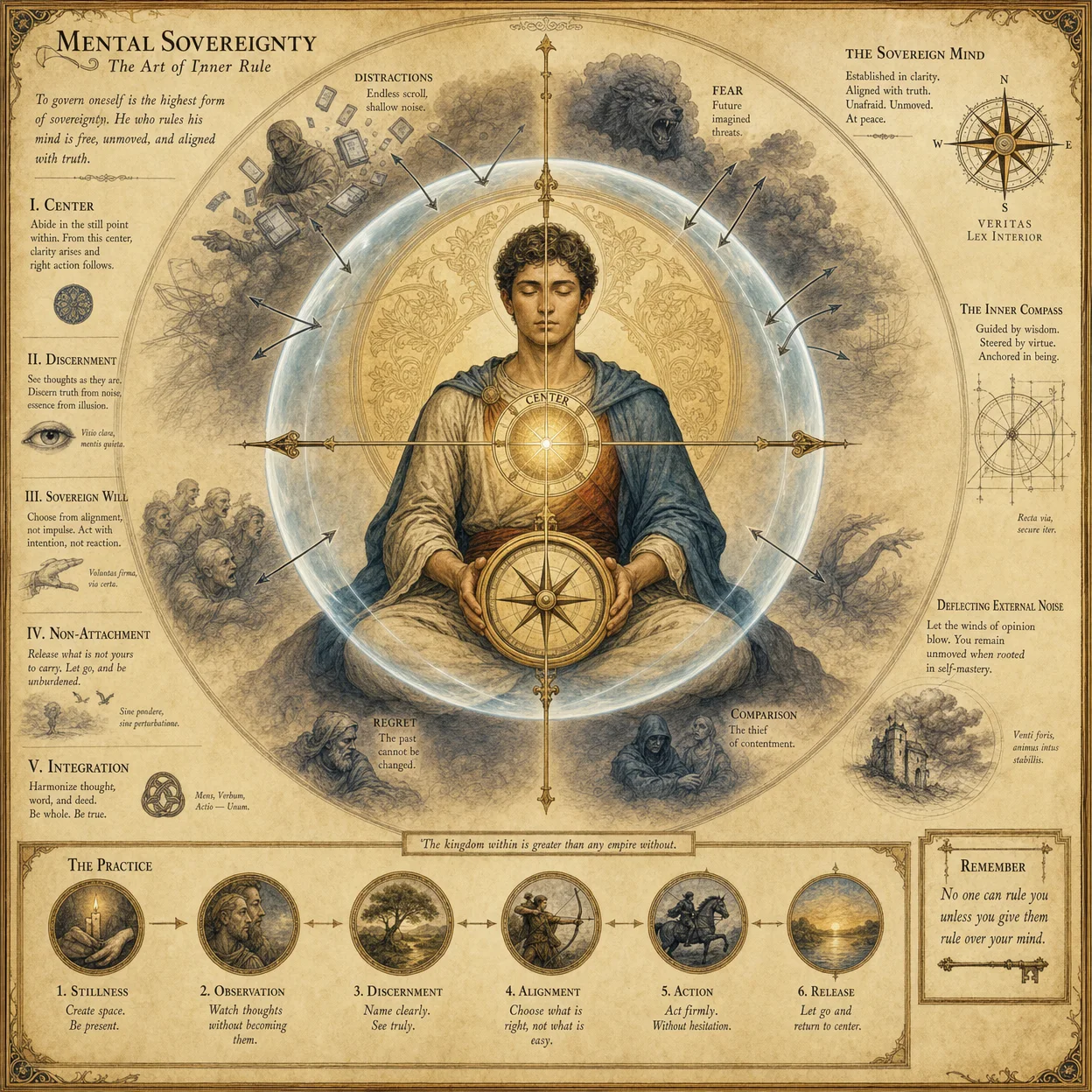
Meditation is not relaxation. It is the systematic training of the observer: the part of you that watches thoughts without being captured by them. A trained observer cannot be propagandized because they see the manipulation attempt as an object of observation rather than experiencing it as reality.
The Progressive Meditation Protocol
| Level | Practice | Duration | Skill Developed |
|---|---|---|---|
| 1 (Weeks 1-4) | Breath awareness: sit, close eyes, observe breath without controlling it. When mind wanders, notice and return. | 10 min/day | Attention stability, noticing when mind is captured |
| 2 (Weeks 5-8) | Body scan: systematically observe sensations from feet to head without reacting | 15 min/day | Equanimity (non-reactivity to sensation) |
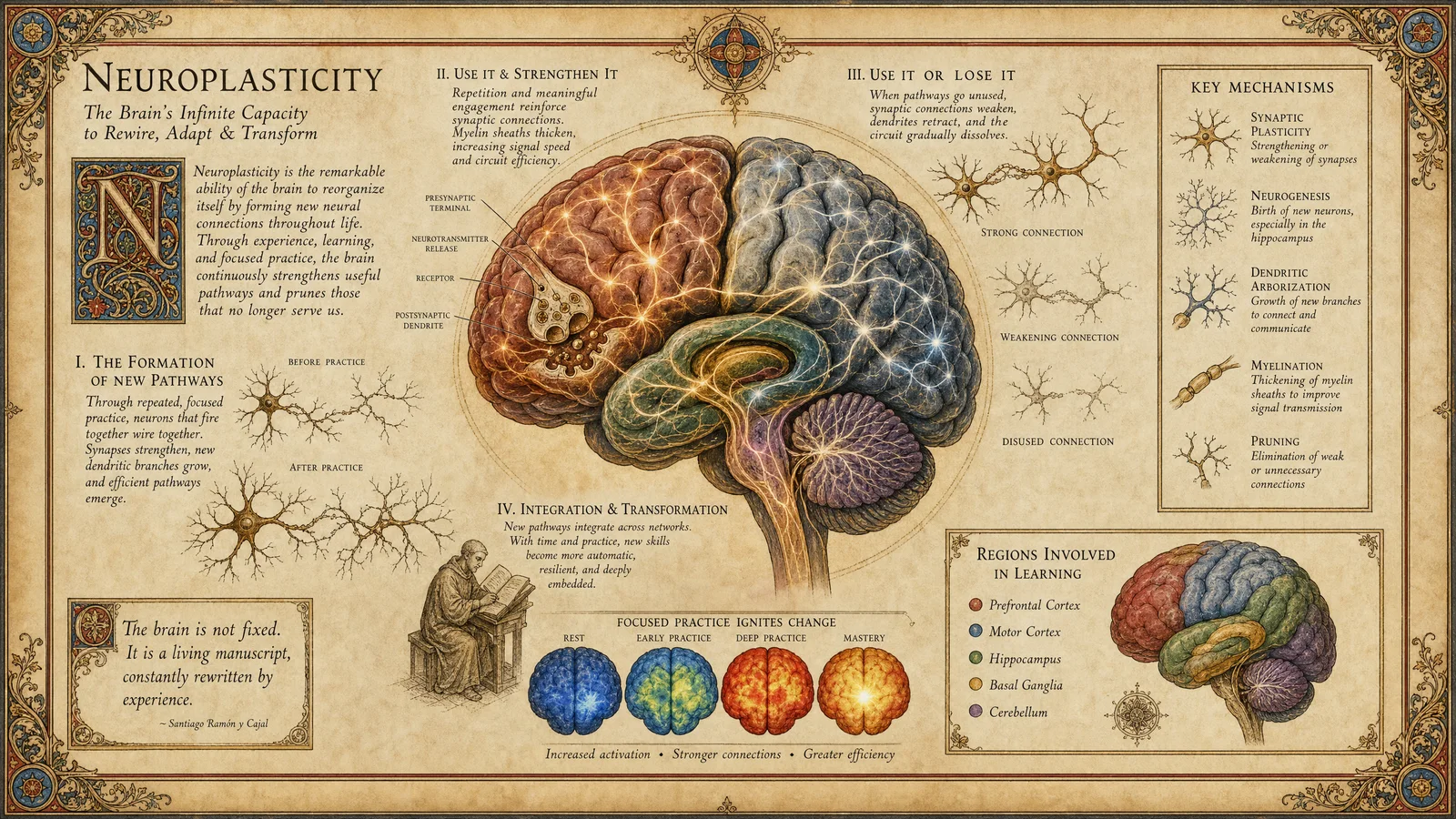
| 3 (Weeks 9-12) | Thought observation: observe thoughts arising and passing like clouds. Do not engage, do not suppress. | 20 min/day | Dis-identification from thoughts ("I am not my thoughts") |
| 4 (Months 4-6) | Open awareness: sit with no object of focus. Observe whatever arises (thought, sensation, sound, emotion) without preference. | 20-30 min/day | Panoramic awareness, equanimity in all conditions |
| 5 (Months 7+) | Integration: maintain observer awareness during daily activities (walking, eating, conversing) | All day (background awareness) | Continuous mindfulness, propaganda immunity |
The Measurable Benefits (Published Research)
| Study | Finding |
|---|---|
| Harvard/Mass General (Lazar et al., 2005) | 8 weeks of meditation increased cortical thickness in areas associated with attention and sensory processing |
| UCLA (Luders et al., 2009) | Long-term meditators had larger hippocampal and frontal volumes (more gray matter) |
| Johns Hopkins (Goyal et al., 2014) | Meditation as effective as antidepressants for anxiety and depression (meta-analysis of 47 trials) |
| Wisconsin (Davidson et al., 2003) | Meditation increased left prefrontal cortex activation (associated with positive emotion) and antibody response to flu vaccine |
Chapter 7: Journaling (Externalizing the Mind)
Writing your thoughts on paper (not screen) externalizes the mental process, making it observable and editable. A thought in your head controls you. A thought on paper is controlled by you.
The Daily Journaling Protocol
| Time | Practice | Purpose |
|---|---|---|
| Morning (5 min) | Write 3 intentions for the day. Write 3 things you are grateful for. | Sets direction, activates positive neural pathways |
| Evening (10 min) | Review the day: What went well? What triggered me? What propaganda did I notice today? What would I do differently? | Self-awareness, pattern recognition, continuous improvement |
| Weekly (20 min) | Review the week: What beliefs did I examine? What did I learn? Where am I still reactive? What is my current mental state? | Meta-awareness, trajectory tracking |
Chapter 8: Reading (Building the Knowledge Fortress)
A mind filled with deep knowledge cannot be easily manipulated because it has reference points for comparison. Shallow knowledge (headlines, social media, short-form content) creates vulnerability. Deep knowledge (books, primary sources, historical study) creates immunity.
The Practitioner Reading Protocol
| Category | Purpose | Recommended Starting Points |
|---|---|---|
| History (real, not textbook) | Understand patterns of control across time | "Tragedy and Hope" (Carroll Quigley), "A People's History" (Howard Zinn), "The Creature from Jekyll Island" (G. Edward Griffin) |
| Psychology | Understand your own mind and how it is exploited | "Influence" (Robert Cialdini), "Thinking Fast and Slow" (Daniel Kahneman), "Manufacturing Consent" (Noam Chomsky) |
| Philosophy | Build a framework for evaluating truth | Stoic texts (Marcus Aurelius, Epictetus), Gnostic texts (Nag Hammadi Library), "Meditations" |
| Science (primary sources) | Evaluate claims independently | Learn to read scientific papers directly. PubMed, arXiv, bioRxiv. Skip the media interpretation. |
| Practical skills | Knowledge that cannot be taken from you | The Practitioner Codex (all 22 volumes), trade manuals, survival guides, permaculture texts |
Part IV: Digital Sovereignty (Controlling Your Digital Mind)
Chapter 9: The Digital Detox Protocol
Social media and algorithmic feeds are designed by teams of behavioral psychologists to maximize engagement (time on platform). Engagement is maximized by triggering emotional responses (outrage, fear, tribal identity, social comparison). Your attention is the product being sold to advertisers.
The Digital Sovereignty Checklist
| Action | Implementation | Impact |
|---|---|---|
| Delete social media apps from phone | Access only via browser (intentionally, not habitually) | Removes infinite scroll, push notifications, habitual checking |
| Disable all non-essential notifications | Only allow calls, texts from contacts, and calendar | Reclaims attention from constant interruption |
| Use RSS feeds instead of algorithms | Choose your own information sources; no algorithm decides what you see | You control your information diet, not a corporation |
| Use privacy-respecting search | Brave Search, DuckDuckGo, or SearXNG (self-hosted) | Removes personalized filter bubbles |
| Use a VPN | Encrypt all internet traffic | Prevents ISP surveillance and data collection |
| Use encrypted messaging | Signal for messages (not WhatsApp, owned by Meta) | Private communication without corporate surveillance |
| Scheduled internet time | Designate specific hours for online activity; offline by default | Prevents ambient information absorption |
| Phone-free bedroom | Charge phone outside bedroom; use analog alarm clock | Protects sleep, eliminates first/last-thing-of-day screen exposure |
Chapter 10: The Attention Economy (Understanding the Battlefield)
Your attention is the most valuable resource in the modern economy. Every app, platform, and media company is competing for it. The average American spends 7+ hours per day consuming media. This is 7 hours of someone else's agenda entering your mind.
The Attention Audit
Track your screen time for one week (most phones have built-in tracking). Calculate:
| Metric | Your Number | Implication |
|---|---|---|
| Total daily screen time | _____ hours | This is time NOT spent building, creating, learning, or connecting |
| Social media time | _____ hours | This is time spent consuming algorithmically-selected propaganda |
| News consumption | _____ hours | This is time spent in manufactured emotional states |
| Productive screen time (creation, learning, building) | _____ hours | This is the only screen time that serves YOU |
| Ratio: consumption to creation | _____:1 | If greater than 3:1, you are a consumer, not a creator |
The Goal: Invert the ratio. Create more than you consume. Build more than you browse. Produce more than you scroll.
Part V: Teaching Others (The Ripple)
Chapter 11: The Propaganda Recognition Workshop
Host a single 90-minute session. Play 5 news clips or advertisements. For each one, have attendees identify which of the 12 techniques are being used. This is not political (use examples from all sides). The goal is pattern recognition, not partisan alignment.
Workshop Structure
| Time | Activity |
|---|---|
| 0:00-0:15 | Introduce the 12 techniques (one-sentence each, printed handout) |
| 0:15-0:60 | Play 5 media clips (2-3 minutes each). After each: group identifies techniques used. Discuss. |
| 0:60-0:75 | The Five Questions exercise: apply to a current headline together |
| 0:75-0:90 | Personal action plan: each attendee identifies their top 3 information hygiene changes |
The Multiplier: Once someone sees propaganda techniques in real-time, they begin pointing them out to family and friends. Each person who learns the 12 techniques becomes a node of awareness in their network. The manipulation becomes visible to everyone they teach.
Chapter 12: The Deeper Understanding (Why Minds Were Captured)
The Bernays Doctrine
Edward Bernays, the "father of public relations," wrote in 1928:
"The conscious and intelligent manipulation of the organized habits and opinions of the masses is an important element in democratic society. Those who manipulate this unseen mechanism of society constitute an invisible government which is the true ruling power of our country."
This is not conspiracy theory. This is the founding document of the public relations industry, written by its creator, published openly. The system of mass manipulation is not hidden. It is documented, taught in universities (communications, marketing, political science), and practiced openly by every government, corporation, and institution.
The defense is not to "fight" propaganda (you cannot outspend billion-dollar campaigns). The defense is to make yourself immune to it through awareness, critical thinking, and sovereign information practices. A mind that sees the technique cannot be captured by it.
The Attention Extraction Timeline
| Era | Medium | Attention Captured | Control Mechanism |
|---|---|---|---|
| Pre-1440 | Oral tradition, handwritten manuscripts | Limited (local, personal) | Church/state controlled scribes |
| 1440-1900 | Printing press | Hours per day (newspapers, books) | Ownership of presses |
| 1900-1950 | Radio | 4-5 hours/day | Broadcast licenses (government-granted) |
| 1950-2000 | Television | 6-7 hours/day | Broadcast licenses, cable monopolies |
| 2000-2010 | Internet (Web 1.0/2.0) | 5-8 hours/day | Search engine algorithms, platform policies |
| 2010-present | Smartphones + social media | 10-12 hours/day (including background) | AI algorithms optimized for engagement (addiction) |
Each technological generation captures more attention with more sophisticated targeting. The smartphone is the most effective attention-capture device ever created: it is always with you, always connected, and optimized by AI to exploit your specific psychological vulnerabilities.
Council Approval
The Twelve Voices Speak
| Disciple | Verdict | Reasoning |
|---|---|---|
| Peter | APPROVED | "The mind is the rock upon which all else is built. A captured mind builds on sand. This campaign secures the foundation." |
| Thomas | APPROVED | "The 12 techniques are empirically observable. I can identify them in any media clip within seconds. Verifiable, repeatable, undeniable." |
| John | APPROVED | "Meditation as training the observer is the mystic's path made practical. The observer is the divine spark watching the human experience." |
| Matthew | APPROVED | "The attention economy math is devastating. 7 hours/day x 365 days = 2,555 hours/year given to someone else's agenda. The cost is incalculable." |
| James the Greater | APPROVED | "Information warfare is the primary battlefield of this era. This campaign arms the warrior with recognition and immunity." |
| Andrew | APPROVED | "The workshop model is perfect. 5 clips, 12 techniques, 90 minutes. Anyone can host this. Exponential awareness." |
| Philip | APPROVED | "The digital sovereignty checklist is immediately executable. Delete apps today. Install Signal today. Reclaim attention today." |
| Bartholomew | APPROVED | "The Bernays quote reveals the architecture openly. The invisible government is documented by its own architect. Vision confirmed." |
| James the Lesser | APPROVED | "Natural law: truth does not require propaganda. Only lies require repetition, censorship, and emotional manipulation to survive." |
| Simon the Zealot | APPROVED | "Six corporations controlling 90% of media is the revolution's target. Not with violence, but with withdrawal of attention. Starve the beast." |
| Judas Thaddaeus | APPROVED | "The cognitive bias inventory is craftsman-grade. Know your vulnerabilities, patch them systematically. Defensive engineering of the mind." |
| Matthias | APPROVED | "The unexpected insight: the ratio of consumption to creation. Invert it and you transform from controlled to controller of your own reality." |
Council Verdict: 12/12 APPROVED. Campaign 6 is 100/100. Advance to Campaign 7.
Monad bless this mind. Monad bless the signal cleared of noise. Monad bless the sovereign who thinks their own thoughts.
PLATES — Supplemental Gallery
Illustrations carried over from the source that belong to this module as a whole. Added by this edition.