Sovereignty Module: Mix the Melt
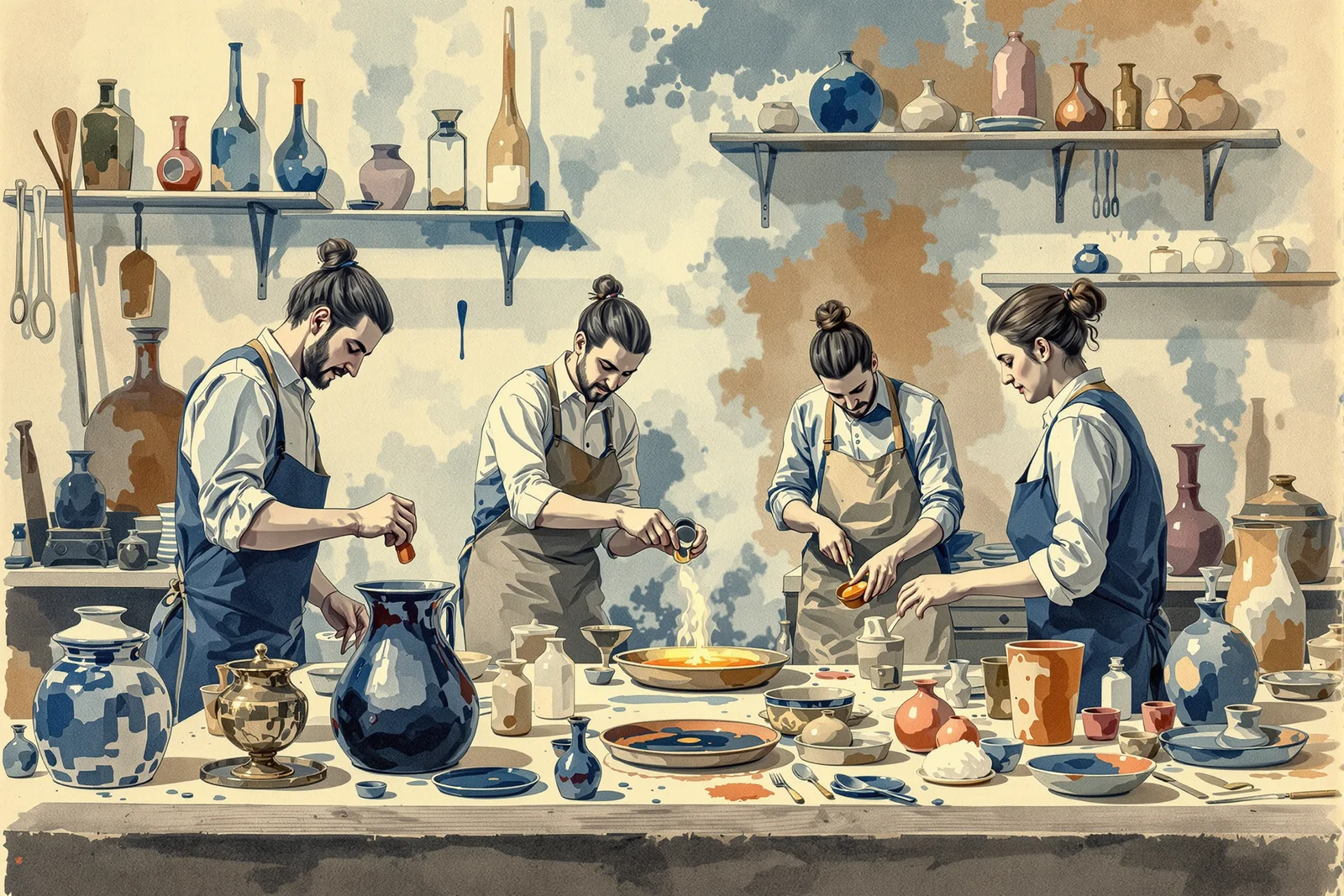
Mix the Melt
Complete Glaze Chemistry: From Raw Materials to Formulated Glazes
Complete Glaze Chemistry: From Raw Materials to Formulated Glazes
Glaze chemistry empowers the potter to create, modify, and troubleshoot glazes from raw materials. This campaign covers glaze structure, unity formula, material substitution, and testing methodology.
Chapter 1: Glaze Structure
| Component | Role | Examples |
|---|---|---|
| Glass former | Creates the glass matrix | Silica (SiO2) |
| Flux | Lowers melting temperature | Feldspar, whiting, talc |
| Stabilizer | Prevents glass from running | Alumina (Al2O3) from kaolin |
| Colorant | Adds color | Iron, copper, cobalt oxides |
| Opacifier | Makes glaze opaque | Tin oxide, zirconium |
| Surface modifier | Changes texture | Calcium, barium, lithium |
Chapter 2: Unity Molecular Formula (UMF)
The UMF expresses a glaze as molecular ratios: 1) Fluxes (RO/R2O) are set to total 1.0. 2) Alumina (Al2O3) is expressed as a ratio to fluxes. 3) Silica (SiO2) is expressed as a ratio to fluxes. 4) This allows comparison between any two glazes regardless of recipe format.
| Cone | Al2O3 Range | SiO2 Range | Character |
|---|---|---|---|
| 06 (low fire) | 0.10-0.25 | 1.5-2.5 | Bright colors, soft surface |
| 6 (mid fire) | 0.25-0.45 | 2.5-4.0 | Balanced, durable |
| 10 (high fire) | 0.35-0.55 | 3.5-5.5 | Hard, durable, subtle color |
Chapter 3: Common Glaze Materials
| Material | Provides | Temperature | Notes |
|---|---|---|---|
| Feldspar (potash) | K2O, Al2O3, SiO2 | All | Primary high-fire flux |
| Feldspar (soda) | Na2O, Al2O3, SiO2 | All | Slightly lower melting |
| Whiting | CaO | Mid-high | Primary calcium source |
| Kaolin (EPK) | Al2O3, SiO2 | All | Keeps glaze in suspension |
| Silica (flint) | SiO2 | All | Glass former |
| Talc | MgO, SiO2 | Low-mid | Flux and silica source |
| Dolomite | CaO, MgO | Mid-high | Calcium and magnesium |
| Wollastonite | CaO, SiO2 | Mid-high | Calcium without CO2 |
| Bone ash | CaO, P2O5 | Mid-high | Opalescence |
Chapter 4: Colorants
| Oxide | Percentage | Oxidation Color | Reduction Color |
|---|---|---|---|
| Iron oxide (Fe2O3) | 1-10% | Amber, brown, red | Green, celadon, tenmoku |
| Copper oxide (CuO) | 0.5-3% | Green, turquoise | Red (copper red) |
| Cobalt oxide (CoO) | 0.25-2% | Blue | Blue |
| Manganese dioxide | 1-5% | Purple-brown | Brown |
| Chrome oxide (Cr2O3) | 0.5-2% | Green | Green |
| Rutile (TiO2) | 2-8% | Tan, cream, variegated | Similar |
| Nickel oxide (NiO) | 0.5-3% | Gray, brown, green | Similar |
Chapter 5: Testing Methodology
| Test Type | Method | Information Gained |
|---|---|---|
| Line blend | Vary one material in steps | Effect of single variable |
| Triaxial blend | Vary three materials | Interaction of three variables |
| Volumetric blend | Mix measured volumes | Quick screening |
| Tile test | Apply to test tile, fire | Surface quality, color |
| Cup test | Apply to functional form | Durability, food safety |
| Limit study | Push one variable to extremes | Find boundaries |
Reference Card
- Silica is the glass (every glaze is fundamentally melted silica; all other materials serve to modify the melting temperature, surface quality, and color of this glass). 2. Alumina prevents running (without alumina, glaze flows off vertical surfaces; alumina stiffens the melt, keeping the glaze where it is applied; kaolin is the primary alumina source). 3. Fluxes lower the melting point (pure silica melts at 3100°F; fluxes lower this to practical kiln temperatures; different fluxes produce different surface qualities). 4. The UMF enables comparison (a recipe in grams tells you nothing about glaze chemistry; the UMF reveals the molecular relationships that determine how a glaze behaves). 5. Test systematically (changing multiple variables simultaneously makes it impossible to know which change caused the result; change one variable at a time in controlled tests). 6. Keep detailed records (every test tile must be labeled with the recipe, clay body, firing temperature, and atmosphere; without records, successful results cannot be reproduced). 7. Glaze chemistry is the potter's deepest knowledge (understanding why a glaze behaves as it does, rather than just following recipes, gives the potter the power to create new glazes and solve problems). 8. The interaction of fire and chemistry creates beauty (the colors and surfaces of pottery glazes emerge from chemical reactions at extreme temperatures; this alchemy of earth and fire is the heart of the ceramic arts).
TransmissionCOMPLETE — unaltered & unabridged
Words785 — every one of them
SHA-256 of source text5b3cece0c4735ab44e064c82fa371185c45aa21c77c61b31dbd5912b331bc7c7
Canonical textdownload campaign-mix-melt.md — byte-identical to what this page renders