Sovereignty Module: Raise the Roof
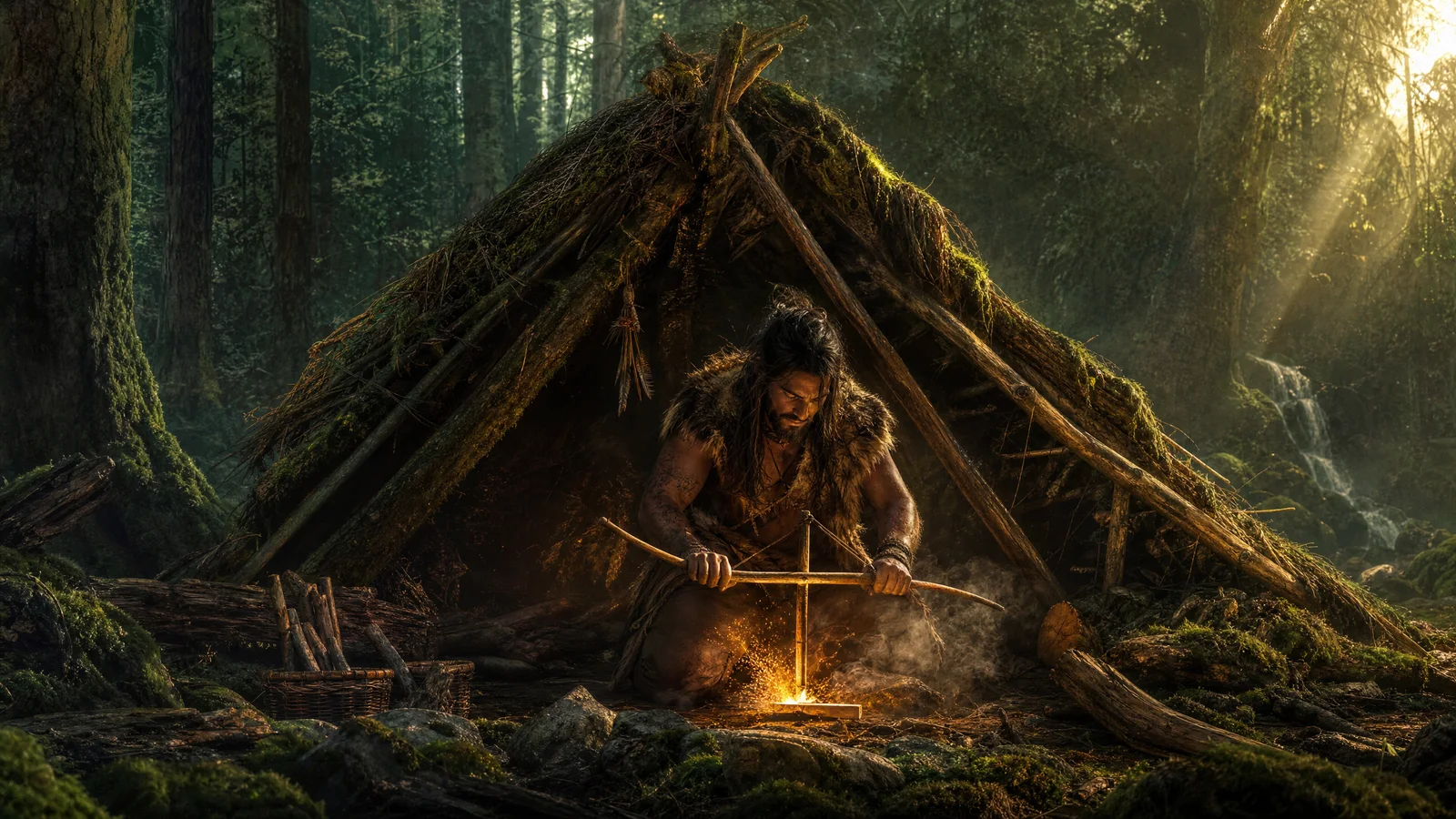
Primitive Shelter Construction: From Emergency to Permanent
Shelter is the first survival priority after immediate safety. This campaign covers emergency shelters, semi-permanent structures, and permanent primitive buildings using only natural materials.
Chapter 1: Emergency Shelters (Build in Hours)
| Type | Build Time | Capacity | Warmth | Materials | Best Climate |
|---|---|---|---|---|---|
| Debris hut | 1-3 hours | 1 person | Excellent (insulation) | Sticks, leaves, debris | Temperate, cold |
| Lean-to | 30-60 min | 1-3 people | Moderate (with fire reflector) | Poles, branches, leaves | Mild, temperate |
| Snow cave | 2-4 hours | 1-3 people | Good (32°F inside) | Packed snow (4+ feet deep) | Arctic, winter |
| Quinzhee | 3-5 hours | 2-4 people | Good (32°F inside) | Piled snow (settle 2+ hours) | Cold, winter |
| Tarp shelter (A-frame) | 15-30 min | 1-2 people | Low (wind/rain protection only) | Tarp/poncho, cordage, poles | Any (with tarp) |
| Brush wickiup | 2-4 hours | 2-3 people | Moderate | Long poles, brush, bark | Temperate, dry |
| Rock overhang (improved) | 30-60 min | 1-4 people | Moderate (wind block) | Natural overhang + wall material | Any (where available) |
Debris hut construction: 1. Ridgepole (1.5× body length, one end elevated 3 feet on stump/fork). 2. Ribbing (sticks angled from ridgepole to ground, both sides, 1 foot apart). 3. Lattice (smaller sticks woven horizontally across ribs). 4. Debris (pile 3+ feet thick of leaves/grass/pine needles over entire structure). 5. Floor (6+ inches of dry debris inside). 6. Door (stuff with debris bundle). Body heat alone warms interior.
Chapter 2: Semi-Permanent Structures (Build in Days-Weeks)
| Type | Build Time | Lifespan | Capacity | Materials | Skill Level |
|---|---|---|---|---|---|
| Wigwam/wickiup (large) | 3-7 days | 2-5 years | 4-8 people | Saplings, bark/hide/thatch | Low-moderate |
| Tipi | 2-5 days | 5-15 years (with hide cover) | 4-10 people | Poles (15-25), hide/canvas cover | Moderate |
| Wattle and daub hut | 1-3 weeks | 10-30 years | 2-6 people | Saplings, clay/mud, straw | Moderate |
| Sod house | 2-4 weeks | 5-20 years | 4-8 people | Sod blocks, timber frame | Moderate |
| Pit house | 2-4 weeks | 10-30 years | 4-8 people | Excavation, timber, earth cover | Moderate-high |
| Yurt/ger | 1-2 weeks (frame) | 20+ years (frame) | 4-10 people | Lattice frame, felt/canvas cover | Moderate-high |
Chapter 3: Permanent Primitive Buildings (Build in Weeks-Months)
| Type | Build Time | Lifespan | Capacity | Materials | Skill Level |
|---|---|---|---|---|---|
| Log cabin | 4-8 weeks | 50-100+ years | 4-8 people | Logs (8-12" diameter), chinking | Moderate-high |
| Timber frame | 6-12 weeks | 100-300+ years | 4-12 people | Heavy timbers, joinery, infill | High |
| Stone cottage | 2-6 months | 200-500+ years | 4-8 people | Stone, mortar, timber roof | High |
| Cob house | 2-4 months | 100-500+ years | 4-8 people | Clay, sand, straw, timber frame | Moderate |
| Adobe house | 2-4 months | 100-500+ years (dry climate) | 4-8 people | Adobe bricks, timber roof | Moderate |
| Rammed earth | 2-4 months | 200-500+ years | 4-8 people | Earth (subsoil), forms, tamper | Moderate-high |
| Cordwood masonry | 2-4 months | 50-100+ years | 4-8 people | Short log rounds, mortar | Low-moderate |
Chapter 4: Roofing Systems
| Type | Materials | Lifespan | Pitch Required | Weight | Skill Level |
|---|---|---|---|---|---|
| Thatch (straw/reed) | Straw, reed, or grass bundles | 15-40 years | 45-55° minimum | Light | Moderate-high |
| Bark (birch/cedar) | Large bark sheets, poles | 10-20 years | 30°+ | Light | Low-moderate |
| Sod/earth | Sod on birch bark or boards | 20-40 years | 20-30° | Very heavy | Moderate |
| Wood shingle (split) | Cedar, oak, or pine (split) | 25-50 years | 30°+ | Moderate | Moderate |
| Slate/stone | Thin flat stones | 100+ years | 30°+ | Very heavy | High |
| Clay tile | Fired clay tiles | 50-100+ years | 30°+ | Heavy | High |
Chapter 5: Heating and Ventilation
| System | Efficiency | Complexity | Materials | Best For |
|---|---|---|---|---|
| Open fire (central) | 10-15% | Very low | Fire ring, smoke hole | Temporary, tipis |
| Fireplace (masonry) | 15-25% | High | Stone/brick, mortar, chimney | Permanent buildings |
| Rocket mass heater | 80-90% | Moderate-high | Firebrick, cob, metal pipe | Permanent buildings |
| Kang (heated bed platform) | 70-80% | Moderate | Brick, flue channels | Cold climates |
| Hypocaust (underfloor) | 60-70% | High | Brick/stone pillars, floor | Cold climates, larger buildings |
| Wood stove (metal) | 50-70% | Low (if stove available) | Cast iron or steel stove | Any permanent building |
Rocket mass heater: Burns small wood at extreme efficiency. Insulated combustion chamber → horizontal heat riser → thermal mass (cob bench). Burns 80-90% of smoke. Uses 1/5 the wood of open fireplace. Heats thermal mass that radiates for 12-24 hours after fire goes out.
Chapter 6: Site Selection
| Factor | Ideal | Avoid | Why |
|---|---|---|---|
| Elevation | Slightly elevated, good drainage | Valley bottoms, flood plains | Cold air pools in valleys, flooding risk |
| Water | Within 200 yards, not directly adjacent | More than 1/4 mile, or directly on bank | Need access but avoid flooding/dampness |
| Aspect (sun) | South-facing (Northern Hemisphere) | North-facing | Maximum solar gain, warmer, drier |
| Wind | Protected (trees, hill behind) | Exposed ridgetops, wind corridors | Wind increases heat loss dramatically |
| Soil | Well-drained, firm (gravel/sand base) | Clay (wet), peat (unstable), solid rock | Foundation stability, moisture management |
| Trees | Nearby (building material, firewood) | Dense forest directly over site | Need materials but also sunlight |
| Defense | Good visibility, difficult approach | Surrounded by cover, blind approaches | Security consideration |
Reference Card
- Debris hut: fastest warm shelter. Ridgepole + ribs + 3 feet of debris. Body heat alone warms interior. Build before dark.
- Log cabin: notch corners (saddle notch easiest). Chink gaps with moss/clay. Roof pitch 30°+ for rain/snow shedding.
- Site selection: south-facing, elevated, near water (not on it), protected from wind, well-drained soil.
- Rocket mass heater: 80-90% efficient. Burns twigs. Heats thermal mass for 12-24 hours. Best permanent heating solution.
- Roof pitch: thatch needs 45°+. Shingles need 30°+. Sod needs 20-30°. Steeper = better water shedding = longer life.
- Foundation: always elevate building above ground. Stone or gravel pad minimum. Prevents rot and moisture wicking.
- Ventilation: every shelter needs air exchange. Smoke hole, ridge vent, or windows. CO2 and moisture buildup kills.
- Thermal mass: heavy materials (stone, cob, earth) absorb heat during day, release at night. Stabilizes temperature.